
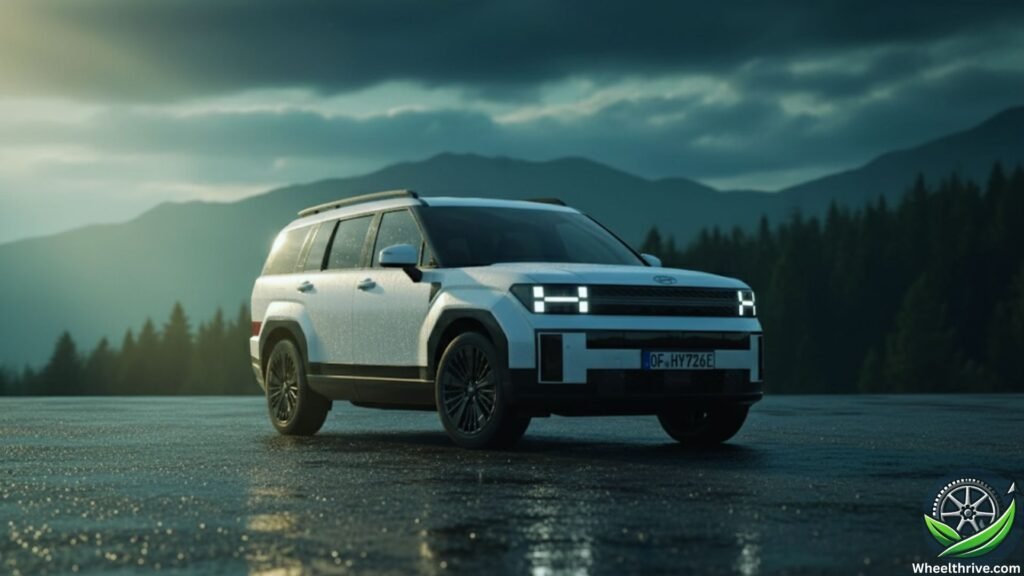
The 2025 Hyundai Santa Fe Hybrid enters a fiercely competitive mid-size SUV market not with a whisper, but with a bold, declarative statement. Redesigned from the ground up for the 2024 model year, this vehicle presents a compelling, if sometimes contradictory, package for the modern American family. It wraps a spacious, tech-forward, and family-friendly interior in an adventurous, boxy exterior that evokes far more expensive European rivals. Paired with Hyundai’s industry-leading warranty, the Santa Fe Hybrid makes a powerful case for itself on value and style.
However, a comprehensive analysis reveals a vehicle of compelling dualities. Its rugged, off-road-inspired aesthetic belies a suspension tuned for on-road comfort and quiet cruising rather than trail-rated capability. It promises exceptional fuel efficiency on paper, yet independent long-term testing reveals real-world mileage that consistently falls short of its EPA estimates. And while it delivers a near-luxury suite of features at a mainstream price point, a growing number of owner complaints about software glitches and overly sensitive driver-assist systems suggest that early adopters may be contending with some new-model teething issues.
Ultimately, the 2025 Hyundai Santa Fe Hybrid is a very good car for a specific type of buyer: one who values standout design, interior space, and cutting-edge technology, and who sees the long-term security of a great warranty as a fair trade-off for its few, albeit significant, quirks.
2025 Santa Fe Hybrid at a Glance
| Specification | Value |
| Engine | 1.6L Turbo GDI 4-Cylinder Hybrid |
| Combined Horsepower | 231 hp |
| Combined Torque | 271 lb-ft |
| Drivetrain | Front-Wheel Drive (FWD) standard; HTRAC All-Wheel Drive (AWD) optional |
| EPA Combined MPG | 36 MPG (FWD) / 34 MPG (AWD) |
| Fuel Tank Capacity | 17.7 gallons |
| Starting MSRP (SEL) | $39,295 |
Pros and Cons of the 2025 Santa Fe Hybrid
| Pros | Cons |
| Distinctive and bold exterior styling | Real-world MPG often falls short of EPA estimates |
| Spacious, practical, and high-quality interior | Uninspired, comfort-focused handling |
| Excellent standard technology features | Tight third-row seating is best for children |
| Strong value proposition (features-per-dollar) | Reported issues with oversensitive driver-assist technology |
| Industry-leading warranty coverage | Limited cargo space with the third row in use |
Performance, Range, and Fuel Economy
At the heart of the 2025 Santa Fe Hybrid’s appeal is its promise of efficient, capable performance. Understanding the nuances of its powertrain, real-world fuel consumption, and total driving range is critical for any prospective buyer.
Under the Hood: The 1.6L Turbo Hybrid Powertrain
Every 2025 Santa Fe Hybrid is equipped with a sophisticated powertrain that blends a 1.6-liter turbocharged gasoline direct injection (GDI) 4-cylinder engine with a 44.2-kW electric motor. This combination delivers a robust total system output of 231 horsepower and 271 lb-ft of torque, providing ample power for daily driving, highway merging, and confident acceleration.
Unlike many competitors that use a continuously variable transmission (CVT), Hyundai has paired this hybrid system with a traditional 6-speed automatic transmission. This choice is significant for the driving experience. Automotive experts and drivers note that the 6-speed automatic provides quicker, more natural-feeling shifts, avoiding the engine drone and “rubber band” effect sometimes associated with CVTs. The result is a powertrain that feels smooth and responsive, seamlessly transitioning between gasoline and electric power.
What is the Range of the 2025 Santa Fe Hybrid?
The total driving range of the Santa Fe Hybrid is a function of its fuel efficiency and its large 17.7-gallon fuel tank. Based purely on official EPA estimates, the vehicle offers an impressive theoretical range:
- FWD Models: Approximately 637 miles on a full tank (17.7 gal×36 MPG).
- AWD Models: Approximately 601 miles on a full tank (17.7 gal×34 MPG).
It is crucial, however, to view these figures as best-case scenarios. A widely reported long-term test by Edmunds on an identical 2024 AWD model found a real-world average fuel economy of just 26.7 MPG over nearly 11,000 miles. Using this more realistic figure, a driver should expect a more conservative but still substantial range of around
472 miles per tank. While the hybrid system demonstrably improves efficiency over the gas-only model, buyers should temper their expectations and not anticipate consistently achieving the maximum range advertised by the EPA.
Gas Mileage for SEL and Limited Trims
One of the simplifying factors of the Santa Fe Hybrid lineup is that the EPA-estimated fuel economy is identical across all trim levels—SEL, Limited, and Calligraphy—as they all share the same powertrain. The only variable is the choice between front-wheel drive (FWD) and HTRAC all-wheel drive (AWD).
- FWD Gas Mileage: 36 MPG city, 35 MPG highway, and 36 MPG combined.
- AWD Gas Mileage: 35 MPG city, 34 MPG highway, and 34 MPG combined.
These figures represent a significant improvement over the non-hybrid Santa Fe, which has a combined rating of around 23-24 MPG. The hybrid’s advantage is most pronounced in city and stop-and-go driving, where the electric motor can handle more of the workload, cutting fuel consumption nearly in half compared to its gas-only counterpart.
Do You Have to Charge the Santa Fe Hybrid?
No. The 2025 Santa Fe Hybrid is a traditional hybrid electric vehicle (HEV), not a plug-in hybrid (PHEV). This is a critical distinction for potential buyers. The vehicle’s 1.49 kWh lithium-ion battery is recharged automatically through two processes: by the gasoline engine during operation and by capturing energy through regenerative braking. There is no need to plug the vehicle into an external power source; you simply refuel at a gas station as you would with any conventional car.
What Kind of Gas Does the 2025 Santa Fe Hybrid Take?
The 2025 Hyundai Santa Fe Hybrid is designed to run on regular unleaded gasoline with an octane rating of 87 or higher. Using premium gasoline is not required and will not provide any significant performance benefit.
The Hybrid Battery: Lifespan, Warranty, and Technology
For many consumers new to hybrid vehicles, the battery is the biggest source of uncertainty. Questions about its lifespan, replacement cost, and the technology that supports it are paramount. Hyundai addresses these concerns with a robust warranty and clever engineering.
How Long Does a Santa Fe Hybrid Battery Last?
The high-voltage lithium-ion battery pack that powers the hybrid system is engineered for longevity. While the vehicle’s smaller, conventional 12-volt battery has a typical lifespan of 3 to 5 years, the main hybrid battery is designed to last much longer. General industry estimates for modern hybrid batteries range from
100,000 to 200,000 miles, often lasting the effective life of the vehicle with proper care. The most important factor for a potential owner, however, is the warranty that protects this critical and expensive component.
Hyundai’s 10-Year/100,000-Mile Hybrid Battery Warranty
Hyundai mitigates long-term ownership anxiety with one of the best warranties in the automotive industry. The 2025 Santa Fe Hybrid’s key components are covered by a 10-year/100,000-mile warranty for the original owner. This comprehensive coverage includes :
- The Hybrid Electric Battery
- The Hybrid Starter/Generator
- The Hybrid Power Control Unit
This warranty effectively removes the financial risk of a premature battery failure for the vast majority of the original ownership period. It is a core feature of the vehicle’s value proposition, providing a level of peace of mind that many competitors do not match.
Regenerative Braking Explained
Every 2025 Santa Fe Hybrid is equipped with a regenerative braking system, a key technology for maximizing efficiency.
- How It Works: In a conventional car, the energy of motion (kinetic energy) is converted into heat by the friction brakes and is wasted. In the Santa Fe Hybrid, when the driver lifts their foot off the accelerator or applies the brakes, the electric motor reverses its function and acts as a generator. It captures that kinetic energy, converts it into electricity, and sends it back to recharge the hybrid battery.
- Driver Control and Customization: The system is not just passive; drivers can actively control the intensity of the regenerative braking effect. Using paddle shifters mounted on the steering wheel, the driver can select from multiple levels of regeneration. A higher level provides stronger deceleration when coasting—similar to downshifting in a gas car—and captures more energy, which is ideal for city driving or descending hills. A lower level allows for smoother, longer coasting on the highway. An “Auto” mode is also available, which uses the vehicle’s forward-facing radar to automatically adjust the regeneration level based on the distance and speed of the vehicle ahead.
- Key Benefits: The primary benefit of regenerative braking is improved fuel economy, as it recycles energy that would otherwise be lost. A significant secondary benefit is reduced wear on the conventional friction brakes. Because the regenerative system handles a large portion of the vehicle’s deceleration, the brake pads and rotors are used less frequently and can last much longer than in a non-hybrid vehicle, leading to lower maintenance costs over time.
Pricing, Trims, and Availability
Navigating the financial aspects of a new car purchase requires understanding not just the sticker price, but also the dealer invoice, potential incentives, and the current market realities of supply and demand.
How Much is the 2025 Santa Fe Hybrid? MSRP vs. Invoice Price
The price of the 2025 Santa Fe Hybrid varies by trim level and drivetrain. The Manufacturer’s Suggested Retail Price (MSRP) is the price set by Hyundai, while the invoice price is what the dealer pays the manufacturer. Knowing both provides a crucial baseline for negotiation.
2025 Santa Fe Hybrid Pricing: MSRP vs. Invoice
| Trim Level | Drivetrain | MSRP | Invoice Price |
| SEL | FWD | $39,295 | $36,515 |
| SEL | AWD | $41,095 | $38,254 |
| Limited | FWD | $46,195 | $43,181 |
| Limited | AWD | $47,995 | $44,920 |
| Calligraphy | FWD | $49,345 | $46,224 |
| Calligraphy | AWD | $51,145 | $47,963 |
Note: Prices are based on available data and exclude a destination charge of approximately $1,495. Actual dealer pricing may vary.
Does the 2025 Santa Fe Hybrid Qualify for Tax Credits?
No. The 2025 Hyundai Santa Fe Hybrid does not qualify for the federal New Clean Vehicle Credit. According to IRS guidelines, this tax credit is reserved for qualifying plug-in hybrid electric vehicles (PHEVs) and battery electric vehicles (BEVs) that meet strict requirements for battery capacity, component sourcing, and final assembly in North America. As a conventional hybrid, the Santa Fe HEV is not eligible. The only Hyundai models that may qualify for the credit are specific versions of the all-electric IONIQ 5 and the forthcoming IONIQ 9.
Wait Times and Production Delays
Obtaining a new 2025 Santa Fe Hybrid can require patience. While some dealer websites in the UK suggest a wait time of 0-3 months, real-world reports from buyers in the United States and Canada paint a more complex picture, with wait times frequently ranging from 2 to 7 months, and in some cases, up to a year.
This high wait time is a result of several factors converging:
- High Consumer Demand: The radical and popular redesign for the 2024 model year generated significant interest and a backlog of orders.
- Supply Chain Constraints: The global automotive industry continues to face intermittent supply chain disruptions that can affect production schedules.
- Production Adjustments: Hyundai, like other automakers, may adjust production schedules based on market conditions, tariffs, and component availability. For example, a major recall and subsequent transmission change for the gas-only Santa Fe can create ripple effects that impact overall plant capacity and model allocation.
Prospective buyers should contact multiple dealerships to inquire about incoming allocations that may not yet be spoken for, as this can sometimes shorten the wait.
Where is the 2025 Santa Fe Manufactured?
The 2025 Hyundai Santa Fe and Santa Fe Hybrid models sold in the United States are proudly manufactured in America. They are assembled at the Hyundai Motor Manufacturing Alabama (HMMA) plant located in Montgomery, Alabama.
Interior Technology and Features
The interior of the 2025 Santa Fe Hybrid is where its value proposition truly shines, offering a level of technology and premium materials that often feels a class above its price point.
What Technology is Included?
Hyundai has packed the Santa Fe Hybrid with an impressive array of standard and available technology designed for connectivity and convenience.
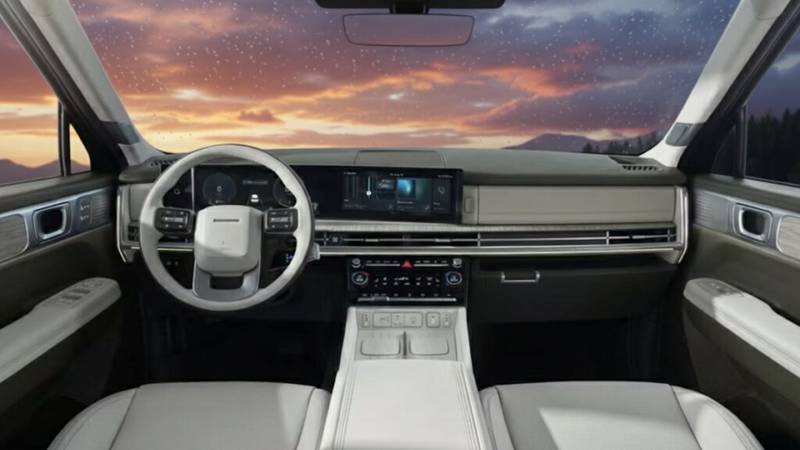
- Panoramic Curved Display: The centerpiece of the dashboard is a stunning, first-in-class Panoramic Curved Display. This single piece of glass seamlessly integrates a 12.3-inch digital instrument cluster for the driver and a 12.3-inch infotainment touchscreen, creating a modern, high-tech cockpit.
- Standard Connectivity: Wireless Apple CarPlay and Android Auto are standard on all trims, allowing for seamless smartphone integration without the need for cables.
- Charging and Power: A wireless device charging pad is standard across the lineup. The top-tier Calligraphy trim upgrades this to a dual wireless charging pad, allowing two phones to charge simultaneously. Numerous 27-watt USB-C ports are available for all three rows to keep everyone’s devices powered.
- Convenience Tech: Every Santa Fe Hybrid comes with a hands-free smart liftgate with auto-open functionality, Hyundai’s Digital Key 2 (which allows your smartphone to act as a key), and the Bluelink Connected Car System for remote functions.
- UV-C Sterilization Compartment: An innovative and unique feature found in the glovebox of higher trims is a UV-C sterilization compartment. It uses ultraviolet light to sanitize small personal items like phones, keys, and wallets, eliminating up to 99.9% of bacteria and viruses.
Navigation and the Head-Up Display (HUD)
Higher trims offer even more advanced technology to aid the driver.
- Onboard Navigation: An integrated navigation system is available, featuring sharp graphics and reliable voice recognition. This system also enables Navigation-based Smart Cruise Control, which uses map data to anticipate curves in the road and automatically adjust the vehicle’s speed for smoother, safer cruising.
- Head-Up Display (HUD): Standard on the Calligraphy trim, a large 12-inch Head-Up Display projects critical driving information directly onto the windshield in the driver’s line of sight. This can include speed, turn-by-turn navigation directions, cruise control status, and warnings from safety systems like the blind-spot monitor. This feature allows the driver to stay informed without taking their eyes off the road.
Table 4: 2025 Santa Fe Hybrid Trim Comparison (SEL vs. Limited vs. Calligraphy)
Choosing the right trim level involves weighing a significant price increase against a substantial list of added features. This table breaks down the key differences.
| Feature | SEL | Limited | Calligraphy |
| Wheels | 18-inch Alloy | 20-inch Alloy | 20-inch Dark Finish Alloy |
| Upholstery | H-Tex® Leatherette | Leather-Trimmed Seats | Premium Nappa Leather |
| Front Seats | Heated, 8-Way Power Driver | Heated & Ventilated, Power Driver/Pass | Heated & Ventilated, Relaxation Function |
| Rear Seats | 60/40 Split-Folding Bench | Heated Outboard Seats | Heated 2nd-Row Captain’s Chairs |
| Steering Wheel | Leather-Wrapped | Heated Steering Wheel | Heated Steering Wheel |
| Audio System | Standard 6-Speaker | Bose® 12-Speaker Premium Audio | Bose® 12-Speaker Premium Audio |
| Advanced Safety | Standard SmartSense Suite | + Surround View Monitor, Blind-Spot View Monitor | + Highway Driving Assist 2, Blind-Spot Collision-Avoidance |
| Convenience | Single Wireless Charger | + Dual Sunroof, Remote Smart Parking Assist (RSPA) | + 12-inch Head-Up Display, Dual Wireless Charger |
| Seating Capacity | 7 Passengers | 7 Passengers | 6 Passengers |
Model Updates and Known Issues
Transparency is a cornerstone of trust. While the 2025 Santa Fe Hybrid is a compelling new vehicle, it’s essential for buyers to be aware of its model year changes (or lack thereof) and the real-world problems reported by current owners.
What’s New? The Difference Between the 2025 and 2024 Santa Fe
The 2025 Hyundai Santa Fe and Santa Fe Hybrid are fundamentally carry-over models. The 2024 model year introduced the fifth-generation Santa Fe, which was a complete, bumper-to-bumper redesign that brought the new boxy styling, standard three-row seating, and updated hybrid powertrain.
For the 2025 model year, the vehicle remains mechanically and aesthetically identical to its 2024 predecessor. The only officially noted change is the introduction of a new exterior paint color option: Atlantis Blue. Therefore, any reviews, specifications, or reported issues for the 2024 model are directly applicable to the 2025 version.
Most Common Problems with the 2024 & 2025 Santa Fe
Based on owner forums and official complaints filed with the National Highway Traffic Safety Administration (NHTSA), several recurring issues have emerged for the new-generation Santa Fe. These problems are primarily related to the vehicle’s advanced electronics and software rather than its core mechanical components.
- Overly Sensitive Driver Attention Warning (DAW) System: This is by far the most frequently reported complaint. Owners state that the system, which monitors the driver’s face for signs of inattentiveness, is poorly calibrated. It frequently issues false warnings and audible alerts to “Consider taking a break,” even when the driver is looking straight ahead. The issue is particularly pronounced when the driver is wearing prescription sunglasses or when sunlight hits the interior cabin sensors at certain angles. This flaw is not just an annoyance; it becomes a safety concern when it automatically deactivates the Smart Cruise Control system, causing the vehicle to unexpectedly slow down on the highway.
- Electrical and Software Glitches: A range of electrical gremlins have been reported. These include problems with the Bluelink app failing to connect or showing incorrect vehicle status, the main infotainment screen failing to turn on, intermittent key fob malfunctions, and in some cases, a completely dead 12-volt battery that requires a jump start or replacement.
- Powertrain Hesitation: Some drivers have experienced a disconcerting hesitation or sluggish response when accelerating from a stop or at low speeds. This can create potentially dangerous situations when trying to merge into traffic.
- Exterior Fit and Finish: A number of meticulous owners have noted cosmetic imperfections on the gloss black plastic trim panels found on higher trims. They describe seeing small, symmetrical creases or “dents” that are visible from certain angles, suggesting a manufacturing process issue rather than damage.
The prevalence of these complaints highlights a modern automotive challenge: the rush to implement cutting-edge technology can sometimes outpace the real-world testing and refinement needed to ensure it works flawlessly. The very safety systems designed to protect the driver can, when improperly calibrated, become a source of distraction and frustration. For prospective Santa Fe buyers, this means accepting the possibility of encountering these software-related quirks, which may require dealership visits for updates or repairs.
Frequently Asked Questions (FAQ)
How safe is the 2025 Santa Fe?
The 2025 Hyundai Santa Fe has earned strong safety ratings from the top U.S. safety agencies. The Insurance Institute for Highway Safety (IIHS) named it a Top Safety Pick, awarding it the highest “Good” rating in multiple key crashworthiness tests. The National Highway Traffic Safety Administration (NHTSA) gave the vehicle
4-star overall safety rating out of a possible five stars.
How long do hybrid cars last in general?
Modern hybrid vehicles are engineered to be as durable as their gasoline-only counterparts. With consistent maintenance, a hybrid car can be expected to last 200,000 miles or more. The high-voltage battery packs are designed for longevity and are typically backed by long warranties, such as Hyundai’s 10-year/100,000-mile coverage, to protect against premature failure.
How much can a 2025 Santa Fe Hybrid tow?
The maximum towing capacity for all trims of the 2025 Hyundai Santa Fe Hybrid is 2,000 pounds. This is suitable for small utility trailers or lightweight recreational gear. The non-hybrid models offer a higher towing capacity.
Where should I buy a 2025 Santa Fe Hybrid?
The 2025 Santa Fe Hybrid can be purchased from any authorized Hyundai dealership across the United States. You can find a local dealer through the official Hyundai USA website.
How much cargo space does it have?
The Santa Fe offers versatile cargo capacity thanks to its boxy shape and standard three-row seating. The cargo volumes are:
- 14.6 cubic feet behind the third row.
- 40.5 cubic feet behind the second row (with the third row folded).
- 79.6 cubic feet maximum capacity (with both second and third rows folded).
Is the 2025 Santa Fe Hybrid Right for You?
After a thorough examination of its performance, features, costs, and real-world owner feedback, a clear picture of the 2025 Hyundai Santa Fe Hybrid emerges. It is a stylish, comfortable, and technologically advanced family SUV that offers a compelling value proposition, backed by an exceptional warranty. However, its real-world fuel economy doesn’t quite live up to its stellar EPA promises, and as a newly redesigned model, it is not without its share of technological quirks.
The decision to purchase one should be based on a clear understanding of these strengths and weaknesses.
Who It’s For:
- The Style-Conscious Family: If you want an SUV that stands out from the crowd with a bold, premium design and offers a spacious, flexible interior for daily family duties, the Santa Fe Hybrid is an excellent choice. Its distinctive looks are a major selling point.
- The Value-Oriented Tech Lover: For buyers who crave the latest features—like a massive panoramic display, a full suite of advanced safety aids, and premium touches like Nappa leather—without the luxury brand price tag, the Santa Fe Hybrid delivers an incredible amount of content for the money, especially in the Limited and Calligraphy trims.
- The Warranty-Focused Buyer: If long-term peace of mind is your top priority, Hyundai’s 10-year/100,000-mile powertrain and hybrid system warranty is arguably the best in the business. It significantly de-risks the long-term ownership of a complex modern vehicle.
Who Should Look Elsewhere:
- The MPG Maximizer: If your primary goal is to achieve the absolute highest real-world fuel economy, you may be better served by a competitor like the Toyota Highlander Hybrid, which has a long-standing reputation for meeting or exceeding its EPA ratings.
- The Driving Enthusiast: Drivers seeking an engaging, athletic, and responsive handling experience should explore alternatives like the Mazda CX-90. The Santa Fe Hybrid is engineered for a quiet, comfortable, and composed ride, not for carving corners.
- The Tech-Averse or Early-Adopter-Averse Buyer: Given the volume of complaints surrounding the overactive driver-assist systems and other software glitches, buyers who prefer proven, simple technology or who want to avoid potential dealership service visits might consider waiting a model year for Hyundai to refine the software, or choose a more established competitor.
Checkout: Chinese Luxury EV Car Brands: Top Chinese Electric Car Manufacturers