 Skip to content
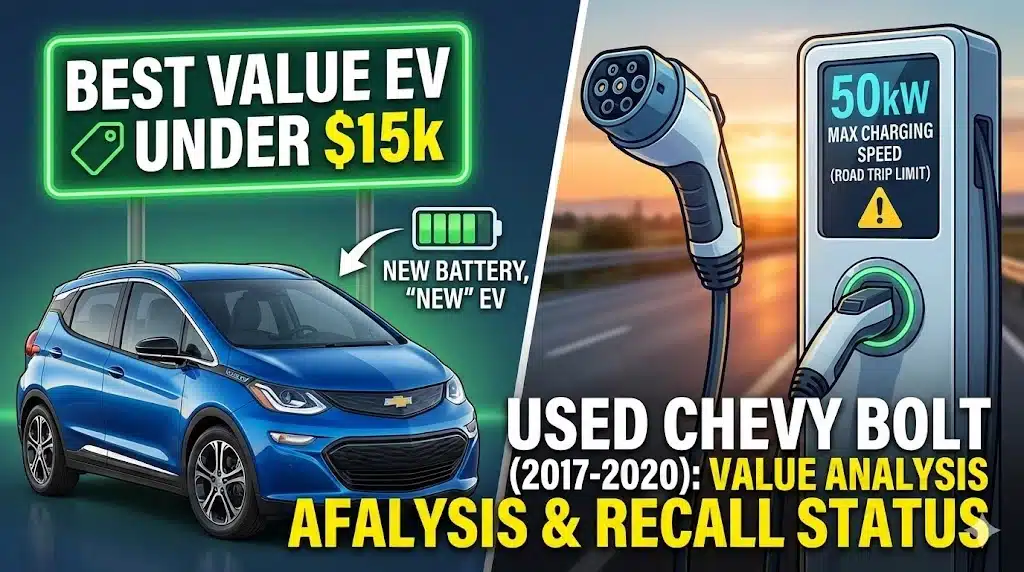
Let’s be real for a second. If you are looking for an affordable entry into the electric vehicle world, the market can feel like a minefield of degraded batteries and high mileage. But there is one outlier sitting on used car lots right now that breaks all the rules.
The Used Chevy Bolt (2017-2020) is currently trading hands for under $15,000—sometimes closer to $10,000. On paper, it looks like just another depreciated hatchback. But if you know what to look for, specifically regarding the battery recall status Bolt owners navigated recently, you aren’t just buying a used car. You might be buying a vehicle with a brand-new factory battery and a warranty that puts new cars to shame.
Is it perfect? Absolutely not. But if you want the best cheap electric car 2025 can provide, you need to understand why this little EV is the market’s best-kept secret.
The “Cheat Code”: Analyzing the Battery Recall Status
The elephant in the room regarding the Chevy Bolt is the massive battery fire recall that affected every model from 2017 to 2022. While this sounds scary, it has created a unique opportunity for savvy used buyers.
General Motors replaced the high-voltage battery modules in thousands of these vehicles. Here is the critical piece of data that most dealerships won’t explicitly tell you: When the battery was replaced, the battery warranty reset.
If you buy a 2017 Bolt that had its battery replaced in 2022, that battery is covered for 8 years or 100,000 miles from the date of replacement, not from the original 2017 purchase date. You could theoretically buy a 7-year-old car with a battery warranty valid until 2030.
How to Verify the Battery Status
Do not take the seller’s word for it. To ensure used Chevy Bolt reliability, follow these steps before money changes hands:
- Get the VIN: Locate the Vehicle Identification Number on the dash or door jamb.
- Check the NHTSA Database: Input the VIN into the National Highway Traffic Safety Administration’s recall lookup tool.
- Look for “Open” Recalls: If the recall status is “Open,” the battery hasn’t been swapped yet (which means you can get it done for free). If it is “Closed,” the work is done.
- Verify Warranty: Use GM’s owner center or call a Chevy service advisor with the VIN to confirm the exact date the new warranty period began.
Range and Performance: Punching Above Its Weight
The 2017-2019 Bolts originally launched with an EPA-estimated range of 238 miles. However, the replacement batteries installed during the recall were often the upgraded 66 kWh packs found in newer models, potentially bumping your real-world range to roughly 259 miles.
In terms of driving dynamics, the Bolt is genuinely zippy. With 200 horsepower and 266 lb-ft of torque, it hits 0-60 mph in under 7 seconds. It features “One-Pedal Driving” (in Low gear), which uses regenerative braking to slow the car down without touching the brake pedal—a feature usually reserved for more expensive EVs.
The Trade-Off: Charging Speed Limitations
We have established the value, but here is the catch. The Bolt is not a road-trip warrior.
The maximum DC fast charging speed for the Bolt is capped at roughly 50kW (technically 55kW). In 2025, where modern EVs like the Ioniq 5 or Tesla Model 3 charge at 220kW+, the Bolt feels prehistoric at a public charger.
- Public Fast Charging (0-80%): Expect to wait about 60 to 75 minutes.
- Home Level 2 Charging: This is where the Bolt shines. It will easily charge overnight, making it the perfect commuter car.
If you plan to drive 400 miles a day, the Bolt will frustrate you. If you drive 40 miles a day and charge at home, the slow DC charging speed is irrelevant.
Interior Comfort and Quirks
When analyzing used Chevy Bolt reliability and livability, we have to talk about the seats. The 2017-2019 models are notorious for having “thin” front seats that some drivers find uncomfortable on long drives.
The interior plastics are hard and utilitarian—this is an economy car, after all. However, the cabin is incredibly spacious due to the flat floor, offering more headroom and legroom than many crossovers twice its size.
The Financial Sweet Spot: Tax Credits
The value proposition gets even better when you factor in the Used Clean Vehicle Credit. As of 2025, eligible buyers can receive a tax credit equal to 30% of the sale price (up to $4,000) for used EVs priced under $25,000.
Since almost all 2017-2020 Bolts are well under the $25k cap, you can essentially stack this discount on top of the already low market price.
FAQ: Used Chevy Bolt Analysis
Is the Chevy Bolt reliable after the recall? Yes. Once the battery module is replaced, the fire risk is resolved. The rest of the car—motor, suspension, and electronics—has proven to be robust with very few mechanical issues reported.
Does a used Bolt qualify for the $4,000 tax credit? Generally, yes. If the car is at least two model years old, priced under $25,000, and purchased from a licensed dealer (not a private seller), it likely qualifies.
Can I upgrade the charging speed on a used Bolt? No. The 50kW limit is hardwired into the vehicle’s onboard charging hardware and software. It cannot be upgraded.
What is the difference between LT and Premier trims? The Premier trim adds leather seats, surround-view cameras (very useful), roof rails, and heated rear seats. Given the compressed prices in the used market, the Premier is often only a few hundred dollars more than the LT.
Final Verdict
If you can charge at home and don’t require cross-country rapid charging, the 2017-2020 Chevy Bolt is arguably the best value in the automotive market today. You get decent range, snappy performance, and potentially a fresh battery warranty for the price of a used economy sedan.
If you are looking for more in-depth EV analysis, check out our other vehicle reviews to see how the Bolt stacks up against hybrids and newer electric competitors.
Next Step: Locate a 2017-2020 Bolt you are interested in and ask the seller for the VIN immediately to check the battery warranty status on the NHTSA website.