 Skip to content
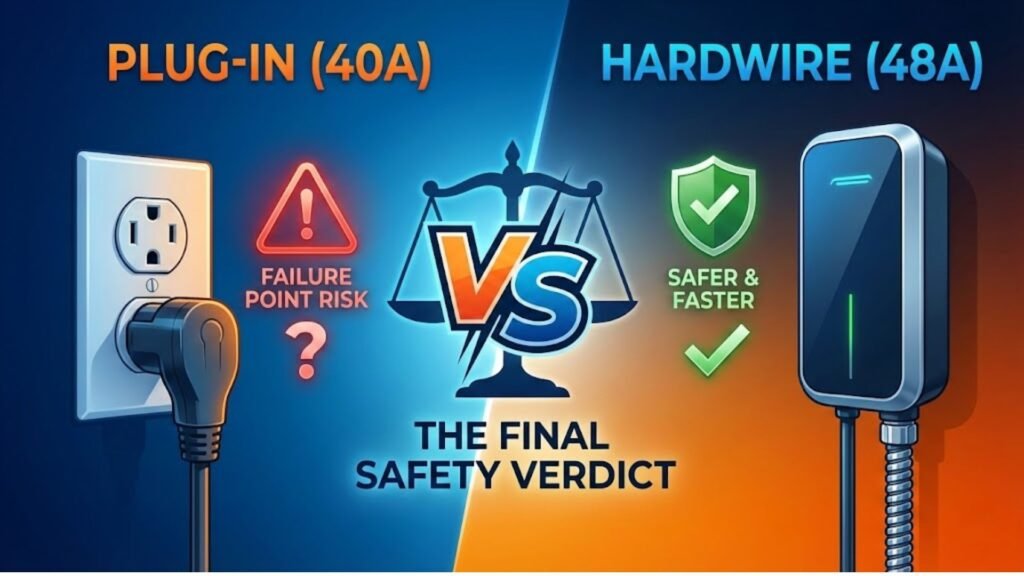
You’ve finally got the EV. You’ve picked out the charger. Now you’re staring at the wall in your garage, stuck on the last big decision: Do you install a NEMA 14-50 outlet and plug it in, or do you hardwire the unit directly into the wall?
It feels like the plug-in option should be the “easy” button. It’s flexible, right? You can take it with you if you move. But after analyzing the data—and seeing one too many photos of charred plastic—the answer isn’t about convenience anymore. It’s about safety.
If you’ve read our forensic analysis on why EV charger outlets melt, you know that the connection point is the weakest link in your charging setup. In this guide, we are looking at the hardwire EV charger vs plug in debate to explain why ditching the plug is the smartest move for your home, your wallet, and your peace of mind.
The Core Difference: How They Connect
Before we get into the heavy safety specs, let’s define the setup.
- Plug-In (NEMA 14-50): Your electrician installs a 240-volt outlet (similar to a dryer outlet). You plug the charger in.
- Hardwired: The electrician runs the conduit and wires directly from your service panel into the charger unit. There is no plug, no receptacle, and no visible break in the wiring.
It looks like a minor aesthetic difference, but inside the wall, it changes everything regarding code requirements, heat management, and charging speed.
Safety First: Eliminating the Failure Point
When we talk about the safety of hardwired EVSE (Electric Vehicle Supply Equipment), we are really talking about thermal management.
Every time you run high amperage through a connection, things get hot. When they stop, they cool down. This is called thermal expansion and contraction. Over months of daily charging, these tiny movements can cause the screws inside a NEMA 14-50 receptacle to loosen. A loose connection creates electrical resistance. Resistance creates heat. Heat melts plastic.
By hardwiring, you remove the outlet entirely. You are eliminating the physical point of failure where 90% of thermal issues occur. The wire is torqued down directly inside the charger’s terminal block, usually monitored by the charger’s internal thermal sensors.
The “Nuisance Trip” Headache
There is another safety quirk that drives plug-in owners crazy. Modern electrical code (NEC) often requires a GFCI (Ground Fault Circuit Interrupter) breaker for any outlet installed in a garage.
The problem? Your EV charger already has a built-in GFCI. When you plug a GFCI charger into a GFCI outlet, they can confuse each other. This leads to “nuisance tripping,” where your breaker cuts power for no reason in the middle of the night. You wake up to an uncharged car.
Hardwired units typically do not require a GFCI breaker because the safety tech is hard-coded into the device itself. You get a cleaner circuit and a reliable charge.
Speed Demons: 48 Amp vs 40 Amp Charging
If safety doesn’t sway you, speed might.
Due to the “80% Rule” in the National Electrical Code, you can only run a continuous load at 80% of the breaker’s capacity.
- Plug-In Limit: The standard NEMA 14-50 outlet is rated for 50 amps. 80% of 50 amps is 40 amps. That is your speed limit.
- Hardwire Potential: Because you aren’t limited by a 50-amp outlet, you can install a 60-amp breaker. 80% of 60 amps is 48 amps.
The Real-World Math
What does 48 amp vs 40 amp charging actually look like for your daily commute?
- 40 Amp Charging: Adds roughly 25-30 miles of range per hour.
- 48 Amp Charging: Adds roughly 35-44 miles of range per hour.
Over a single night, the difference is negligible for a small battery. But if you drive a large SUV or a truck like the Rivian or F-150 Lightning, that extra 20% speed boost can be the difference between hitting 100% charge before your morning commute or leaving with a partial battery.
Cost Analysis: The “Cheap” Plug Is a Myth
Many EV owners choose the plug-in route because they think it’s cheaper. They assume they just need a $15 outlet from the hardware store. Do not do this.
As we covered in our melting outlet investigation, cheap residential grade outlets cannot handle the stress of EV charging. You need an industrial-grade receptacle (like a Hubbell or Bryant), which costs between $50 and $100.
Add the cost of the required GFCI breaker (often $100+ more than a standard breaker), and the “cheaper” plug-in installation is suddenly more expensive than hardwiring. Hardwiring uses a standard breaker and zero receptacle costs.
Frequently Asked Questions
- Is it better to hardwire or plug in an EV charger? Hardwiring is generally considered better. It is safer because it removes a connection point, it is more reliable (no GFCI conflicts), and it allows for faster charging speeds.
- Does hardwiring an EV charger increase home value? Yes. A clean, hardwired installation is viewed as a permanent home upgrade, much like a central HVAC system, whereas a plug is seen as temporary equipment.
- Can I install a hardwired charger outside? Absolutely. In fact, hardwiring is preferred for outdoor use. It eliminates the risk of water corroding the receptacle contacts or someone tampering with the plug.
- Can I switch from a plug to hardwire later? Yes. Most quality chargers (like ChargePoint, Tesla Wall Connector, or Emporia) are capable of both. You can have an electrician remove the outlet and hardwire the existing unit, provided the wiring gauge is sufficient.
The Verdict
When weighing hardwire EV charger vs plug in, the winner is clear. While the flexibility of a plug seems nice, it introduces safety risks, speed throttles, and hidden costs that just aren’t worth it for a daily-use appliance.
For the ultimate “set it and forget it” experience, hardwire your unit. Your car will charge faster, and you won’t have to worry about the outlet melting while you sleep.
Ready to dive deeper into the gear? Check out our full breakdown in the Charging Infrastructure section to find the best hardware for your setup.