 Skip to content
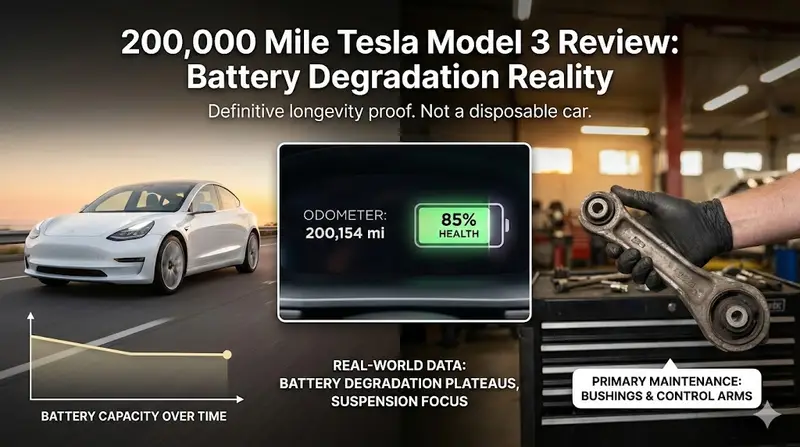
By 2025, the early “mass market” Tesla Model 3s aren’t just cars anymore—they are test subjects. Many have finally crossed the magic 200,000-mile mark, a distance that usually sends gas-powered luxury sedans to the scrapyard.
The internet is full of fear-mongering about “disposable electric cars” and $16,000 battery replacements. But when we look at the actual data from high-mileage owners and taxi fleets, the story changes completely.
If you are considering a used EV or planning to drive yours into the ground, you need the truth about Tesla Model 3 200k miles reliability. The reality? The battery is likely fine. It’s the suspension you need to worry about.
What Happens After 200k Miles?
The biggest fear for any EV owner is the battery dying. However, real-world data from 2018 and 2019 models shows that this fear is largely blown out of proportion.
The “Plateau” Effect
Battery degradation is not linear. Most battery degradation in high mileage Teslas happens in the first 20,000 to 40,000 miles. You might lose about 5-8% of your range early on as the battery chemistry settles.
After that, the degradation curve flattens out significantly—a phenomenon engineers call the “plateau.”
The Numbers don’t Lie
According to fleet data and Tesla’s own impact reports, the average Model 3 Long Range retains about 85% of its original capacity after 200,000 miles.
- Original Range (approx): 310–325 miles
- Range at 200k Miles: ~260–275 miles
Is a 15% loss ideal? No. But is the car “dead”? Absolutely not. For a daily commuter, a vehicle that still offers 260 miles of range is perfectly functional. The “cliff” where a battery suddenly fails is statistically rare and typically covered under the 8-year/100,000-mile warranty if it happens early.
The Real Weakness: Suspension and Control Arms
While everyone is staring at the battery gauge, the real mechanical failures are happening underneath the car. If you are looking at maintenance cost after 100k miles, this is where your money will go.
The Model 3 is a heavy car (thanks to that battery) with sport-tuned suspension. This combination eats rubber bushings for breakfast.
The “Tesla Squeak”
Around 50,000 to 80,000 miles, many Model 3s develop a notorious creaking sound from the front end. By 200,000 miles, you will likely have replaced these components at least twice:
- Upper Control Arms: The ball joints on early models lacked sufficient grease and sealing, leading to water ingress and the infamous squeak.
- Lateral Links: The bushings here often tear due to the high torque and weight of the vehicle.
If you are buying a high-mileage Model 3, listen for clunks or creaks over speed bumps. This isn’t a battery issue; it’s a $1,500 suspension overhaul waiting to happen.
Maintenance Cost After 100k Miles
When comparing the Tesla Model 3 200k miles reliability against a BMW 3-Series or Mercedes C-Class, the Tesla wins on powertrain but loses on tires.
Here is what the maintenance schedule actually looks like for a high-mileage unit:
- Tires: You will go through tires faster than an ICE (Internal Combustion Engine) car. Expect a new set every 30,000–40,000 miles.
- 12V Battery: The small lead-acid battery usually dies every 3–4 years. If your screen goes black or doors won’t open, this is the culprit, not the main high-voltage pack.
- Cabin Air Filters: These need changing often to prevent that “gym sock” smell, a common complaint in older Model 3s.
- Brakes: Surprisingly, these are almost free. Thanks to regenerative braking, many owners hit 200k miles on their original brake pads.
Is a 200,000 Mile Tesla Worth It?
The data suggests that the “disposable car” narrative is false. The drivetrain (motors and battery) is incredibly robust. The drive units are rated for a million miles and rarely fail.
However, the car around the battery does age. Seats wear out, steering wheels peel, and suspension rattles. But these are fixable issues.
If you are willing to handle suspension repairs and keep an eye on your tires, a high-mileage Model 3 offers incredible value. It provides the same software updates, Autopilot features, and Supercharger network access as a brand-new one, for a fraction of the price.
For those interested in a deeper dive into how these vehicles age compared to competitors, check our category on comprehensive EV reviews to see how other models stack up.
FAQ: High Mileage Tesla Model 3
How much range does a Tesla Model 3 lose after 200,000 miles?
On average, a Model 3 loses about 12-15% of its battery capacity after 200,000 miles. This means a car that started with 310 miles of range will likely have around 265 miles remaining.
What is the most common repair on a Tesla Model 3 after 100k miles?
The most common non-maintenance repair involves the front suspension, specifically the upper control arms and lateral link bushings, which tend to wear out due to the vehicle’s weight.
Are Tesla batteries expensive to replace?
Yes, a full battery replacement can cost between $12,000 and $16,000. However, data shows that total battery failure is rare, with most units simply degrading slowly over time rather than dying suddenly.
Does the Tesla Model 3 rust?
The Model 3 uses a mix of aluminum and steel. While generally resistant, early models (2017-2019) have seen some paint issues around the rocker panels and wheel wells (due to road debris), which can lead to surface rust if not protected with mud flaps or PPF.