 Skip to content
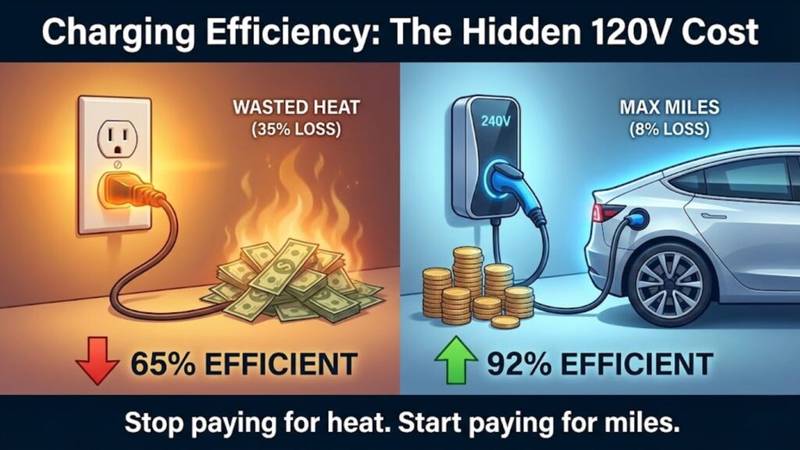
Most new EV owners drive home with a simple plan: plug the car into a standard wall outlet and forget about it. It feels free and convenient, just like charging a phone. But after analyzing charging data and real-world efficiency numbers, it becomes clear that relying on a standard 120V outlet is silently inflating your electricity bill.
This isn’t just about slow charging speeds. It is about a hidden financial penalty that most drivers never notice until they crunch the numbers. By sticking to Level 1 charging, you are likely paying for electricity that never actually reaches your battery.
The Hidden Data: Level 1 vs Level 2 Charging Efficiency
When you plug an electric vehicle into a standard 120V household outlet, the process is surprisingly inefficient. Data studies and community testing consistently show that Level 1 charging efficiency hovers around 65% to 75%. In contrast, a dedicated 240V Level 2 station typically operates at 90% to 95% efficiency.
The technical reason for this gap is simple but costly. Every time you charge, the car’s onboard computer, battery management system (BMS), and coolant pumps must wake up and run. These systems consume a fixed amount of power—roughly 200 to 400 watts—regardless of how fast you are charging.
On a low-power 120V circuit, this “overhead” power represents a huge chunk of the total energy coming from the wall. You might be pulling 1,400 watts from the outlet, but if the car uses 300 watts just to stay awake, nearly 20% of your electricity is wasted before it even touches the battery cells. During conversion from AC to DC, further losses occur as heat.
With a 240V charger, the car’s systems still run, but because the energy flow is so much higher (often 7,000 to 11,000 watts), that fixed 300-watt overhead becomes a negligible percentage of the total. The result is that you pay for miles, not for keeping the car’s computer awake.
Calculating the Cost of 120V Charging Losses
To understand the financial impact, we have to look at the annual numbers. This is where the cost of 120v charging losses becomes a measurable expense rather than just a technical statistic.
Consider a driver who covers 12,000 miles per year. An average efficient EV might consume 3,500 kWh of energy to travel that distance.
If you charge at 90% efficiency (Level 2), you need to pull roughly 3,890 kWh from the grid to get that 3,500 kWh into the battery. At a national average electricity rate of $0.16 per kWh, your annual fuel cost is approximately $622.
If you charge at 70% efficiency (Level 1), you need to pull 5,000 kWh from the wall to get the same 3,500 kWh into the car. Your annual cost jumps to $800.
That is a difference of nearly $180 per year simply lost to heat and system overhead. Over five years, that is nearly $900 wasted—often enough to pay for the installation of a proper Level 2 outlet. This doesn’t even account for cold weather, where 120V efficiency can drop significantly lower as the car struggles to warm the battery, sometimes spending hours using all available power just for heat without adding a single mile of range.
240V Savings Calculator: When Does It Pay Off?
Many drivers hesitate to upgrade because of the upfront cost of an electrician. However, using a 240v savings calculator mindset helps visualize the return on investment. The “payback period” is often shorter than expected when you factor in efficiency losses, not just convenience.
If you install a simple NEMA 14-50 outlet for $500, the efficiency savings alone could pay for the installation in under three years. If your local utility offers rebates for installing Level 2 equipment, that payback time can drop to less than a year.
Beyond the raw dollar savings, there is the “time efficiency” value. Level 2 charging allows you to schedule charging strictly during off-peak hours (like 12 AM to 6 AM) when rates are often cheapest. A 120V charger is too slow to take full advantage of these narrow time windows; it has to be plugged in constantly, often drawing power during expensive peak hours just to keep up with your daily commute.
Why Cold Weather Worsens the Penalty
The financial gap widens drastically in winter. Batteries are reluctant to take a charge when they are cold. The vehicle must use energy to heat the battery pack to an optimal temperature before charging can effectively begin.
On a 120V circuit, the power supply is so limited that the car may use nearly 100% of the energy just for heating. You could leave your car plugged in for 10 hours overnight and wake up with only a few miles added, or sometimes none at all. You have essentially paid for a space heater for your garage floor for 10 hours.
A 240V connection provides enough power to heat the battery quickly and then switch to charging, ensuring that the electricity you pay for is actually converted into driving range.
Next Steps for EV Owners
If you are currently relying on a standard outlet, check your daily energy usage. You are likely paying a “convenience tax” in the form of wasted electricity. Moving to a dedicated circuit isn’t just a luxury upgrade for speed; it is an efficiency upgrade that stops your meter from spinning unnecessarily.
For more details on setting up the right equipment, you can explore our guide on Charging Infrastructure to find the best setup for your home and budget.
FAQs
Is Level 1 charging bad for the battery?
No, Level 1 charging is actually very gentle on the battery because it generates very little internal heat compared to fast charging. However, it is “bad” for your wallet due to the poor efficiency and high energy waste.
How much does it cost to install a Level 2 charger?
Installation costs vary wildly based on your home’s wiring. A simple outlet installation near your electrical panel might cost $400-$600, while a complex run requiring a panel upgrade could cost $1,500 or more.
Can I save money by using 120V charging?
Generally, no. While you save the upfront cost of installation, you pay more per mile in electricity costs due to efficiency losses. The only exception is if you drive very few miles (under 3,000 miles a year), where the efficiency loss is too small to offset the installation price.
Does voltage affect charging speed or just efficiency?
It affects both. Doubling the voltage (120V to 240V) typically triples or quadruples the charging speed because you are also usually increasing the amperage. The efficiency gain comes from the fact that the car spends less time “awake” and charging.