 Skip to content
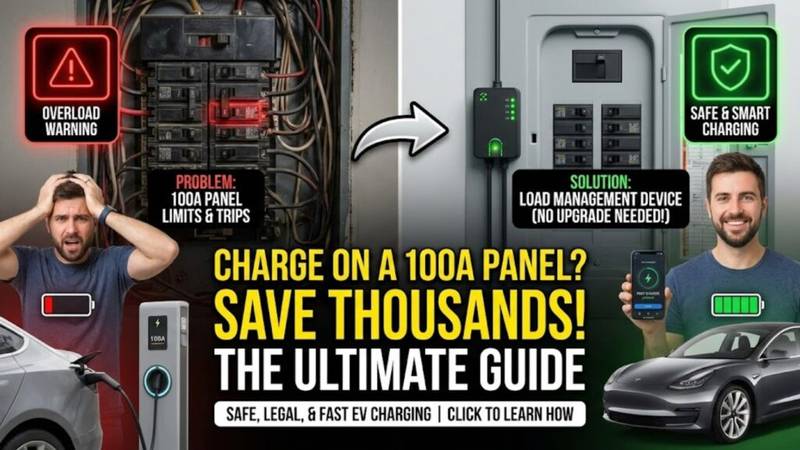
It is the most common roadblock for new EV owners living in older homes. You buy the car, call an electrician to install a Level 2 charger, and get hit with the bad news: “You don’t have enough power. You need a service upgrade.”
Suddenly, your simple charger installation has ballooned from a few hundred dollars to a $3,000+ construction project involving the utility company, trenching, and a new main breaker panel.
But here is the secret most general contractors won’t tell you: You probably don’t need to upgrade your panel.
Thanks to smart technology known as an EV load management device, you can safely install a fast charger on a standard 100-amp service without risking a blackout or violating electrical codes. This guide will explain how these devices work, review the top options like the DCC-9, and help you decide if this solution is right for you.
The Problem: Why 100 Amps Isn’t Enough (Usually)
Most older homes were built with 100-amp service, which was plenty for lights, a fridge, and a TV. Today, we have central AC, electric dryers, induction stoves, and now, electric vehicles.
When you add a 50-amp circuit for an EV charger, you are technically using up half of your home’s total available capacity. The National Electrical Code (NEC) requires a “load calculation” before adding a new circuit. If your math shows that turning on the AC, the oven, and the car charger at the same time could exceed 100 amps, the code forbids the installation.
This is where an EV load management device changes the math.
The Solution: How Load Management Works
Think of a load management device as a traffic cop for your electricity. It installs directly in between your main electrical panel and your EV charger.
Here is the step-by-step process:
- Monitoring: The device uses current transformers (CT clamps) to watch exactly how much power your house is using in real-time.
- Shedding: If you turn on the dryer and the AC, and your total home usage spikes near 80% of your panel’s limit (usually 80 amps), the device instantly cuts power to the EV charger.
- Restoring: Once the dryer finishes or the AC turns off, the device sees the load drop and automatically turns the EV charger back on.
Because the device guarantees the main breaker will never trip, the NEC allows you to install EV charger on 100 amp service legally, without a service upgrade.
Top Load Management Devices Reviewed
1. DCC-9 (The Condo & Home Standard)
The DCC-9 is often the go-to solution for electricians, especially in condos or homes where the electrical panel is completely full or physically inaccessible.
- How it works: It acts as a sub-panel / splitter. You feed the main power line into it, and it splits power between your house and the charger.
- Best for: Situations where you have zero breaker slots left in your main panel.
- Pros: widely recognized by inspectors; highly reliable.
- Cons: bulky box; professional installation is mandatory.
2. SimpleSwitch (The Retrofit Friendly)
The SimpleSwitch is a newer competitor that offers more flexibility. Unlike the DCC-9, which is often used for new installs, SimpleSwitch is excellent for sharing a specific circuit.
- How it works: It can share an existing 40A or 50A breaker (like your stove range) with your EV charger.
- Best for: Homes where running a new wire from the main panel is difficult.
- Pros: Compact; slightly cheaper than DCC units; UL certified.
3. Smart Splitters (The Plug-and-Play Option)
For a non-permanent solution, devices like the NeoCharge plug directly into an existing dryer outlet (NEMA 14-30 or 14-50).
- How it works: You plug your dryer and your EV into the splitter. When the dryer runs, the EV pauses.
- Best for: Renters or owners who have a dryer outlet in the garage.
- Pros: No electrician needed (DIY friendly); portable.
- Cons: Limited charging speed (usually 24A or 32A) compared to hardwired units.
Cost Breakdown: Upgrade vs. Management
Is the hardware worth it? Let’s look at the numbers.
| Expense Item | Panel Service Upgrade | Load Management Install |
| Hardware | $200 – $500 (New Panel) | $600 – $900 (DCC-9/SimpleSwitch) |
| Labor | $2,000 – $4,000 | $400 – $800 |
| Utility Fees | $500 – $2,000+ (if trenching needed) | $0 |
| Permits | $150 – $400 | $50 – $150 |
| Total Estimated Cost | $2,850 – $6,900+ | $1,050 – $1,850 |
Note: Prices vary by region and complexity.
As you can see, spending $800 on a smart device can save you thousands in labor and utility fees.
Frequently Asked Questions
- Does a load management device slow down my charging?Only temporarily. It does not throttle the speed (e.g., lowering 40A to 20A); it acts as an on/off switch. It only pauses charging when your home is using peak energy—usually for 20-30 minutes while you cook dinner or dry clothes.
- Is the DCC-9 safe for my car?Yes. The power cut is handled safely, similar to unplugging the car. Modern EVs are designed to handle sudden power interruptions without damage.
- Can I install this myself?Hardwired devices like the DCC-9 or SimpleSwitch require working with main service lines and should strictly be installed by a licensed electrician. Smart splitters (like NeoCharge) are safe for DIY use.
- Will this pass inspection?Yes. These devices are UL-listed and recognized by the National Electrical Code (NEC) specifically for energy management systems (EMS). However, always check with your local authority as some jurisdictions have specific rules.
What to do next
If you have a 100A panel, don’t immediately agree to a service upgrade. Go to your electrical panel, take a clear photo of the label and the breakers, and send it to three local electricians asking specifically for a quote to “install an EV load management device like a DCC-9.” This specific request shows you know your options and prevents them from upselling you a panel upgrade you don’t need.
For more on setting up your home station, check out our guide on Charging Infrastructure.