 Skip to content
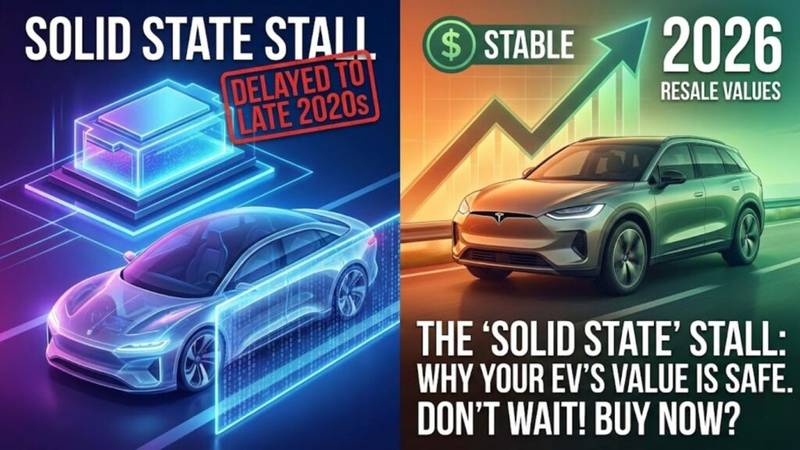
The automotive industry has spent the last decade dangling a carrot in front of us: the solid state battery. We’ve been promised 600 mile ranges, charging speeds that rival gas station fill ups, and safety profiles that make thermal runaway a thing of the past.
Naturally, this has created a massive “Osborne Effect” many potential buyers are paralyzed, asking themselves, “Why buy an EV now if it’s going to be a dinosaur in three years?”
But here is the twist that recent market data is revealing: The technology is late.
According to recent reports from major financial institutions like Goldman Sachs, mass-market adoption of solid-state batteries has likely been pushed to the late 2020s or even 2030. Paradoxically, for anyone looking at EV resale value trends 2026, this “stall” is actually good news. It means the electric vehicle you buy today is not at risk of the immediate obsolescence we feared.
Here is a deep dive into why the delay stabilizes the market and what it means for your wallet.
The Reality of the Solid State Stall
To understand the resale market, we first have to look at the tech timeline. Solid-state batteries replace the liquid electrolyte in current lithium-ion cells with a solid material. It is harder to manufacture at scale than anyone admitted.
While we might see solid-state tech in ultra-luxury hypercars by 2026 or 2027, the “Toyota Corolla” of EVs won’t have them for a long time. The industry is currently struggling with:
- Scalability: moving from lab samples to gigafactory production.
- Cost: Current estimates put solid-state production costs significantly higher than mature lithium-ion lines.
- Durability: Solving expansion and contraction issues during charging cycles.
This delay removes the “cliff edge” for current owners. If a revolutionary cheap battery appeared tomorrow, every 2025 EV would plummet in value. Since that revolution is delayed, the depreciation curve for current tech flattens out.
Impact on 2026 Resale Values
So, what is the specific solid state battery delay impact on the car you are driving (or looking to buy) right now?
1. The “Total Cost of Ownership” Parity
The market is shifting its focus from “magic batteries” to “affordable batteries.” The same Goldman Sachs analysis suggests that standard lithium-ion battery prices are falling faster than expected, potentially reaching $80/kWh by 2026.
This leads to TCO (Total Cost of Ownership) parity with internal combustion engines without needing solid-state tech. When new EV prices stabilize due to cheaper lithium batteries, used EV prices stabilize in tandem. The market becomes predictable.
2. The “Good Enough” Threshold
Current EVs have crossed a critical threshold. A Model Y or Ioniq 5 with 300 miles of range and 20-minute fast charging is “good enough” for 95% of use cases.
- In 2026, a used 2024 EV with 300 miles of range will still be a highly practical vehicle.
- It won’t be rendered useless by a solid-state car because the solid-state car will likely be $20,000 more expensive.
3. Segmentation of the Market
By 2026, we expect the market to split:
- Premium Tier: Early solid-state models (very expensive, high resale).
- Standard Tier: Mature Lithium-Ion/LFP models (affordable, stable resale).
Your current EV fits into that Standard Tier, which will remain the volume seller for years.
Buy EV Now or Wait for Solid State?
This is the most common question we get. If you are debating to buy EV now or wait for solid state, consider your timeline.
You should BUY NOW if:
- You need a vehicle in the next 1-3 years.
- You drive average daily distances (under 100 miles).
- You want to take advantage of current mature tech (LFP batteries) that is known for longevity.
- You are worried about depreciation; the “stall” protects you for the typical 3-5 year ownership cycle.
You should WAIT if:
- You absolutely require 500+ miles of range without stopping (e.g., heavy towing, extreme rural driving).
- You are looking to buy a “forever car” to keep for 15+ years.
- Your budget allows for a premium price tag (likely $80k+) when the tech first arrives.
For staying updated on these timelines, keep an eye on our EV news section, where we track manufacturer announcements weekly.
Frequently Asked Questions
Will solid-state batteries kill current EV resale value?
Not in the short term. Because solid-state technology is delayed until the late 2020s for mass production, current lithium-ion EVs will remain the industry standard for years, stabilizing their resale value through 2026.
When will solid-state batteries be available in affordable cars?
Experts predict mass-market availability (in affordable family cars) won’t happen until roughly 2030. The first wave in 2026-2028 will likely be restricted to luxury performance vehicles due to high manufacturing costs.
Should I lease or buy an EV in 2025?
Leasing is a strong strategy if you are risk-averse regarding tech. However, buying is safer now than it was two years ago because the delay in next-gen tech means your car won’t become obsolete overnight.
Do solid-state batteries degrade?
Yes, they still degrade, but theoretically at a slower rate than liquid-electrolyte batteries. However, current LFP (Lithium Iron Phosphate) batteries already offer incredible lifespans, often outlasting the vehicle itself.