 Skip to content
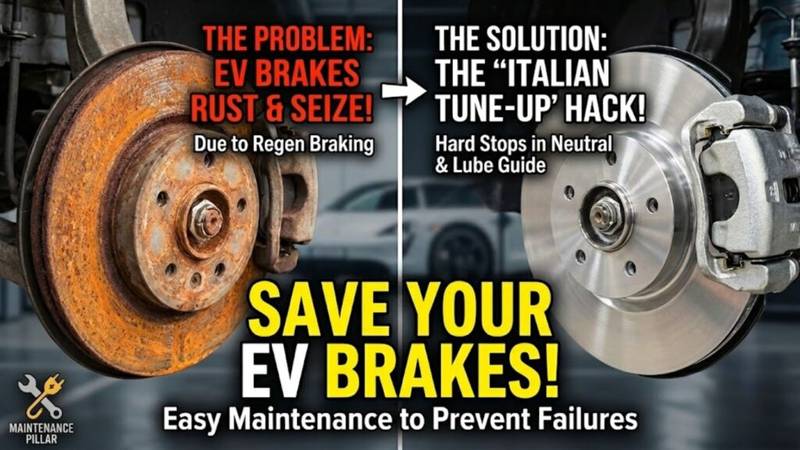
If you drive an electric vehicle, you probably enjoy one-pedal driving. It’s smooth, efficient, and feeds energy back into your battery. You might even brag that your brake pads will last 100,000 miles because you rarely touch the pedal.
But here is the dirty secret the dealership probably didn’t tell you: Disuse is the enemy of brake health.
Because regenerative braking handles 90% of your deceleration, your physical friction brakes—the pads and rotors—spend most of their life doing absolutely nothing. In the automotive world, static parts are prone to rust, seizing, and glazing.
This guide covers a critical “hidden” maintenance task for every EV owner: how to perform an “Italian Tune-up” for your brakes to scrub off rust, and why lubricating your caliper slide pins is non-negotiable in the electric era.
The Problem: Rusty Brake Discs on Electric Cars
On a gas car, you use the friction brakes constantly. This friction generates heat, which naturally scrubs the discs clean of surface rust and moisture every time you drive.
On an EV, that cleaning cycle rarely happens. If you live in a wet climate or an area that salts the roads, moisture settles on the steel rotors and stays there. Over time, this surface rust can pit the metal and cause the pads to delaminate or glaze over. Worse, the caliper slide pins—the metal rods that allow your brakes to float freely—can seize up from lack of movement, leading to uneven wear or stuck brakes.
The Solution: The EV “Italian Tune-up”
Old-school mechanics used to drive gas cars hard (the “Italian Tune-up”) to burn off carbon deposits. For EVs, we use a modified version of this concept to save your brakes.
The goal is to force the physical brakes to engage fully, bypassing the regenerative system entirely, to scrub the rotors clean.
How to Clean Rusty Brake Discs on an Electric Car
Note: Only perform this on a dry, empty stretch of road where it is safe to do so. Check your rear-view mirror.
- Find a Safe Road: You need a clear straightaway with no traffic behind you.
- Get Up to Speed: Accelerate to about 30–40 mph.
- Shift to Neutral (N): This is the magic step. In almost all EVs, shifting to Neutral completely disables regenerative braking.
- Brake Firmly: Apply the brake pedal with moderate to heavy pressure until you come to a near stop. Because regen is off, the hydraulic calipers have to do 100% of the work.
- Repeat: Do this 2–3 times.
- Shift Back to Drive (D): Continue on your way.
You will likely hear a grinding noise on the first stop that is the sound of rust being scrubbed off. By the third stop, it should be silent. Doing this once a week is often enough to keep your rotors shiny and healthy.
Lubricating EV Brakes: The Forgotten Service
Scrubbing the rotors is great for the surface, but it doesn’t solve the issue of seized mechanical parts. Because the calipers don’t move as often or get as hot as they do on gas cars, the grease on the slide pins can harden and gum up.
When to Service Your Slide Pins
For most EVs, you cannot wait for a brake pad change to lube the pins, because your pads might last 6 years! By then, the pins will be rusted solid.
- Salt Belt / Wet Climates: Clean and lubricate slide pins every 12 months or 12,000 miles.
- Dry Climates: You can likely stretch this to 24 months or 24,000 miles.
If you are comfortable with a wrench, this is an easy Saturday job. If not, ask your mechanic specifically for a “brake cleaning and lubrication service” (not a replacement). Using high-quality silicone-based brake grease is essential here, as petroleum-based greases can swell the rubber boots.
FAQ: Common EV Brake Questions
Why do my EV brakes make a grinding noise in the morning?
This is usually flash rust. Moisture accumulates on the iron discs overnight. The grinding sound is the pads scrubbing that rust layer off. If the noise goes away after a few stops, it is normal. If it persists, your rotors may be pitted and need professional attention.
Do I really need brake maintenance if my pads aren’t worn?
Yes. On an EV, you service the brakes to prevent corrosion, not just wear. You might have 90% pad life left, but if the metal backing plate rusts and separates from the friction material (delamination), you will need a full replacement anyway.
Can regenerative braking damage my brakes?
Regen itself doesn’t damage brakes, but the lack of use caused by regen does. It creates a “use it or lose it” scenario. If you exclusively use one-pedal driving, you are accelerating the risk of seized calipers.
Is the “Italian Tune-up” safe for my battery?
Yes. Shifting to Neutral temporarily disconnects the motor from the wheels (electrically or mechanically depending on the car), so no energy flows in or out of the battery during the stop. It is purely a mechanical friction event.
Summary
You bought an EV to save on maintenance, and for the most part, you will. But ignoring your brakes because “regen does everything” is a recipe for a rusty, expensive repair bill. A few hard stops in Neutral every week and a yearly lubrication service are all it takes to keep your stopping power as reliable as your acceleration.
For more in-depth guides on keeping your vehicle running smoothly without breaking the bank, check out our full library on maintenance and DIY repairs.
- Next time you are on an empty road, try the Neutral braking technique safely to clear off that morning rust layer. If you hear a significant grind that doesn’t go away, it might be time to inspect those slide pins.