 Skip to content
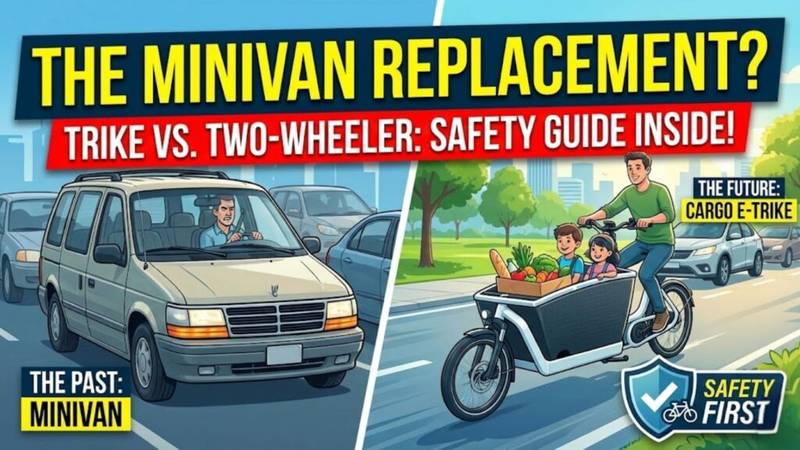
If you have driven through a suburban neighborhood lately, you have likely seen them: parents ditching their SUVs for electric cargo bikes. The “Minivan Killer” trend is no longer just a hashtag; it is a full-blown lifestyle shift. But as you scroll through options, a massive conflict arises in your mind.
The market is flooding with new 3-wheelers (trikes) promising “no-balance” ease. But are they actually safer than the 2-wheel titans like the Lectric XPedition 2.0 or the Aventon Abound LR?
For most parents, the decision comes down to one deep, often unspoken fear: I am terrified of dropping my kids.
You might think a trike is the obvious safety choice because it doesn’t fall over when stopped. But the reality of electric cargo trike vs 2-wheel cargo bike safety is much more complex. Stability is not simple. It comes in two forms: Static (stopped) and Dynamic (moving). Choosing the wrong one for your specific terrain can actually make your ride less safe.
The Physics of “The Tipping Point”
To understand which bike is the safest e-bike for carrying kids, we have to look at physics. The biggest misconception in the cargo world is that three wheels are always more stable than two. This is the “Trike Myth.”
The Trike Myth: Static Stability vs. Dynamic Instability
Trikes have incredible static stability. You can sit at a red light with three kids in the back, hands off the handlebars, and the bike won’t budge. This feels amazingly safe during a test ride in a flat parking lot.
However, trikes suffer from dynamic instability. Because a standard trike cannot lean into a turn like a bicycle, centrifugal force tries to push it over to the outside of the turn. If you take a sharp corner too fast, the inside wheel can lift, leading to a tip-over. Furthermore, on cambered roads (roads that slope to the side for drainage), a trike will tilt away from the slope, which can feel unsettling for the rider and passengers.
The Two-Wheeler Learning Curve
Two-wheelers rely on dynamic stability. At 0 mph, they are unstable (the “wobble zone”) and require you to balance the weight. This is where the fear of dropping the bike exists.
But once you are moving faster than 5 mph, the gyroscopic effect of the wheels takes over. A 2-wheel cargo bike naturally wants to stay upright. More importantly, you can lean into turns, keeping the child seat center of gravity aligned with the bike. This makes them significantly more stable at speed and on uneven terrain than a trike.
The 2-Wheel Heavyweights (The Benchmarks)
If you are leaning toward a two-wheeler, 2025 has brought us some incredible contenders that directly address the balance issue.
1. Lectric XPedition 2.0: The Workhorse
The Lectric XPedition 2.0 is often cited as the best family cargo e-bike for value. It is designed as a pure utility hauler.
- Focus: Heavy payload capacity and dual-battery options are essential for hauling heavy cargo or multiple kids over long distances.
- Safety Note: It features a remarkably low center of gravity. While you still need to balance it at a stop, the weight sits low, making it easier to manage than older cargo bikes.
2. Aventon Abound LR: The Refined Ride
The Aventon Abound LR takes a different approach to safety, focusing on rider confidence.
- Focus: It utilizes a torque sensor. Unlike cadence sensors that can be “jerky” (a nightmare with kids on the back), the torque sensor delivers power smoothly based on how hard you pedal.
- Safety Note: The standout feature here is the dropper seat post. This allows you to press a lever and drop the seat instantly when you stop, letting you plant both feet flat on the ground. This eliminates the “tippy-toe” anxiety at red lights.
The Trike Challengers (Stability at a Cost)
Models like the Lectric XP Trike or premium front-loader trikes are gaining traction for a reason. They serve a specific purpose.
- Pros: There is zero wobble when loading energetic toddlers. You can ride as slowly as you want uphill without losing balance. For grandparents or riders with balance issues, this is the only option.
- Cons: They have a much wider turning radius. You must slow down significantly for corners. They can feel “tippy” on potholes or slanted driveways because the rigid frame rocks side-to-side rather than absorbing the bump.
Head-to-Head Comparison Table (2025 Edition)
| Feature | 2-Wheel Long-Tail (XPedition/Abound) | Electric Cargo Trike |
| Loading Kids | Requires holding bike upright (Kickstand vital) | Effortless (Stable platform) |
| Cornering Speed | High (Leans into turns) | Low (Must slow down to avoid tipping) |
| Uneven Terrain | Handles well (Rider corrects) | Poor (Rocks side-to-side) |
| Storage | Narrow (Fits in hallway) | Wide (Needs garage/parking spot) |
| “Minivan” Factor | 2 Kids max (usually) | 3-4 Kids (Front bucket models) |
Buying Guide: Which one fits your life?
So, is the cargo e-bike minivan replacement a trike or a bike? It depends on your daily route.
Choose a 2-Wheeler (XPedition/Abound) if:
- You have a commute longer than 3 miles.
- Your roads have potholes, speed bumps, or significant camber.
- You need to fit through narrow gates or navigate tight urban traffic.
- You are comfortable riding a standard bicycle.
Choose a Trike if:
- You have balance issues or lack confidence on a standard bike.
- Your route is almost entirely flat and allows for slow speeds.
- You need to haul groceries or heavy gear purely in a neighborhood setting where speed isn’t a factor.
- You are carrying 3+ kids (specifically in large front-loader box trikes).
The Verdict
Trikes aren’t necessarily “safer”—they just trade one risk (falling at stops) for another (tipping in turns). For most agile commuters looking for a true car replacement, a low-center-of-gravity 2-wheeler like the Aventon Abound LR remains the king of versatility. However, for “slow-roll” neighborhood families who prioritize loading ease over speed, the Trike wins the driveway test.
Checkout our guides for more information
Frequently Asked Questions
Are electric trikes safer than cargo bikes for toddlers? Not necessarily. While trikes are safer during the loading process because they don’t tip over when stopped, they can be more prone to tipping during turns if ridden too fast. Two-wheel cargo bikes are generally more stable while moving but require the parent to balance the bike when stopped.
Can the Lectric XPedition 2.0 carry two child seats? Yes, the Lectric XPedition 2.0 is designed with a long rear rack that can accommodate two child seats, making it a popular choice for families with two young children.
Why does my electric trike feel unstable in turns? This is due to physics. Unlike a bicycle, a standard trike cannot lean into a turn. Centrifugal force pushes the weight to the outside, creating a sensation that the trike wants to tip over. You must slow down significantly before turning on a trike.
What is the safest e-bike for carrying kids if I am short? Look for a cargo bike with a “dropper seat post” (like the Aventon Abound) or a step-through frame with 20-inch wheels. These features allow you to lower your center of gravity and put your feet flat on the ground when stopped, which is the most critical safety factor for shorter riders.