 Skip to content
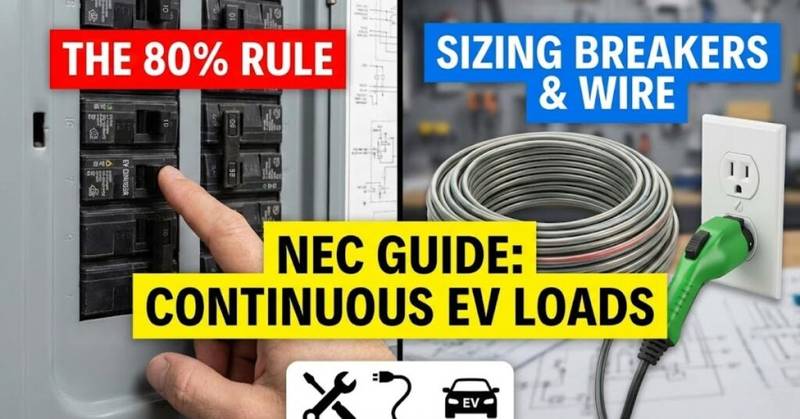
You just bought a 40-amp EV charger. You’re standing in the electrical aisle looking at a 40-amp breaker. It feels like a perfect match, right?
Stop. Do not install that breaker.
If you install a 40-amp charger on a 40-amp breaker, you are creating a fire hazard. Unlike a toaster or a power drill that runs for a few minutes, an EV charger is what the National Electrical Code (NEC) defines as a Continuous Load. It runs at maximum power for hours at a time, generating significant heat. If you match the breaker exactly to the charger, that heat will eventually trip the breaker—or worse, melt the busbar in your panel.
To install this safely and pass inspection, you need a buffer. In the electrical world, we call this the 125% Rule (or the 80% Rule, depending on how you look at it).
The Core Rule: 80% vs. 125%
Many DIYers get confused because they hear two different numbers. Here is the secret: they are the exact same mathematical concept, just viewed from opposite ends of the wire.
- The Breaker Perspective (80%): You can only load a breaker to 80% of its rated capacity for continuous use.
- Example: A 50A breaker $\times$ 0.80 = 40A max continuous load.
- The Charger Perspective (125%): You must size the breaker at 125% of the device’s load.
- Example: A 40A charger $\times$ 1.25 = 50A required breaker.
This isn’t just a suggestion; it is a requirement under NEC Article 625 (EV Charging Systems) and NEC 210.20(A).
The Cheat Sheet: Charger vs. Breaker vs. Wire
Use this table to find your requirements instantly. Note the specific difference between hardwired (THHN in conduit) and standard home wiring (NM-B/Romex), which is where most people fail inspection.
| Charger Output | Calculation (125%) | Required Breaker | Min Copper Wire (THHN/Conduit) | Min Copper Wire (NM-B/Romex) |
| 16 Amps | 16 x 1.25 = 20A | 20 Amp | 12 AWG | 12 AWG |
| 24 Amps | 24 x 1.25 = 30A | 30 Amp | 10 AWG | 10 AWG |
| 32 Amps | 32 x 1.25 = 40A | 40 Amp | 8 AWG | 8 AWG |
| 40 Amps | 40 x 1.25 = 50A | 50 Amp | 8 AWG | 6 AWG |
| 48 Amps | 48 x 1.25 = 60A | 60 Amp | 6 AWG | 4 AWG (Do not use #6!) |
| 80 Amps | 80 x 1.25 = 100A | 100 Amp | 3 AWG | 2 AWG |
Note: Wire sizes assume copper conductors. Aluminum requires upsizing and is generally not recommended for novice EV installs.
Wire Sizing: The “NM-B vs. THHN” Gotcha
This is the single most common reason EV charger installations fail inspection or overheat.
If you are running standard “Romex” (yellow or black sheathed cable inside your walls), you are limited by the 60°C column of the NEC ampacity charts. Even if the wire inside says “THHN 90°C,” the plastic sheath acts as a blanket, trapping heat.
The 48-Amp Danger Zone:
A 48-amp charger requires a 60-amp breaker.
- In Conduit (THHN): You can use #6 gauge wire, because it is rated for 65 amps at 75°C.
- In Walls (Romex/NM-B): You cannot use #6 gauge wire. In a wall, #6 Romex is only rated for 55 amps. You must upgrade to #4 gauge Romex to handle a 60-amp breaker safely.
Never let a contractor tell you “#6 Romex is fine for a 48-amp Tesla charger.” It is a code violation that places your home at risk.
Installation Types: Hardwire vs. Plug (NEMA 14-50)
NEMA 14-50 (Plug-in)
This is the standard “RV style” outlet. It is convenient, but it has limits. A NEMA 14-50 outlet is usually on a 50-amp breaker. Applying the 80% rule means you are capped at 40 amps of charging.
- Warning: Avoid cheap “big box store” receptacles (often costing $10-$15). They are not built for the heat of EV charging and frequently melt. Spend the extra money on an industrial-grade receptacle like a Hubbell or Bryant (usually $50+).
Hardwire
Hardwiring involves running the flexible whip directly into the charger. This is superior for two reasons:
- Speed: You can install breakers larger than 50 amps, unlocking charging speeds of 48A, 60A, or even 80A.
- Reliability: It eliminates the receptacle—the weakest link in the circuit—reducing failure points.
Code Watch: NEC 2026 Updates
As of December 2025, the electrical code has evolved to catch up with EV adoption. Two key updates you should know:
- GFCI Rollback: In a major win for reliability, the 2026 NEC (approved mid-2025) removed the requirement for GFCI breakers on hardwired chargers. The internal protection of the charger often fought with the GFCI breaker, causing “nuisance tripping.”
- Disconnects: If your charger is rated more than 60 amps, you usually need a disconnect switch within sight of the charger.
Frequently Asked Questions (FAQ)
Can I use a 50A breaker for a 48A charger?
No. A 48A charger is a continuous load. The math is $48A \times 1.25 = 60A$. You must use a 60-amp breaker. If you only have a 50-amp breaker, you must dial your charger down to 40 amps.
What wire size for 60 amp breaker ev charger?
You need #6 AWG THHN copper wire if running inside conduit. If you are using non-metallic cable (NM-B/Romex), you must use #4 AWG copper.
Does NEC 2026 require hardwiring for EV chargers?
No, NEC 2026 does not ban plugs, but it does heavily incentivize hardwiring by removing the GFCI breaker requirement for hardwired units, which saves money and prevents nuisance tripping.
Why does my EV charger trip the breaker after 30 minutes?
This is a classic symptom of violating the continuous load rule. The breaker isn’t tripping from an instant short circuit; it’s tripping thermally because it has been running at 100% capacity for too long. You likely have a 40A load on a 40A breaker.
Conclusion
When it comes to high-voltage car charging, safety always beats speed. When in doubt, size up your wire and breaker, never down.
Next Step: Go to your EV charger’s manual right now and find the line labeled “Maximum Input Current.” Multiply that number by 1.25. That is the breaker size you need to buy today.