 Skip to content
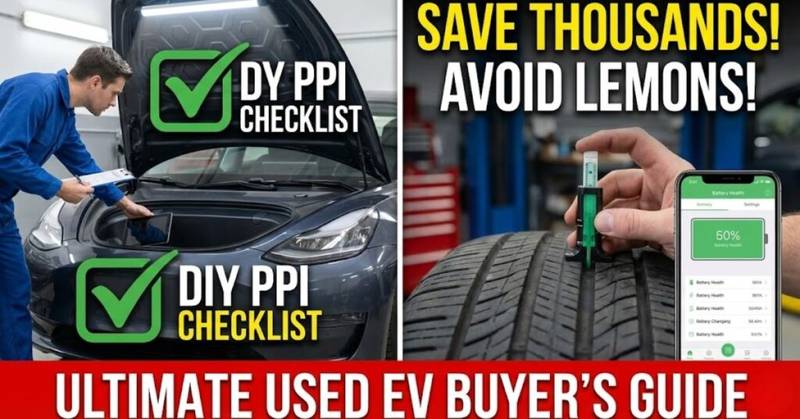
Stop kicking the tires. When you are buying a used electric car, the engine oil doesn’t exist, and the transmission fluid is minimal. The real risk isn’t under the hood; it is under your feet. This DIY used EV inspection checklist is designed to help you spot a $15,000 battery replacement bill or dangerous suspension wear before you sign the paperwork, all without hiring a mechanic.
The “Chemistry” Over The “Mechanical”
A clean vehicle history report doesn’t tell you if the battery cells are unbalanced or if the previous owner Supercharged the car to death every single day. While finding a bargain on a high-mileage EV is entirely possible—and often a smart financial move—it requires a specific eye. You need to look past the paint and check the chemistry.
Most buyers walk around the car, check for scratches, and maybe sit in the seats. That is how you buy a gas car. For an EV, you need to be smarter. This guide will turn you into a pro inspector in about 30 minutes.
“Pre-Flight” Gear List (Don’t Go Empty-Handed)
You wouldn’t buy a house without an inspection, so don’t buy an EV without these three simple tools. You don’t need a lift or a garage, just a few items you can carry in your pocket.
- An OBDII Dongle: This is non-negotiable. You need a Bluetooth scanner that plugs into the car’s port to talk to the battery management system (BMS). Brands like Veepeak or OBDLink CX are reliable choices for 2025.
- The Right App: Hardware is useless without software.
- For General EVs (Hyundai, Kia, Ford, VW): Car Scanner ELM OBD2 is excellent.
- For Nissan: LeafSpy is the gold standard.
- For Tesla: The “Scan My Tesla” app is powerful, though you can often get by with the built-in “Service Mode” (more on that below).
- Analog Tools: A bright flashlight (your phone is okay, a real torch is better), a small mirror for looking under the car, and a tire tread depth gauge.
The Battery (The $15,000 Question)
This is the most critical part of your inspection. If the battery is cooked, the car is worthless.
Step 1: The Dashboard “Quick Math” Check If you can’t plug in a scanner immediately, do the math. Charge the car to 100% if the seller allows it. If not, look at the current range estimate and the battery percentage. Formula: (Current Range / Current Battery %) * 100 Compare this projected total range to the original EPA rating for that specific model year. If the number is significantly lower (more than 15-20% drop), walk away.
Step 2: The OBD Deep Dive (SOH Reading) Plug your OBD2 dongle into the port (usually under the steering wheel). Open your app and look for one specific metric: SOH (State of Health).
- The Green Zone: SOH above 85% is excellent.
- The Caution Zone: SOH between 75% and 85% is average for older EVs but warrants a lower price.
- The Red Flag: SOH below 70%. Most manufacturer warranties trigger a replacement at 70% or 65%. If it’s close to this number and out of warranty, you are buying a ticking time bomb.
- Cell Voltage Deviation: Look for the “Delta” or difference between the highest and lowest cell voltages. A high deviation means you have “bad cells” dragging the whole pack down.
Step 3: The Tesla-Specific “Service Mode” Hack If you are looking at a Model 3 or Model Y, you might not even need a dongle.
- Go to Settings > Software.
- Press and hold the model name (e.g., “Model 3”) for 3 seconds, then release.
- Type “service” in the password box.
- Navigate to the High Voltage menu. While the full “Health Test” takes 24 hours, you can view live data immediately to see if there are any active alerts or BMS errors stored in the computer.
Tires & Suspension (The “Inner Edge” Killer)
EVs are heavy. A Tesla Model Y weighs significantly more than a Honda CR-V. This weight, combined with instant torque and factory negative camber (the wheels tilting inward for stability), shreds tires in a very specific way.
The “Kneel and Feel” Technique Do not just kick the tires or look at the outer tread. The outside can look brand new while the inside is worn down to the wire.
- Turn the steering wheel fully to one side.
- Kneel down and run your hand along the inner edge of the tire.
- If you feel smooth rubber, wires, or “cupping” (wavy bumps), the alignment is shot or the control arm bushings are worn out.
- Suspension Check: While you are down there, look for the control arms. Listen for “clunking” or “squeaking” over bumps during your test drive. Suspension components on EVs wear out faster than on gas cars due to the weight.
The Underbody (The Danger Zone)
The most expensive component of the car is sitting inches above the asphalt. One bad scrape over a speed bump or a rock can compromise the battery seal.
Use your flashlight and mirror to inspect the battery shield.
- Scrapes: Light scratches on the plastic or metal shield are normal.
- Dents: Deep dents that deform the metal are a major risk. They can press into the battery modules internally.
- Leaks: If you see any blue or green fluid dripping from the battery casing, run. That is battery coolant. A coolant leak inside the pack usually means a total battery replacement is needed.
Electronics & The “Heat Pump” Check
In an EV, the heater isn’t “free” waste heat from an engine; it uses energy.
The Heat Pump Test Turn the climate control to MAX HEAT and listen outside the car. You should hear the compressor humming (it sounds like a loud fridge). If the car uses a resistive heater (common in older models) or if the heat pump is broken, your winter range will plummet, and repairs can cost $2,000 to $4,000.
The “Phantom Touch” Test On cars with large touchscreens (especially older Teslas), go to a drawing app or drag an icon around the screen. If the icon “jumps” or drops, or if the screen registers touches you aren’t making, the digitizer is failing.
The Test Drive (Ears Open)
Turn the radio off. Electric cars are quiet, which makes it easier to hear problems.
The “Clicking” Test Drive the car in a tight circle (full lock left, then full lock right) at low speed in a parking lot. If you hear a rhythmic click-click-click, the CV joints are failing. This is common because the high torque of an electric motor puts immense stress on the axles.
Regen Braking Test Take your foot off the accelerator. The car should slow down smoothly. If the deceleration feels jerky, uneven, or if you hear a whining noise that changes pitch drastically, there could be an issue with the motor inverter or the regen calibration.
The Take
If the battery SOH is above 85%, the underbody shield is intact, and the inner tires have tread, you likely have a solid vehicle on your hands. Buying used is smart, but buying blind is a gamble you don’t need to take.
Found a car that passed this list but has high numbers on the odometer? Don’t panic. High mileage isn’t the dealbreaker it used to be. Read our guide on Buying a Used EV with Over 100k Miles to see why modern battery thermal management makes these cars reliable workhorses long after 100,000 miles.
Frequently Asked Questions
- How do I check battery health on a used EV? The most accurate method is using an OBD2 scanner with an app like LeafSpy or Car Scanner to read the SOH (State of Health) data directly from the BMS.
- What is a good SOH for a used electric car? Anything above 90% is like new. 80-90% is acceptable for a used car. Below 70% is generally considered end-of-life for the battery in terms of warranty standards.
- Does fast charging ruin the battery? Not necessarily. While excessive fast charging can accelerate degradation, modern thermal management systems protect the battery well. Focus on the SOH number rather than the charging history.
- Can I test a Tesla battery without an app? Yes, you can enter “Service Mode” via the main screen to view live high-voltage system data, though a full health test requires the car to be plugged in and sleep for 24 hours.