 Skip to content
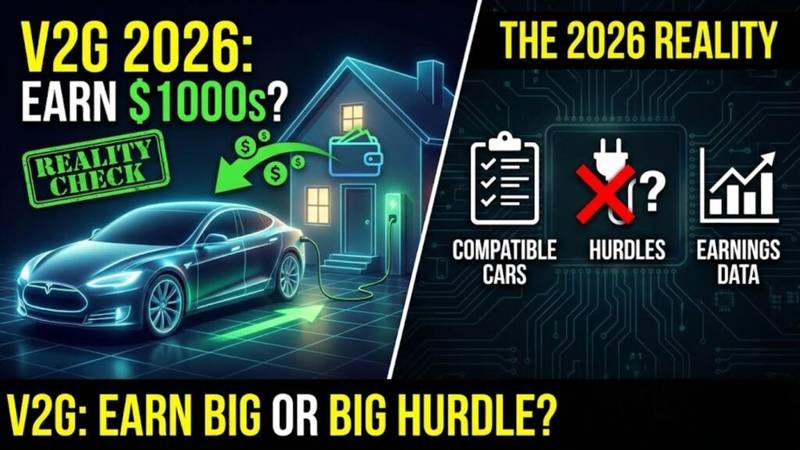
Your EV is sitting in the driveway with a 60–100 kWh battery. That is enough energy to power your entire home for three days or stabilize the local grid during a heatwave.
For years, we’ve been promised a future where your car pays for itself by selling electricity back to the utility companies. The 2026 reality? The technology works, the cars are here, but the paperwork is still stuck in 2010.
Before we dive into the hardware, let’s clear up the definitions that confuse almost everyone:
- V2L (Vehicle-to-Load): Camping mode. This allows you to plug a coffee maker or laptop into your car. It’s easy and standard on many modern EVs.
- V2H (Vehicle-to-Home): Backup power. If the grid goes down, your car powers your house. This is growing rapidly.
- V2G (Vehicle-to-Grid): The holy grail. Selling energy back to the utility for cash. This is the hard part.
The “Hardware” Reality: You Need Three Things
Most people think buying a “V2G Compatible” car is enough. It isn’t. You need a “Triad of Compatibility” where three distinct pieces of hardware shake hands perfectly. If one fails, you just have a very expensive parked car.
- The Car: It must have the bidirectional hardware (inverter capability) and the software unlocked to support the ISO 15118-20 standard.
- The Charger (EVSE): You cannot use a standard Amazon wall charger. You need a specialized Bidirectional DC charger (like the Wallbox Quasar 2) or an advanced AC solution (like the Enphase IQ Bidirectional). These units often cost $3,000+, not the standard $500.
- The Utility Meter: This is the gatekeeper. You need an interconnection agreement that allows “export,” similar to solar panels. Without this, your meter might flag your exported energy as tampering or simply not pay you for it.
The 2026 Compatibility Matrix
This table breaks down which cars can actually do what as of late 2025. Note that “Hardware Ready” means the car can do it, but might need a software update or a specific charger to unlock the feature.
| Make / Model | V2L (Device Power) | V2H (Home Backup) | V2G (Grid Export) | Connector Type |
| Ford F-150 Lightning | Yes (9.6kW) | Yes (Requires Charge Station Pro) | Limited (Pilot Programs) | CCS1 / NACS |
| Nissan Leaf | No | Yes (Proven tech) | Yes (Most established) | CHAdeMO (Legacy) |
| Tesla Cybertruck | Yes | Yes (Powershare) | Limited (Texas VPP Pilots) | NACS |
| Kia EV9 / EV6 | Yes | Yes (With Wallbox Quasar 2) | Hardware Ready (ISO 15118-20) | CCS1 / NACS |
| Hyundai Ioniq 5 / 6 | Yes | Yes (With Wallbox Quasar 2) | Hardware Ready (ISO 15118-20) | CCS1 / NACS |
| VW ID.4 / Buzz | No | Yes (2025+ Software) | Yes (Select EU/US Pilots) | CCS1 / NACS |
| Chevy Silverado EV | Yes | Yes (GM PowerShift) | Limited (Pilot Programs) | CCS1 / NACS |
The “Bureaucracy” Reality: Why You Can’t Just “Sell” Yet
If you have the car and the charger, why can’t you sell power today?
The Interconnection Nightmare:
Utilities treat a V2G car exactly like a solar farm. You need to file for an “interconnection agreement.” Because cars move, utilities are terrified of “double taxation” paying you for solar energy you grabbed at work and sold back at home.
The Standard War:
The industry has finally rallied around ISO 15118-20. This is the digital language that allows the car and grid to talk about prices securely. While cars are adopting it, charger manufacturers have been slower to roll out certified units. Until your charger speaks this language fluently, your utility won’t let you connect.
Follow the Money: Who is Actually Earning?
So, is anyone actually making the “thousands per year” we were promised? Yes, but it’s probably not your neighbor.
Commercial Fleets:
Electric school buses are the big winners. They have massive batteries, predictable routes, and sit idle during peak energy demand hours (summer afternoons). They are earning significant revenue in fleet V2G programs.
Residential Pilots (The Golden Tickets):
For regular drivers, earnings depend entirely on your zip code.
- Massachusetts (National Grid): The “ConnectedSolutions” program is the gold standard. It pays participants for discharging batteries during peak events.
- California (PG&E/SCE): The ELRP (Emergency Load Reduction Program) offers credits for reducing load, which V2G can participate in.
Earnings Estimate:
In 2026, realistic V2G earnings for a residential user are $300–$800/year. This usually comes in the form of bill credits, not a check in the mail. It is not an income stream; it is a cost-offset mechanism.
V2H is the Real “Killer App” for Now
While we wait for the utilities to sort out the V2G red tape, V2H (Vehicle-to-Home) is the real reason to buy bidirectional hardware today.
Forget earning $2 on a Tuesday afternoon. The real value is keeping your freezer running and your lights on during a 3-day blackout. A standard Ford F-150 Lightning can power a typical home for days. If you live in an area prone to storms or rolling blackouts, the “insurance value” of V2H outweighs the modest earnings of V2G.
Should You Wait?
If you are buying an EV solely to make money selling power to the grid, wait. The hardware costs for the charger (often $3,000+) will take years to recoup at $500/year in earnings.
However, if you want energy independence and blackout protection, buy now. Look for cars with ISO 15118-20 support (like the Kia EV9 or updated VW ID series) to ensure you are future-proof. By 2027, as NACS becomes standard and regulations mature, plugging in will likely automatically bid your energy into the market without you lifting a finger.
Confused about charging basics? Start with our Pillar Guide: Everything You Need to Know About EV Charging.
Frequently Asked Questions
- Which cars support V2G in 2026? The Nissan Leaf remains the most proven option, but the Kia EV9, Hyundai Ioniq 5/6, Ford F-150 Lightning, and VW ID.4 (with newer software) are the modern leaders using CCS/NACS standards.
- How much can I earn from V2G? Realistically, between $300 and $800 per year depending on your local utility’s specific programs (like ConnectedSolutions in Massachusetts).
- Does Tesla support V2G? Tesla’s Cybertruck supports “Powershare” (V2H/V2L). V2G (sending power to the grid) is currently limited to specific Virtual Power Plant (VPP) pilots, such as those in Texas, rather than being a standard feature for all users.
- What is the difference between V2H and V2G? V2H (Vehicle to Home) powers your specific house during an outage. V2G (Vehicle to Grid) sends power back through the utility meter to the general electric grid to earn credits.