 Skip to content
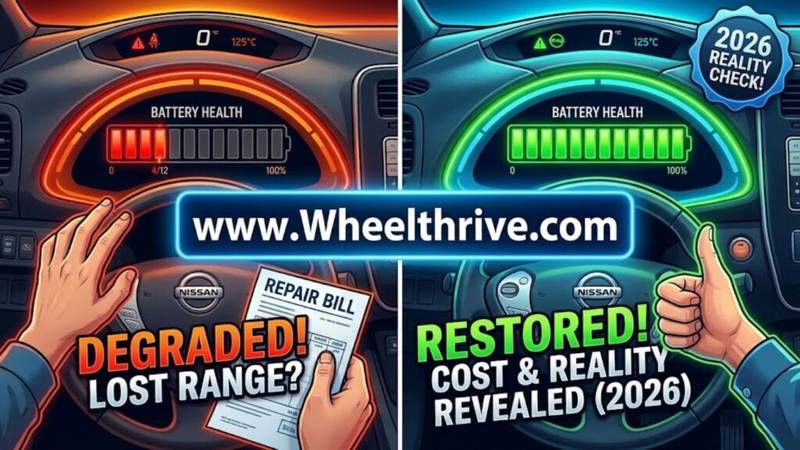
You cannot permanently “restore” Nissan Leaf battery health bars without replacing the physical battery cells. Software resets are temporary illusions. In 2026, the average nissan leaf battery replacement cost for a refurbished 24kWh pack ranges from $3,500 to $4,500, while a brand new 40kWh range-doubling upgrade costs between $8,000 and $12,000 installed.
If you are driving a 2011-2017 Nissan Leaf, you are likely staring at a dashboard that is missing a few “bars” and wondering where your range went. You might be hoping for a cheap software fix to bring those capacity bars back, or perhaps you are weighing the cost of a full replacement against the value of the car. Here is the reality of the market in 2026.
The “Health Bar” Obsession: What Do They Actually Mean?
Before you spend thousands, you need to understand the dashboard geometry. The 12-bar scale on your Leaf is a visualization of the State of Health (SOH) reported by the Battery Management System (BMS).
- 12 Bars: Indicates 100% down to approximately 85% SOH.
- 9 Bars: This is the critical warranty threshold, roughly equivalent to 66-72% SOH.
- The Drop: The first bar to disappear represents a massive 15% drop in capacity. Every subsequent bar represents roughly a 6.25% drop.
This means losing that first bar hurts the most psychologically and practically. However, these bars are just a display. They do not change the chemistry of the battery. If your battery is degraded, no amount of dashboard manipulation will put electrons back into the lithium.
The Myth of “Software Restoration” (Don’t Be Scammed)
There is a prevalent scam in the used EV market involving Nissan Leaf battery bar restoration via software. Unscrupulous sellers or misinformed mechanics use diagnostic tools (like the Nissan Consult or even the LeafSpy app) to perform a “BMS Reset.”
This tells the car’s computer to forget its historical degradation data and assume the battery is factory new. The result? The dashboard magically shows 12 bars again. The reality? You will drive about 20 to 50 miles, and as the voltage sags under load, the BMS will “relearn” the weak cells. The bars will drop rapidly back to their true level, often stranding drivers who thought they had more range. There is absolutely no software fix for chemical degradation.
2026 Replacement Cost Breakdown
If you need real range, you need real hardware. Below is the 2026 pricing landscape for replacing or upgrading a Nissan Leaf battery.
| Option | Capacity | Range Est. | Cost (Installed) | Warranty |
| Refurbished (Greentec) | 24 kWh | 70-80 mi | $3,500 – $5,000 | 12-36 Mos |
| New OEM (Nissan) | 40 kWh | 150 mi | $6,500 – $8,000 | Varies |
| Aftermarket Upgrade | 62 kWh | 220+ mi | $12,000 – $14,000 | 3 Years |
| Salvage Yard DIY | 24-30 kWh | Unknown | $1,500 – $3,000 | None |
For a broader context on how these prices stack up against other brands, you can compare these prices to other EV battery replacement costs in 2026 to see if the Leaf remains economical.
The “Upgrade” Path: 24kWh to 62kWh
The Nissan Leaf is unique because it is one of the few EVs that allows for significant backward compatibility. It is possible to take a Nissan Leaf 62kWh upgrade cost of around $12,000 and install a modern battery into a 2013 chassis.
This is not a “plug and play” swap. It requires a specialized piece of hardware called a “CAN-Bridge.” This device acts as a translator, taking the signals from the modern 2026 battery and translating them into a language the older 2013 car computer can understand. Furthermore, the 62kWh pack is physically thicker and heavier. Installers often need to add spacer kits to lower the battery mounting points and install stiffer suspension springs to handle the extra weight.
Is It Worth It?
- Yes: If your Leaf is in pristine condition and you want a 200-mile EV for $12,000—which is significantly cheaper than buying a new car.
- No: If your Leaf has rust, worn suspension, or interior damage. Investing $12k into a $2k chassis is rarely financially wise.
Warranty: The 8-Year/100,000 Mile Rule
Understanding the Nissan Leaf battery warranty 2026 landscape is critical before you pay out of pocket.
- 2011-2017 Models: These warranties have officially expired by time, regardless of mileage, unless a replacement was purchased recently that carried its own coverage.
- 2018+ Models: Many of these are still active. If you own a 2019 or newer Leaf and it drops to 9 bars (not 10 or 11), Nissan is contractually obligated to replace or repair the battery for free.
The Loophole: Nissan no longer manufactures the smaller 30kWh packs found in 2016-2017 models. If you have a warranty claim on one of these rare late-model units, Nissan often replaces it with a 40kWh pack, effectively giving you a free range upgrade.
Where to Buy? (Reputable 2026 Vendors)
You should avoid buying batteries from Craigslist unless you are a battery engineer. Stick to established vendors who offer warranty support.
- Greentec Auto: This is the largest nationwide chain specializing in hybrid and EV batteries. A Greentec Auto Leaf battery review typically highlights their strong warranty support and nationwide installation network.
- EV Rides (Portland): Known specialists in the 62kWh upgrade process, offering turnkey solutions for older Leafs.
- Recell: They focus on module replacement, which can be cheaper but carries higher long-term risks.
- Nissan Dealership: This is the most expensive route, but it guarantees you are getting brand-new OEM cells, not refurbished ones.
Is “Cell Replacement” (Module Swapping) Viable?
You might find offers to restore Nissan Leaf battery capacity bars by just replacing the “bad modules.” The concept is to open the sealed battery pack, identify the weak cells, and swap them out.
In practice, this is a game of “Whack-a-Mole.” When you introduce fresh, strong modules into a pack of old, weak modules, the voltage imbalance stresses the new cells. The BMS struggles to balance the pack, and often the new modules degrade rapidly to match the old ones. Unless you are selling the car immediately, module swapping is rarely a long-term fix for a daily driver.
Financial Analysis: Fix It or Junk It?
Before proceeding, do the math.
- Car Value (bad battery): ~$2,000
- Car Value (new battery): ~$6,000
- Cost of Battery: ~$5,000
- Net Result: You lose $1,000.
Replacing the battery only makes sense if you plan to keep the car for another 5+ years to save on gas. It does not add enough resale value to “flip” the car for a profit. If you decide to upgrade, make sure to check if the Used EV Tax Credit applies to upgrading your battery or if it’s better to just buy a newer used EV that already qualifies.
Frequently Asked Questions (FAQ)
Q: Can I use a Leaf battery for home solar storage?
- A: Yes! Old Leaf batteries are incredibly popular for DIY “Powerwall” projects because the modules are easy to reconfigure and don’t require liquid cooling systems, making them perfect for stationary storage.
Q: Why did my bars drop suddenly?
- A: A failing 12V accessory battery can sometimes confuse the BMS and cause erratic bar readings. Replace the small 12V battery ($150) before you panic about the main high-voltage pack.
Q: Does fast charging kill the battery?
- A: On the Nissan Leaf, YES. Unlike Teslas or Hyundais, the Leaf battery is air-cooled (passive). Frequent use of CHAdeMO fast chargers heats up the battery, cooking the chemistry and accelerating degradation.
Final Take
Don’t chase “bars” with software hacks; they are a mirage. Accept the degradation as part of the car’s lifecycle or budget for a proper hardware upgrade.
Check your VIN warranty status first. If your coverage is expired, get a quote from Greentec Auto before trading your Leaf in for scrap value.
For official terms, consult the Nissan Warranty Information Booklet. To monitor your real battery health beyond the dashboard bars, we recommend using the LeafSpy Pro app.