 Skip to content
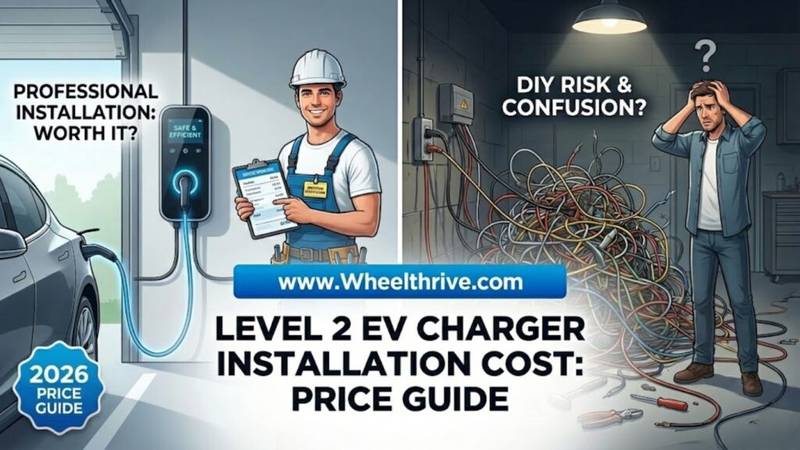
In 2026, the average cost to install a Level 2 EV charger at home ranges between $1,150 and $2,400. This includes the charger unit ($400-$700) and electrician labor ($750-$1,700). However, if your home requires a 200-Amp Panel Upgrade, expect the total cost to jump significantly to $3,800 – $5,500.
If you just bought an EV, you are probably tired of vague estimates like “it costs between $500 and $5,000.” That doesn’t help you budget. Below, we break down every line item—from the rising cost of copper wire to the specific permit fees you can expect this year.
Installation Cost Cheat Sheet
This table assumes a standard installation with a reputable licensed electrician.
| Cost Factor | Low End (Simple) | High End (Complex) |
| Charger Hardware | $400 (Basic) | $800 (Smart/Wi-Fi) |
| Electrician Labor | $750 (Next to panel) | $1,800+ (Long run) |
| Permits & Inspection | $50 | $350 |
| Materials (Wire/Conduit) | $150 | $600 |
| TOTAL ESTIMATED | $1,350 | $3,550 |
| (Note: These estimates do not include a Service Panel Upgrade) |
The “Big Ticket” Variables: Why Quotes Vary
Why did your neighbor pay $900 while you were quoted $2,800? It usually comes down to three factors.
1. Distance from the Panel
In 2026, the price of heavy-gauge copper wire remains high, costing roughly $2.00 – $2.50 per foot.
- Scenario A (Cheap): Your electrical panel is in the garage. The electrician only needs 5 feet of wire and conduit.
- Scenario B (Expensive): Your panel is in the basement on the opposite side of the house. The electrician has to drill through floor joists, fish wire behind drywall, or run conduit along the exterior siding.
- Scenario C (Very Expensive): You have a detached garage. This requires digging a trench, which adds labor and heavy-duty PVC conduit costs.
2. Electrical Panel Capacity (The $3,000 Surprise)
Most older homes (pre-1990) were built with 100-Amp service. A modern Level 2 EV charger requires a dedicated 50-Amp or 60-Amp breaker. If your panel is already “full” (running A/C, electric stove, dryer), you physically cannot add the charger safely.
- The Fix: A “Heavy Up” (Service Panel Upgrade) to 200 Amps.
- 2026 Cost: Expect to pay $2,500 – $4,500. This price varies wildly because sometimes the local utility company charges extra to run a new, thicker line from the street transformer to your house.
3. Trenching & Concrete Work
If you need to get power to a detached garage or a driveway post, you can’t just lay a wire on the grass.
- The Cost: Excavation generally costs $100 per linear foot. If you have to break up and repour a concrete driveway to cross it, add another $1,000 to the bill.
Hardwired vs. Plug-In (NEMA 14-50): Which is Cheaper?
Most people assume installing an outlet (plug-in) is cheaper. In 2026, Hardwiring is often the cheaper and safer option. Here is why:
Option A: NEMA 14-50 Outlet (Plug-In)
- Pros: Portable. If you move, you can unplug the charger and take it with you.
- Cons:
- GFCI Breaker Required: The 2026 NEC (National Electrical Code) requires a GFCI breaker for garage outlets. These breakers cost ~$150 (vs $20 for a standard one) and are prone to “nuisance tripping” because the EV charger already has internal GFCI protection.
- Industrial Outlet Needed: You cannot use a cheap $15 dryer outlet from Home Depot. EV charging runs at max power for hours. You must use an industrial-grade receptacle (Hubbell or Bryant) which costs **$80 – $100**, or you risk melting the plastic.
- Speed Cap: Plug-in chargers are limited to 40 Amps.
Option B: Hardwired (Direct Connection)
- Pros: Safer because there are fewer connection points to loosen or melt. Supports full 48-Amp charging, giving you faster speeds.
- Cons: It becomes a permanent fixture of the house.
- Verdict: Because you skip the expensive GFCI breaker and the expensive industrial outlet, hardwiring saves you money upfront and headaches later.
The 2026 Federal Tax Credit (IRS Form 8911)
The “Alternative Fuel Vehicle Refueling Property Credit” (30C) is still active, but the clock is ticking.
- Deadline: The credit expires on June 30, 2026.
- The Benefit: You can claim 30% of your installation and hardware costs, up to a maximum of $1,000.
- The Catch: As of the 2024/2025 rule changes, you typically must live in a “Non-Urban” or “Low-Income” census tract to qualify. Many suburban homeowners no longer qualify.
- Action: Use the DOE Mapping Tool to check your address before factoring this into your budget.
Permit Costs: Do You Really Need One?
The Answer: Yes.
The Risk: If your garage catches fire due to an unpermitted electrical modification, your home insurance provider can legally deny your claim. It is not worth saving a few dollars to risk your biggest asset.
Average Cost: $50 – $250, depending on your municipality. Read more about specific permit costs and inspection requirements in major cities. Costs vary by state. See our EV charger permit cost guide for CA, TX, and FL.
DIY vs. Hiring a Pro
Can you install it yourself?
- Simple NEMA 14-50: Maybe, if you are comfortable working with 240V systems and know how to torque screws to spec.
- Hardwire/Panel Upgrade: Absolutely Not.
- Safety Warning: One loose connection on a circuit running a 40A continuous load will generate immense heat and cause a fire. Licensed electricians carry insurance for this exact reason.
Frequently Asked Questions
Q: Does a Tesla Wall Connector cost more to install?
- A: No. In fact, many electricians prefer them because they have a spacious internal design that makes wiring easier.
Q: Can I install a charger on a 100-amp panel?
- A: Maybe. If your load calculation shows you are maxed out, you can use a “Load Management System” (like the DCC-9 or Emporia Vue). This device monitors your panel and cuts power to the EV charger if you turn on the electric stove or dryer, preventing the main breaker from tripping. These units cost roughly $800 plus installation.
Q: How long does installation take?
- A: A standard run takes 4-6 hours. A full panel upgrade is a heavy job that will take a full day, and your power will be out during that time.
Before installing, compare the Tesla Wall Connector vs. ChargePoint vs. JuiceBox.
Conclusion
Budget $2,000 to be safe. If you don’t need a panel upgrade, you’ll be pleasantly surprised when the quote comes in lower.
Get at least 3 quotes from Qmerit certified installers or highly-rated local electricians. Ask specifically: “Does this quote include the permit fee?” to avoid hidden costs later.
For tax credit details, see IRS.gov Instructions for Form 8911. To check your census tract eligibility, use the Department of Energy (DOE) mapping tool.