 Skip to content
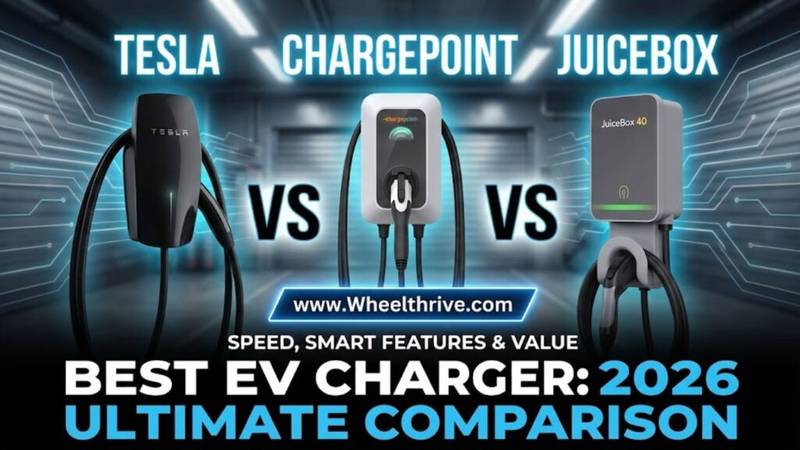
In 2026, the Tesla Universal Wall Connector is the best overall choice due to its integrated “Magic Dock” adapter that charges both NACS and J1772 vehicles effortlessly. ChargePoint Home Flex remains the top pick for data lovers needing detailed utility tracking. JuiceBox should be avoided entirely following Enel X Way’s exit from the North American market.
If you are reading old reviews from 2024, you are getting dangerous advice. The market has shifted dramatically. One of the formerly top-rated chargers is now a “zombie product,” and Tesla has opened its walled garden to everyone. Here is the definitive guide to spending your money wisely this year.
Quick Verdict
We compared hardware reliability, app support, and future-proofing to rank these three units.
| Feature | Tesla Universal Wall Connector | ChargePoint Home Flex | JuiceBox 40/48 |
| Best For | Most Drivers (Mixed EV Households) | Data Nerds & Cold Climates | NOBODY (Do Not Buy) |
| Connector | Universal (NACS + J1772) | Selectable (NACS or J1772) | Legacy J1772 |
| Max Speed | 48 Amps (11.5 kW) | 50 Amps (12 kW) | 40 Amps (9.6 kW) |
| App Quality | Excellent (Tesla App) | Superior (Cost Tracking) | Broken / Unsupported |
| Price | ~$595 | ~$599 | ~$549 |
The “JuiceBox” Warning: Why It’s Disqualified
Let’s address the elephant in the room. You might see JuiceBox 40 listed as a “Top Pick” on other sites that haven’t updated their affiliate links. Do not buy this charger.
The Competitor Gap:
In late 2024, Enel X Way (the parent company of JuiceBox) officially exited the North American residential charging market.
- No Support: Customer service operations have ceased. If your unit breaks, there is no warranty support.
- Zombie Software: While the servers are currently being kept alive by a third-party interim solution (VoltiE), the long-term viability of the app is shaky at best. Smart features like scheduling and load sharing could vanish overnight.
- The Verdict: Buying a JuiceBox in 2026 is buying hardware with an expiration date.
Tesla Universal Wall Connector (The Winner)
Tesla has solved the biggest headache of EV ownership: “Which plug do I need?”
Why it Wins in 2026:
- The “Magic Dock”: This is the killer feature. The unit has a NACS (Tesla) plug, but a J1772 adapter is permanently built into the handle. If you press the button on the handle, it releases just the NACS plug for a Tesla or Rivian. If you grab the handle firmly, it brings the adapter with it for a Ford or Audi. You never lose the adapter because it’s part of the dock.
- Ecosystem: It integrates seamlessly with the Tesla App, which 50% of EV owners already use. You don’t need a second login.
- Powersharing: It has best-in-class ability to link up to 6 chargers on one circuit via Wi-Fi. This is critical for households that are buying their second EV but don’t have the panel capacity for two 50-amp circuits.
Warning: older units may experience the Tesla Wall Connector 3 red blink error.
ChargePoint Home Flex (The Runner Up)
If Tesla wins on hardware, ChargePoint wins on software and ruggedness.
Why Choose This Instead?
- The Cable: ChargePoint uses a premium “cold weather” cable that stays flexible even at -20°F. Tesla’s cable is thinner and tends to get stiff and difficult to coil in freezing garages.
- The App: ChargePoint’s app is better at calculating exact costs. You can select your specific utility rate plan (e.g., PG&E EV-A), and it will tell you exactly how much you spent charging down to the penny. Tesla’s app estimates this, but ChargePoint’s is granular.
- The NACS Dilemma: Unlike Tesla’s universal solution, you have to choose at purchase whether you want the NACS cable or J1772 cable. You can swap them later, but it requires buying a $200 conversion kit.
Head-to-Head Feature Matrix
1. Charging Speed (Amperage)
- Tesla: 48 Amps (11.5 kW). This requires a hardwired connection to a 60-amp breaker.
- ChargePoint: 50 Amps (12 kW). Technically faster, but the real-world difference is negligible (it adds maybe 1 mile more per hour of charging). Both will charge any modern EV overnight easily.
2. Installation Flexibility
- Plug-In (NEMA 14-50): ChargePoint is the winner here. It comes with a high-quality NEMA 14-50 plug attached. You can mount it and plug it in yourself.
- Hardwiring: Tesla’s Universal connector comes ready to hardwire (no plug included). We generally recommend hardwiring for safety as it eliminates a failure point (the receptacle) that can melt under continuous load. hardwiring affects the final cost to install your Level 2 charger.
3. The “NACS” Factor in 2026
In 2026, almost every major manufacturer (Ford, GM, Rivian, Hyundai) is switching to the NACS port.
- Future Proofing: If you buy a charger with a J1772 plug today, you are buying a legacy product. You will need an adapter for your next car. This is why the Tesla Universal is the smartest buy—it covers the cars of the past (J1772) and the cars of the future (NACS) without loose dongles.
Who Should Buy What? (Scenarios)
Scenario A: You own a Tesla and a Rivian (Both NACS).
- Buy: Tesla Wall Connector (Standard NACS). You don’t need the Universal adapter since both cars use the NACS port. Save the $100 price difference.
Scenario B: You own a Tesla and a Jeep 4xe (NACS + J1772).
- Buy: Tesla Universal Wall Connector. It handles the Tesla natively and the Jeep via the Magic Dock without you ever having to hunt for a loose adapter in the trunk.
Scenario C: You live in Canada/Minnesota and park outside.
- Buy: ChargePoint Home Flex. The cable durability in deep frost is unmatched, and the app is excellent for tracking energy usage in extreme weather.
Frequently Asked Questions (FAQ)
Q: Can I use the Tesla Wall Connector if I don’t own a Tesla?
- A: Yes! The “Universal” model works on any EV. You can use the Tesla App just to set up the Wi-Fi and configure the amperage. You do not need to own a Tesla car to use their charger.
Q: Is JuiceBox coming back?
- A: Unlikely. While the brand assets are being managed by third parties, the “smart” features are effectively on life support. There is no development team pushing updates for new features or security patches.
Q: Does ChargePoint work with Tesla?
- A: Yes, perfectly. You can order it with a NACS plug, or use the J1772 adapter that came with your Tesla.
Summary
The EV charging market has consolidated. For 2026, the Tesla Universal Wall Connector is the safest, most versatile investment for your home. It eliminates “adapter anxiety” and works with every car on the road.
Don’t get stuck with a bricked charger. Check the latest price on the Tesla Universal Connector here, and avoid the clearance sales on JuiceBox at all costs.
For detailed specs, visit the Tesla Shop. To see if your utility covers the cost, check the ChargePoint Rebate Finder.