 Skip to content
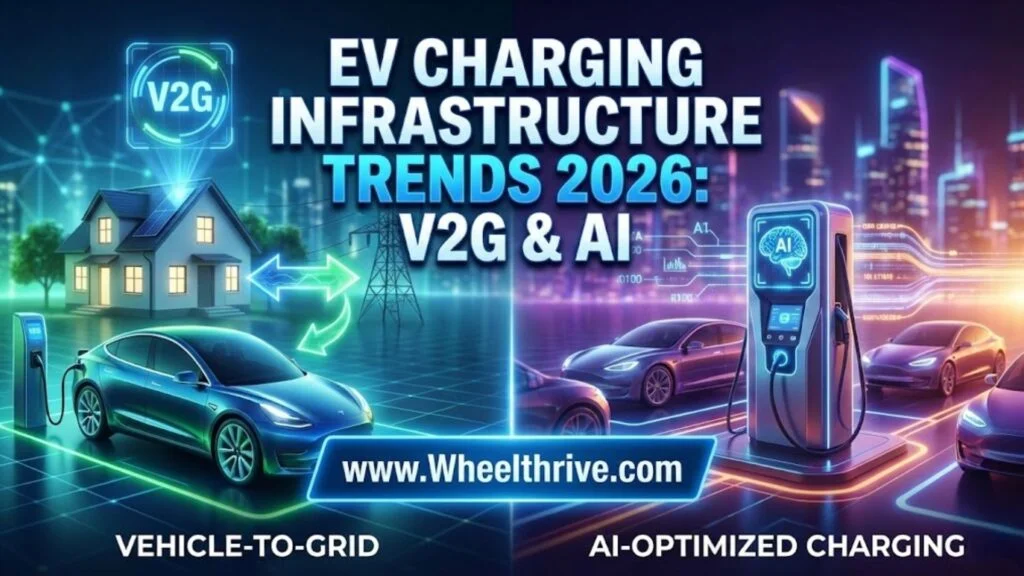
In 2026, EV charging infrastructure is shifting from simple “refueling” to active energy management. Key trends include Vehicle-to-Grid (V2G) turning fleets into revenue-generating Virtual Power Plants, AI algorithms optimizing dynamic pricing to slash demand charges, and the commercial rollout of Megawatt Charging Systems (MCS) for heavy-duty trucking.
Trend 1: V2G Goes Mainstream (From “Smart” to “Bidirectional”)
For years, “Smart Charging” (V1G) meant unidirectional control delaying your charge until 2:00 AM when rates were low. In 2026, we are witnessing the mass commercialization of V2G (Vehicle-to-Grid), where energy flows both ways.
The Business Case: Virtual Power Plants (VPP)
The biggest driver for 2026 is not altruism; it is revenue. Fleet managers are discovering that a school bus or delivery van parked for 12 hours a day is a stranded asset. By aggregating 50 parked buses into a Virtual Power Plant, operators can sell power back to the grid during peak demand windows (typically 4 PM – 9 PM).
- Revenue Potential: Industry data suggests that in 2026, aggressive V2G participation can offset fleet lease costs by 10-15%. This is achieved through “revenue stacking”—combining arbitrage (buying low/selling high) with frequency regulation payments from utility providers.
- Hardware Readiness: The hardware barrier has fallen. Thanks to the widespread adoption of the ISO 15118-20 communication standard, “Plug & Charge” bidirectional capabilities are now standard on most Tier 1 commercial chargers.
- The trend is moving toward smart units like those in our Tesla vs. ChargePoint comparison.
Trend 2: AI & Predictive Maintenance
The “reliability crisis” of 2023–2024, where public chargers were frequently broken, is being solved by Artificial Intelligence. In 2026, charging networks are becoming Self-Healing.
The Mechanism: Predictive vs. Reactive
Old systems relied on a driver calling a support number to report a broken screen. The 2026 standard is AI-driven telemetry.
- AI Diagnosis: Algorithms analyze millisecond-level data—voltage fluctuations, internal fan speeds, and cable heat profiles.
- The Result: The system predicts a hardware failure weeks before it happens. A technician is dispatched to replace a degrading capacitor before the unit goes offline, pushing network uptime targets toward 99.9%.
Dynamic Pricing 2.0
AI is also revolutionizing cost management. Instead of simple Time-of-Use (TOU) tariffs, 2026 algorithms adjust pricing in real-time based on local grid strain and renewable availability. This incentivizes automated fleets to charge precisely when the wind is blowing or the sun is shining, slashing demand charges for operators.
Trend 3: Megawatt Charging Systems (MCS) for Heavy Duty
While passenger cars are fighting over NACS plugs, the heavy-duty sector has launched its own revolution: the Megawatt Charging System (MCS).
The Technology: 1,000+ kW Speeds
Standard CCS chargers max out at 350 kW. MCS is designed to deliver 1.2 megawatts (1,200 kW) and beyond. This serves a critical logistical need: the “45-Minute Rule.”
The 2026 Milestone
In the EU and parts of North America, truck drivers are legally mandated to take a 45-minute break every 4.5 hours.
- The Use Case: MCS allows a Class 8 electric semi (like the Tesla Semi or Volvo VNR Electric) to recharge from 10% to 80% within that mandatory break window.
- Infrastructure Impact: These stations are beasts. A single MCS stall draws as much power as a small factory. This is driving a secondary trend of installing massive on-site battery buffers (stationary storage) at truck stops to prevent these megawatt spikes from crashing the local grid.
Trend 4: Wireless Charging (Inductive) Finds its Niche
For years, wireless charging was dismissed as inefficient and expensive. In 2026, it has found its “Killer App”: Robotaxis.
The Niche: Autonomous Fleets
Autonomous vehicles (AVs) cannot plug themselves in. While robotic arms exist, they are mechanically complex and prone to failure. Inductive charging mats allow robotaxis to simply drive over a pad and “graze”—charging in short, high-power bursts at taxi stands—without human intervention.
Efficiency Breakthroughs
Forget the old “70% efficiency” myths. Modern magnetic resonance technology, utilizing silicon carbide (SiC) inverters, is now hitting 93%+ efficiency. This puts it nearly on par with wired charging, removing the energy-loss penalty that held the technology back.
Trend 5: The “Cable Convergence” (NACS is King)
The “Plug War” is effectively over. By 2026, the transition to the North American Charging Standard (NACS / J3400) is largely complete for new vehicle manufacturing.
- Native Support: We are seeing the first wave of non-Tesla vehicles (like the 2026 models from Stellantis, GM, and Ford) shipping with native NACS ports.
- Infrastructure Simplification: The era of carrying bulky adapters is ending. Public infrastructure is aggressively retrofitting to NACS-first cables, relegating CCS1 to a legacy role. This standardization significantly lowers the “friction” for new EV buyers, who no longer have to worry if the plug will fit. Consider V2G readiness when calculating your home charger installation costs.
Frequently Asked Questions
- Will V2G degrade my battery? Surprisingly, no. Studies indicate that intelligent V2G management—which keeps the battery hovering at an optimal mid-range State of Charge (e.g., 50%) rather than sitting at 100% full can actually extend battery calendar life.
- Is wireless charging safe? Yes. 2026 wireless standards include robust Foreign Object Detection (FOD). If a metal object (like a coin) or a living creature (like a cat) moves between the charging pads, the system cuts power in milliseconds to prevent heating.
- Can older EVs use Megawatt Charging (MCS)? No. MCS uses a completely different, triangular physical connector designed for liquid cooling and massive amperage. It is physically incompatible with CCS or NACS ports found on passenger cars.
Summary
The “wild west” of early EV adoption is over. The trends of 2026 define an era of Interoperability and Grid Integration. Your EV is no longer just a car; it is a grid asset that can stabilize the network and generate income.
Fleet managers: audit your 2026 procurement strategy. If your chargers aren’t V2G-ready, you are leaving free revenue on the table.