 Skip to content
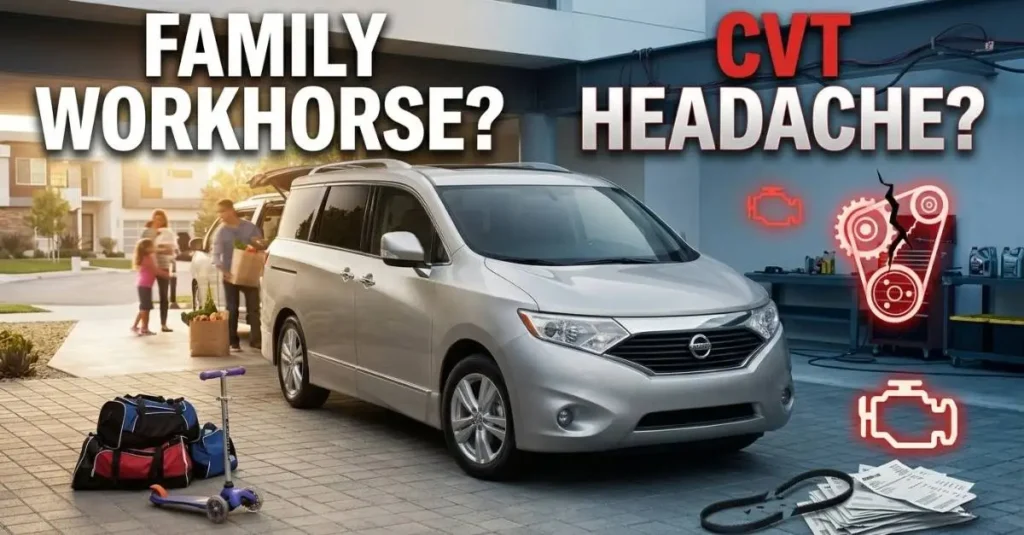
If you’re eyeing a Nissan Quest van in the UAE, here’s the short version: it can be a very cheap, very comfortable people‑mover, if you buy the right model and treat the CVT gearbox like a ticking bomb that needs constant care.
That’s the trade. Big space and low price, paid for with a bit of mechanical paranoia.
My quick take after actually living with one
A few years ago, I helped a friend in Sharjah hunt down a 2014 Nissan Quest LE imported from the US. It had around 160,000 km on the clock, full service history, and a nervous seller who clearly knew the reputation of Nissan CVTs.
We did the boring stuff: proper inspection, transmission scan, long test drive on Emirates Road at 120 km/h. Then we bought it, changed all fluids, fitted an extra CVT cooler, and treated that gearbox like gold.
Two years later:
- Four kids, daily school runs, and grocery trips.
- Regular Dubai–Al Ain drives with the van loaded.
- No transmission failure, no scary warning lights.
Was it perfect? No. Interior plastics aged faster than in a Toyota. But for what he paid versus a Sienna or Odyssey, the numbers still make sense.
That’s the lens I’m writing from. Not brochure talk. Real UAE use.
What the Nissan Quest van actually is
Forget the old boxy versions for a second. The one that matters in the UAE market is the fourth generation (2011–2017) that most importers bring in.
Key facts:
- Body style: 7‑seater minivan
- Engine: 3.5L V6 (around 260 hp) across the 2011–2017 run
- Gearbox: CVT (continuously variable transmission) only
- Drive: Front‑wheel drive
- Seating layout: 2–2–3 with captain chairs in the second row on most trims
Production ended after 2017, so every Quest you see here is used, usually a US or Canadian import.
Why you barely see Quest vans in Dubai and Abu Dhabi
Two simple reasons:
- It was never a GCC flagship. Nissan Middle East pushed Patrol, X‑Trail, Altima and friends. The Quest was mainly a North American product.
- People in the UAE gravitate to SUVs. If you say “family car”, most buyers jump straight to Prado / Pilot / Pathfinder, not a van.
Because of that, the Quest sits in this odd spot where:
- Supply is limited but demand is even smaller.
- Prices on the used market stay soft compared to Toyota and Honda vans.
On sites like YallaMotor you’ll see 2013–2016 Quests floating in the AED 20k–25k range depending on mileage and spec noticeably cheaper than similar age Siennas and Odysseys.
If you’re value hunting, that alone should get your attention.
Space, comfort and family usability
On the stuff families actually care about, the Quest punches hard.
Seating and space
- Proper 7‑seater with adult‑usable third row. Not kid‑only punishment seats.
- Second‑row captain chairs make it much easier to strap kids in and move between rows.
- Flat floor, wide sliding doors, and a naturally low step in height older parents and toddlers both appreciate that.
Cargo and flexibility
Numbers vary slightly by year, but for the 2017 model you’re looking at roughly:
- ~25–26 cu ft of cargo behind the third row. Good for weekly shopping or a couple of big suitcases.
- Over 100 cu ft with rear rows folded, which is “I’m moving apartment and don’t want to pay a truck” level of space.
Drop the third row, keep the captain chairs, and you’ve basically got an airport shuttle layout.
Comfort
- The V6 is smooth and fairly quiet at highway speeds.
- Suspension tuning is soft by design, so speed bumps in Sharjah and internal roads in Ajman aren’t a spine workout.
- And the big one for our region: the AC is strong. Even the older third‑gen Quest had a reputation for serious cooling, and the 2011+ models keep that tradition.
If your life is school runs, weekend trips to Ras Al Khaimah, and airport pickups, the Quest fits that use‑case naturally.
Fuel use vs UAE petrol prices
Let’s get the boring math out of the way.
The 3.5L V6 in the 2011–2017 Quest returns about 20 mpg city / 27 mpg highway in US testing, roughly 11.8 / 8.7 L per 100 km.
With March 2026 UAE prices for Special 95 hovering around 2.48 AED per litre, you’re looking at:
- Roughly 0.30–0.35 AED per km in mixed city use.
- Closer to 0.25 AED per km on longer highway runs if you drive calmly.
That’s more than a 2.5‑litre four‑cylinder crossover, but lower than a Patrol or other thirsty V8 SUVs many families still daily‑drive.
If you’re replacing a big SUV with a Quest, your fuel bill probably dips. If you’re coming from a Corolla, it goes up. Simple.
The elephant in the room: CVT reliability
Let’s talk about the thing that scares off half the buyers.
Nissan’s CVTs from this era have a mixed record. Some owners sail past 250,000 km. Others cook a transmission before 150,000 km. Reports of overheating, shuddering under load, and early failure show up repeatedly across multiple models, including the Quest.
Certain years are flagged more often than others. 2004–2009 Quests are old enough now that any weak box has either died or been replaced, while some early fourth gen years show patterns of CVT issues as mileage climbs.
Here’s what that means for you in the UAE heat.
How CVT problems usually start
Patterns I’ve seen (and what forum owners describe):
- Slow, rubber‑band feel under acceleration that gets worse over time.
- Whining noise that rises with speed.
- Sudden drop in power and the car refusing to rev CVT going into “protect” mode.
- Warning lights and codes like P1778 pointing to pressure or step motor problems.
Push that long enough, you’re talking full transmission replacement or major rebuild, which can wipe out whatever “bargain” price you paid.
Can you reduce the risk? Yes, but you have to be disciplined
If you do go for a Quest, treat the transmission as a component that needs active protection:
- Aggressive fluid changes. Ignore long‑life claims. Do CVT fluid every 40–50k km, sooner if the previous owner was lazy. Use the correct Nissan‑spec fluid.
- External cooler. Heat kills transmissions. In our climate, fitting an extra CVT cooler is cheap insurance, especially if you tow a small trailer or drive heavily loaded a lot.
- Drive it like a van, not a sports car. Hard launches and constant kick downs stress the belt and pulleys. Smooth throttle is your friend.
- Scan before you buy. On a pre‑purchase inspection, insist the workshop scans for transmission codes and does a long test drive at operating temperature. Any shudder or delay? Walk.
Does this guarantee zero issues? No. But it heavily tilts the odds in your favour, which is all you really get with any used CVT Nissan.
How the Quest compares to Sienna and Odyssey in the UAE
Most buyers cross‑shop three names: Nissan Quest, Toyota Sienna, Honda Odyssey.
Quick comparison for the UAE context:
- Price: Quest is usually the cheapest, then Odyssey, with Sienna often the most expensive on the used market for similar age/mileage.
- Reliability: Sienna wins. Odyssey next. Quest trails because of the CVT history.
- Comfort and space: All three are roomy; Quest’s interior feels a bit more “living room” than Toyota’s slightly more utilitarian approach, but that’s subjective.
- Parts and resale: Toyota and Honda have the edge. Workshops see them daily. Resale liquidity is higher. Quest is more niche.
So why would someone still pick a Quest? Because if you find a clean one, you can often buy a newer model year with better spec for the same money as an older Sienna/Odyssey. For some people that trade is worth it.
Buying a mini Nissan Quest van in the UAE without getting burned
If you’re serious, treat shopping for a Quest minivan like a small project, not an impulse.
1. Start with the right generation and spec
- Focus on 2011–2017 models. They offer the best blend of safety tech, comfort, and parts availability.
- Higher trims (SV, SL, LE) often come with nicer interiors, power sliding doors, and better audio. Just remember more gadgets can also mean more things that age badly.
2. Check the import story
Most Quests here are American imports. Get the VIN, pull a report, and look for:
- Accident history (especially front‑end hits that might have affected the drivetrain).
- Odometer inconsistencies.
- Flood or salvage titles—big red flag for electrical gremlins later.
3. Get a proper inspection, not a quick look
Insist on a full check at a workshop that actually understands Nissan CVTs. Ask them specifically to:
- Scan for codes while the transmission is hot.
- Measure fluid condition (colour, smell, level).
- Test drive on highway and in stop‑and‑go traffic.
If the seller resists, that tells you all you need to know.
4. Budget for a “reset” service
Even if the car feels fine, assume you’ll spend a few thousand dirhams right after buying on:
- Engine oil and filters.
- CVT fluid and maybe a cooler.
- Brake pads and# Nissan Quest Van in the UAE: Hidden Bargain or Headache on Wheels?
If you’re hunting for a Nissan Quest van in the UAE, here’s the short answer:
it can be a very cheap, very comfortable family hauler if you buy the right year, accept the CVT gearbox’s quirks, and treat maintenance seriously.
If you want zero drama and bullet‑proof resale, it’s the wrong van.
Let’s be honest about it.
So… is the Nissan Quest van worth it in the UAE?
If you want a big, comfortable family box on wheels for as little cash as possible, and you’re willing to treat the CVT with respect, the Nissan Quest can be a very smart left‑field choice here.
You’ll get space, cold air, and motorway comfort that makes school runs and airport drop‑offs feel easy instead of exhausting.
But if your stomach drops every time you hear the word “CVT”, or you see cars mainly as assets to flip later at a strong price, you’ll sleep better in a Sienna, Odyssey, or even a more common SUV.
So ask yourself: are you okay owning the slightly odd minivan no one else noticed on the classifieds because you understood what you were buying?