
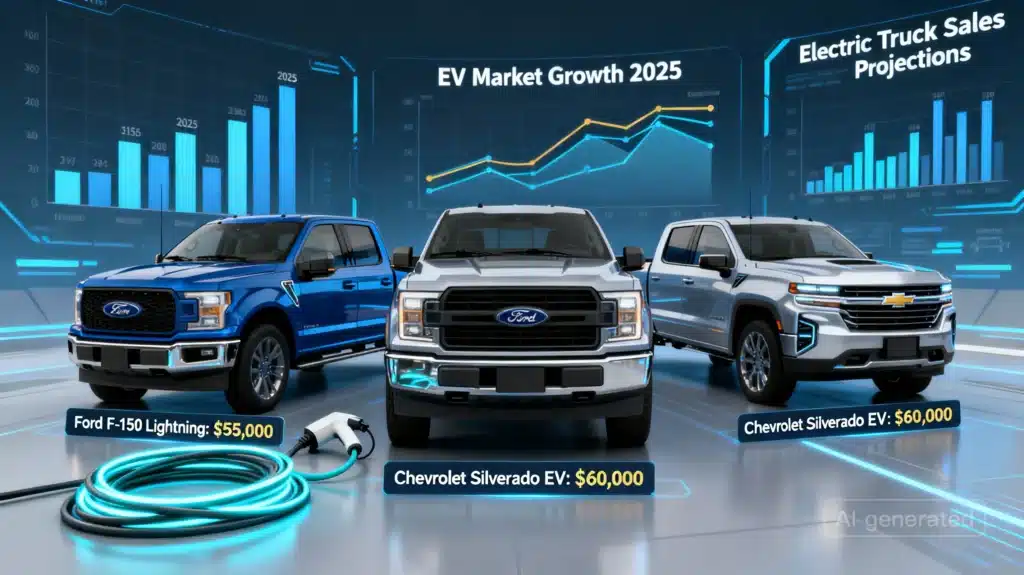
The search for an affordable electric truck in 2025 reveals a complex market landscape where “affordable” remains a relative term. While the electric vehicle industry continues to expand rapidly, with electric truck sales surging nearly 80% in 2024, finding a truly budget-friendly option requires managing expectations and understanding what the current market offers versus what’s coming soon.
For buyers entering the market today, the Ford F-150 Lightning stands as the most accessible mainstream option, with work-oriented trims starting around $49,780. However, the truly transformative shift toward affordability lies just beyond the horizon, with Ford’s upcoming compact EV truck targeting a remarkable $30,000 price point and the innovative Slate EV promising to deliver an electric pickup for under $27,500 before incentives. These forthcoming models represent a fundamental reimagining of what an electric truck can be, prioritizing essential functionality over luxury features to achieve price points that could finally democratize electric truck ownership.
Affordability in Today’s Electric Truck Market
The electric truck segment has experienced unprecedented growth, with the global market valued at $852.5 million in 2024 and projected to reach $6,652.6 million by 2033, exhibiting a compound annual growth rate of 25.6%. Despite this expansion, affordability remains elusive for most American buyers. The average transaction price for new vehicles in the United States hovers around $49,100, while electric vehicles command an additional $8,000 premium.
When examining the current electric truck lineup, the pricing reality becomes stark. The most affordable electric truck available today is the Ford F-150 Lightning Pro, with a manufacturer’s suggested retail price starting at $49,780. This positions it as the sole entry-level option among current production electric trucks, with competitors like the Chevrolet Silverado EV starting at $57,095, the GMC Sierra EV at approximately $62,400, the Rivian R1T at $70,990, and the Tesla Cybertruck at $72,235.
Market analysts from Cox Automotive note that a decade ago, budget-conscious buyers had 43 different vehicle models available for under $25,000. Today, that number has dwindled to just five, and none are electric. This scarcity of affordable options has created intense consumer demand for lower-priced electric trucks that can compete with traditional gasoline-powered vehicles.
Ford F-150 Lightning: The Most Accessible Electric Truck Today
The Ford F-150 Lightning represents the current gold standard for affordability in the electric truck segment, offering multiple trim levels to accommodate different budgets and needs. The Pro trim, designed specifically for commercial fleets and work applications, serves as the entry point at $49,780. This work-focused variant delivers 452 horsepower from dual electric motors and provides an EPA-estimated 240 miles of range with the standard battery configuration.
For retail consumers seeking additional comfort features, the F-150 Lightning XLT starts at $63,345, while the Flash trim begins at $69,995. Higher-end configurations include the Lariat at $76,995 and the Platinum at $84,995. Each trim level offers distinct value propositions, with the standard-range battery providing 240 miles of range and the extended-range battery extending that to approximately 320 miles.
The Lightning’s performance capabilities rival many sports cars, with the extended-range battery variants achieving 0-60 mph times under 4 seconds. Beyond raw acceleration, the truck offers practical features that justify its premium over gasoline alternatives, including the ability to power a home for up to three days during outages through its onboard power system. Towing capacity reaches up to 10,000 pounds with the Max Trailer Tow package and extended-range battery, while payload capacity exceeds 2,000 pounds in certain configurations.
Industry experts consistently rank the F-150 Lightning as the most affordable option among electric pickup trucks. Its pricing strategy reflects Ford’s understanding that the transition to electric vehicles requires accessible entry points, particularly in the truck segment where traditional F-150 buyers expect exceptional value and capability.
Chevrolet Silverado EV: Premium Features at Premium Prices
The Chevrolet Silverado EV entered the market positioning itself as a technology-forward alternative to the F-150 Lightning, though at a significantly higher price point. The 2025 Silverado EV starts at $57,095 for the base Work Truck configuration, representing a $7,315 premium over the comparable Ford Lightning Pro.
However, this higher initial investment delivers compelling advantages in specific areas. The Silverado EV offers substantially greater range than its Ford competitor, with the extended-range variants providing up to 408 miles and the Max Range configuration achieving an impressive 460 miles on a single charge. This represents more than 140 additional miles compared to the F-150 Lightning’s maximum 320-mile range.
Charging speed presents another area where the Silverado EV demonstrates technical superiority. With support for 350-kW DC fast charging, the Silverado can add approximately 100 miles of range in just 10 minutes, compared to the Lightning’s 150-kW maximum charging capability. This faster charging becomes particularly valuable for owners who regularly undertake long-distance trips or require rapid turnaround times.
The Silverado EV’s innovative Multi-Flex Midgate system provides unprecedented cargo versatility, allowing the rear panel separating the bed from the cabin to be removed, creating a continuous load floor measuring up to 10 feet, 10 inches. This feature addresses a unique capability gap that the F-150 Lightning simply cannot match.
Despite these advantages, test drivers consistently note that the Silverado EV’s enormous 205-kWh battery contributes to a curb weight of 8,780 pounds, making it feel “ponderous, harsh and skittish” compared to the lighter, more refined F-150 Lightning. The Lightning’s 6,850-pound curb weight provides more car-like handling characteristics while still delivering exceptional truck functionality.
For budget-conscious buyers, the Silverado EV’s higher pricing places it outside the “affordable” category, even as it offers compelling technological advantages that may justify the premium for specific use cases requiring maximum range and rapid charging.
Rivian R1T: Premium Adventure Truck Pricing
The Rivian R1T occupies a distinct position in the electric truck market, targeting adventure-oriented buyers willing to pay premium prices for exceptional off-road capability and cutting-edge technology. The 2025 R1T starts at $70,990 for the Dual Standard configuration, placing it more than $20,000 above the entry-level F-150 Lightning.
This significant price premium reflects Rivian’s positioning as a premium brand rather than a value-oriented option. The R1T offers three battery configurations: the Standard pack providing 258 miles of range, the Large pack extending to 330 miles, and the Max pack delivering an impressive 420 miles. The tri-motor variant starts at $100,990, while the flagship quad-motor configuration commands $115,900.
Performance capabilities justify some of this premium, with the tri-motor variant achieving 0-60 mph in just 2.9 seconds and the quad-motor configuration reaching that benchmark in an astonishing 2.5 seconds. This level of acceleration surpasses most dedicated sports cars, though it’s questionable whether such extreme performance aligns with the practical needs of most truck buyers.
The R1T’s unique features include a gear tunnel running laterally through the vehicle between the cab and bed, providing weatherproof storage for outdoor equipment. The truck’s air suspension allows for variable ground clearance, enhancing both on-road comfort and off-road capability. However, these premium features come at a cost that places the R1T firmly outside the affordable category for most consumers.
For comparison, the R1T’s $70,990 starting price represents a 42% premium over the F-150 Lightning Pro and a 24% premium over the Silverado EV base model. While Rivian offers exceptional products, their pricing strategy targets affluent early adopters rather than mainstream truck buyers seeking value-oriented transportation.
Tesla Cybertruck: Controversial Design, High Prices
The Tesla Cybertruck represents perhaps the most polarizing entry in the electric truck segment, combining radical design with performance capabilities that challenge traditional truck conventions. Originally promised with a starting price around $40,000 in 2019, the Cybertruck eventually launched in late 2023 with a base price of $60,990, representing more than a 50% increase from initial projections.
As of 2025, the Cybertruck’s pricing has continued evolving, with the Long Range RWD model starting at $72,235. The most expensive Cyberbeast variant recently saw a price increase to $114,990, incorporating a “Luxe Package” with Full Self-Driving capability and premium features. This represents a 287% increase from the original $40,000 target price announced in 2019.
Tesla has struggled with Cybertruck sales despite significant media attention, offering substantial discounts of approximately $10,000 on certain inventory units. Competitors like the F-150 Lightning and Chevrolet Silverado EV typically present lower entry prices on specific trims, intensifying competitive pressure as Cybertruck prices escalated.
The Cybertruck’s unique stainless steel exoskeleton and angular design divide potential buyers, with some embracing the futuristic aesthetic while others find it off-putting. Performance capabilities include impressive towing and acceleration, but the truck’s unconventional design limits its appeal beyond Tesla’s core enthusiast base.
For buyers seeking an affordable electric truck, the Cybertruck fails to meet the criteria, with pricing that consistently exceeds more conventional alternatives offering greater functionality and broader appeal. The gulf between Tesla’s original promises and current reality exemplifies the challenges facing electric truck affordability in 2025.
The Future of Affordability: Ford’s $30,000 Compact EV Truck
The most significant development for affordable electric truck seekers comes from Ford’s announcement of an upcoming compact electric pickup targeting a remarkable $30,000 starting price. Ford CEO Jim Farley described this as a “Model T moment” for the company, invoking the revolutionary vehicle that made automobiles accessible to average Americans in the early 20th century.
This forthcoming truck, built on Ford’s new Universal EV platform, represents a fundamental reimagining of electric vehicle design and manufacturing. The platform incorporates several innovative cost-reduction strategies, including “unicasting” techniques that reduce parts count and complexity, elimination of approximately 4,000 feet of wiring, and a structural battery pack that requires 33% less capacity while delivering equivalent range to current offerings.
The compact truck will offer RAV4-sized passenger space despite its smaller exterior dimensions, combining a usable bed with a front trunk for additional storage. Ford promises acceleration faster than a Mustang EcoBoost, though specific performance figures remain undisclosed. Perhaps most impressively, the truck will provide sufficient battery capacity to power a home for up to six days during outages.
Production will take place at Ford’s Louisville Assembly Plant in Kentucky, with deliveries scheduled to begin in 2027. The vehicle will serve as the foundation for a broader family of affordable electric vehicles, including multiple SUV configurations and potentially a sedan variant.
However, recent comments from CEO Jim Farley suggest the vehicle “is really not a traditional pickup,” indicating it may blend conventional truck elements with innovative design approaches that challenge category definitions. This positions Ford’s offering as a versatile utility vehicle that happens to include truck-like capabilities rather than a traditional full-size pickup in miniature form.
The $30,000 price point, if achieved, would represent a 40% reduction compared to the current F-150 Lightning Pro and would position Ford’s compact electric truck competitively against traditional gasoline-powered compact trucks like the Ford Maverick, which starts around $27,000.
Slate EV: The $20,000 Electric Truck Revolution
Perhaps no vehicle better exemplifies the potential for truly affordable electric trucks than the Slate Truck, an ultra-minimalist offering from startup Slate Automotive that’s backed by Amazon founder Jeff Bezos. The Slate represents a radical departure from conventional automotive thinking, prioritizing affordability above all other considerations through systematic elimination of non-essential features.
The Slate Truck carries a base price of approximately $27,500 before incentives, which would have dropped to less than $20,000 with the previously available federal EV tax credit. Although recent legislative changes eliminated these federal incentives, the base price still positions the Slate as potentially the most affordable electric vehicle in America, undercutting even the $29,280 Nissan Leaf S.
This remarkable affordability comes through purposeful austerity. The Slate eschews power windows in favor of manual cranks, eliminates a built-in infotainment system in favor of smartphone mounting, and features unpainted composite body panels to reduce manufacturing costs. The basic configuration seats just two passengers, though an innovative SUV conversion kit can expand capacity to five.
Standard specifications include a 52.7-kWh battery providing approximately 150 miles of range, with an optional 84.3-kWh battery extending that to 240 miles. A single rear-mounted motor produces 201 horsepower and 195 pound-feet of torque, enabling 0-60 mph acceleration in approximately 8.0 seconds. Maximum towing capacity reaches 1,000 pounds, while payload capacity hits 1,433 pounds.
The truck measures just 174.6 inches long—1.8 inches shorter than a Subaru Crosstrek—making it ideal for urban environments where full-size trucks prove unwieldy. The compact dimensions don’t sacrifice utility, as the Slate features a five-foot bed and a 7.0-cubic-foot front trunk.
Slate’s business model centers on extensive customization, offering over 100 accessory options at launch. Buyers can add features ranging from speakers and spare tires to the complete SUV conversion kit, creating a long-tail revenue model that extends beyond the initial purchase. This approach allows customers to buy exactly the vehicle they need without paying for unwanted features.
Industry analyst Ed Kim from AutoPacific identifies two potential challenges for Slate. Buyers considering the entry-level configuration might instead purchase a used traditional truck with more features for similar money, while those considering higher-end Slate configurations might opt for new vehicles from established manufacturers. However, for buyers prioritizing low cost and basic functionality, the Slate represents an unprecedented opportunity in the electric truck market.
Production is scheduled to begin at the end of 2026 from a repurposed facility in the U.S. Midwest, with deliveries commencing shortly thereafter. The success or failure of Slate’s radically simplified approach will provide valuable insights into consumer willingness to sacrifice creature comforts for affordability in the electric truck segment.
Emerging Competitors and International Options
Beyond the major American manufacturers, several additional electric truck offerings provide context for the affordability discussion, though most remain outside budget-conscious buyers’ reach. The GMC Sierra EV, essentially a luxury-oriented variant of the Silverado EV, starts at approximately $91,995, positioning it firmly in the premium segment.
The GMC Hummer EV pickup represents the extreme opposite of affordability, with pricing starting around $99,045 and limited appeal beyond wealthy enthusiasts seeking maximum performance and presence. These vehicles demonstrate that the electric truck market encompasses vast price ranges, though the affordable end remains severely underserved.
International markets offer interesting alternatives, though most remain unavailable to American buyers. Chinese manufacturers produce electric trucks at substantially lower price points, with models like the BYD Shark 6 offering impressive specifications at competitive prices in markets where they’re available. However, tariffs and regulatory barriers prevent these vehicles from reaching U.S. consumers, maintaining the current supply-demand imbalance for cheap electric trucks.
The Alpha Wolf represents another promising compact option, with a targeted starting price around $36,000. This two-seat compact electric pickup offers 250-275 miles of range, 0-60 mph acceleration in 6.2 seconds, and 1,360 kg towing capacity. However, production timelines remain uncertain, and the Alpha Wolf’s availability may not materialize as quickly as initially projected.
Toyota, the dominant player in the mid-size truck segment with its Tacoma, is reportedly eyeing the compact truck market as well. If Toyota leverages its manufacturing expertise and economies of scale to produce a smaller, more affordable electric truck, it could significantly accelerate mainstream adoption. The current Tacoma starts just under $32,000, suggesting Toyota could potentially deliver a competitive electric alternative in a similar price range.
The Affordability Equation: Total Cost of Ownership
Understanding electric truck affordability requires examining total cost of ownership (TCO) rather than focusing exclusively on purchase price. While electric trucks typically command higher initial costs, they offer substantial operational savings that narrow or eliminate the cost gap over the vehicle’s lifetime.
Fuel costs represent the most obvious area of savings. Electricity typically costs significantly less per mile than gasoline, with electric vehicles achieving the equivalent of 70-100 MPGe depending on configuration. Based on national average electricity rates, operating an electric truck costs approximately $0.03-$0.05 per mile compared to $0.10-$0.15 per mile for comparable gasoline trucks.
Maintenance requirements also favor electric vehicles substantially. Electric powertrains eliminate oil changes, transmission service, spark plug replacements, and many other routine maintenance items required by internal combustion engines. The regenerative braking systems in electric trucks extend brake life considerably, further reducing maintenance costs. Studies suggest electric trucks can save operators $3,000-$4,500 annually in energy and maintenance costs compared to diesel equivalents.
Government incentives, while recently curtailed at the federal level, continue providing value in many states and localities. Some states offer additional purchase rebates, tax credits, or special electricity rates for EV charging that can reduce effective ownership costs by thousands of dollars annually. Colorado, for example, offers $3,500 in state incentives beyond any federal programs.
Insurance costs present a more complex picture. Some insurance companies charge higher premiums for electric vehicles due to expensive battery replacement costs in accidents, while others offer discounts recognizing the advanced safety features standard in most electric trucks. Buyers should obtain specific insurance quotes rather than relying on general assumptions.
The TCO analysis becomes increasingly favorable as fuel prices rise and battery costs continue declining. Industry projections suggest electric trucks will achieve TCO parity with diesel trucks across all market segments by 2035. For some applications, particularly those with high annual mileage, electric trucks already offer superior TCO despite higher purchase prices.
The Hidden Affordability Factor
The availability and cost of charging infrastructure significantly impacts electric truck affordability beyond the vehicle’s purchase price. Home charging represents the most economical option, with Level 1 charging using standard 120-volt outlets requiring no additional equipment investment. However, Level 1 charging delivers only 3-5 miles of range per hour, making it suitable primarily for light daily use.
Level 2 home charging requires installation of a 240-volt circuit and dedicated charging equipment, typically costing $800-$2,000 depending on existing electrical infrastructure and distance from the main panel. This provides 20-60 miles of range per hour, making overnight charging practical for most daily driving needs. For electric truck owners with home charging access, this represents the primary energy source and delivers the lowest per-mile costs.
Public fast charging networks continue expanding, with over 5,000 stations compatible with electric trucks deployed globally. However, charging costs vary dramatically based on network, location, and time of day. DC fast charging typically costs $0.25-$0.60 per kWh, significantly more than home electricity rates averaging $0.12-$0.16 per kWh. For buyers without home charging access, these higher public charging costs substantially increase operational expenses and erode TCO advantages.
Time-of-use electricity pricing offers opportunities for additional savings. Many utilities provide discounted rates for overnight charging during off-peak hours, potentially reducing home charging costs by 30-50%. Electric truck owners who can schedule charging during these periods maximize their economic advantage over gasoline alternatives.
The charging infrastructure landscape continues evolving rapidly, with the California Energy Commission projecting needs for 151,000-156,000 chargers by 2030 and 434,000-460,000 by 2035 just within California. This massive infrastructure buildout requires investments estimated at $7.1-$7.4 billion by 2030 and $16.4-$17.8 billion by 2035 in California alone. How these infrastructure costs get distributed among vehicle owners, governments, and utilities will significantly impact the true affordability of electric truck ownership.
Market Dynamics: Supply, Demand, and Price Evolution
The electric truck market exhibits fascinating dynamics as established manufacturers compete with startups while managing the transition from internal combustion engines. Ford has invested heavily in electric vehicle development but has accumulated losses exceeding $12 billion in its EV division over the past two and a half years, demonstrating the financial challenges of this transition.
Production capacity constraints have artificially inflated prices as demand outstrips supply. The Ford F-150 Lightning experienced extensive wait lists during its initial launch, with most pre-ordered units spoken for well into 2023. This supply-demand imbalance allowed Ford and other manufacturers to maintain pricing power, though competitive pressures are beginning to force adjustments.
Battery costs represent the largest single component of electric vehicle pricing, typically accounting for 30-40% of total vehicle cost. Battery pack prices have declined dramatically over the past decade, falling from approximately $1,100 per kWh in 2010 to around $140-$180 per kWh in 2023. This trend continues, with industry projections suggesting prices will fall below $100 per kWh by 2027-2028, finally enabling price parity with gasoline vehicles.
Market research firm BloombergNEF recently revised its EV adoption projections downward, estimating that electric vehicles will represent just 27% of new vehicle sales by 2030, down from a previous projection of 48%. This revision reflects reduced government incentives and softer-than-expected consumer demand, though the long-term trajectory still points toward increasing electrification.
The elimination of federal EV tax credits worth up to $7,500 represents a significant setback for affordability. This policy change particularly impacts vehicles like the Slate Truck, which was marketed specifically on its sub-$20,000 post-incentive price. Without federal support, achieving true affordability requires manufacturers to find additional cost reductions through improved manufacturing efficiency and economies of scale.
Who Should Buy an Electric Truck in 2025?
Given the current market dynamics and pricing realities, certain buyer profiles benefit more from electric trucks despite their higher initial costs. Understanding whether you fit these profiles helps determine if purchasing now makes sense or if waiting for upcoming affordable models proves wiser.
Fleet operators and commercial buyers represent the strongest candidates for current electric trucks. The Ford F-150 Lightning Pro’s fleet-focused design delivers TCO advantages that justify the initial investment for businesses with high annual mileage. Commercial buyers can often access special fleet pricing and may qualify for business tax incentives unavailable to retail customers. The predictable duty cycles and overnight depot charging available to most fleets maximize the operational advantages of electric powertrains.
Environmentally motivated buyers willing to pay a premium for zero-emission transportation find current electric trucks deliver on sustainability goals despite higher costs. These buyers prioritize reducing their carbon footprint and supporting the transition to clean energy, viewing the price premium as worthwhile for alignment with their values.
Early adopters enthusiastic about technology and willing to accept some inconveniences for cutting-edge features represent another strong market segment. These buyers appreciate the instant torque, quiet operation, and advanced technology features standard in most electric trucks. They’re typically comfortable with the current charging infrastructure and range limitations.
Buyers with specific use cases well-suited to current electric truck capabilities also benefit. Those with daily driving distances well within the truck’s range, reliable access to home charging, and occasional rather than constant towing needs find electric trucks meet their requirements admirably while delivering operational cost savings.
Conversely, buyers who prioritize absolute lowest purchase price, regularly undertake long-distance trips beyond the truck’s range, lack access to home charging, or require maximum towing capacity for extended periods should carefully consider whether current electric trucks suit their needs. For these buyers, waiting for future affordable models or choosing traditional powertrains may prove more practical.
The Road Ahead: 2026-2027 and Beyond
The electric truck market stands at an inflection point, with the next 18-24 months likely bringing genuinely affordable electric truck options to American consumers. Ford’s $30,000 compact truck, scheduled for 2027 delivery, represents the most significant development from an established manufacturer. If Ford achieves its target price while delivering promised capabilities, it could trigger rapid market transformation.
Slate’s entry at the end of 2026 provides an even more affordable option for buyers willing to sacrifice amenities for price. The success of Slate’s ultra-minimalist approach will test whether American consumers truly prioritize affordability over features, or if cultural preferences for equipment-laden vehicles limit its appeal.
Chevrolet plans to reintroduce the Bolt as an affordable electric option, though specific pricing and timing remain unannounced. Tesla continues development of more affordable Model Y variants, potentially expanding electric vehicle accessibility beyond the truck segment.
Battery technology continues advancing rapidly, with solid-state batteries promising higher energy density, faster charging, and lower costs within the next 3-5 years. These improvements could enable sub-$25,000 electric vehicles with 300+ mile ranges, fundamentally altering the affordability equation.
Manufacturing innovations pioneered by Ford’s Universal EV platform may spread across the industry, reducing production costs through simplified assembly processes and reduced parts counts. These efficiency gains benefit consumers through lower prices while improving manufacturer profitability.
The charging infrastructure buildout will accelerate as adoption increases, with the U.S. government and private companies investing tens of billions of dollars in public charging networks. This infrastructure expansion addresses one of the primary barriers to electric truck adoption, particularly for buyers without home charging access.
Checkout: affordable electric vehicles in the USA.
Managing Expectations While Preparing for Change
The honest answer to whether truly affordable electric trucks exist in 2025 is “not yet, but soon.” The Ford F-150 Lightning Pro’s $49,780 starting price positions it as the most accessible current option, undercutting competitors by $7,000-$70,000 depending on configuration. For commercial buyers and those prioritizing total cost of ownership, the Lightning delivers compelling value despite its higher initial investment.
However, the definition of “affordable” typically implies parity with budget-conscious gasoline alternatives, and no current electric truck achieves that standard. The average price of a new vehicle at $49,100 roughly aligns with the Lightning Pro’s pricing, but compact gasoline trucks start thousands of dollars lower, creating a meaningful affordability gap.
The transformation arrives in 2026-2027 with Ford’s $30,000 compact electric truck and the Slate EV’s sub-$28,000 offering. These vehicles don’t just incrementally improve affordability—they fundamentally reimagine what an electric truck can be through purposeful simplification and innovative manufacturing approaches.
Buyers in 2025 face a classic early adoption dilemma: purchase now and accept current pricing realities, or wait for upcoming affordable models while continuing with existing vehicles. For those whose current trucks remain serviceable and who prioritize purchase price above all else, waiting likely proves optimal. For buyers needing trucks immediately, those qualifying for exceptional TCO advantages through specific use patterns, or early adopters excited by current technology, purchasing now makes sense despite the premium.
The electric truck market’s trajectory points unambiguously toward increasing affordability, improving capability, and expanding choice. The question isn’t whether affordable electric trucks will arrive, but how quickly they’ll become the default rather than the exception. Based on current announcements and market trends, that transformation begins in earnest within the next 18 months, finally delivering on the promise of accessible electric truck ownership for mainstream American buyers.