
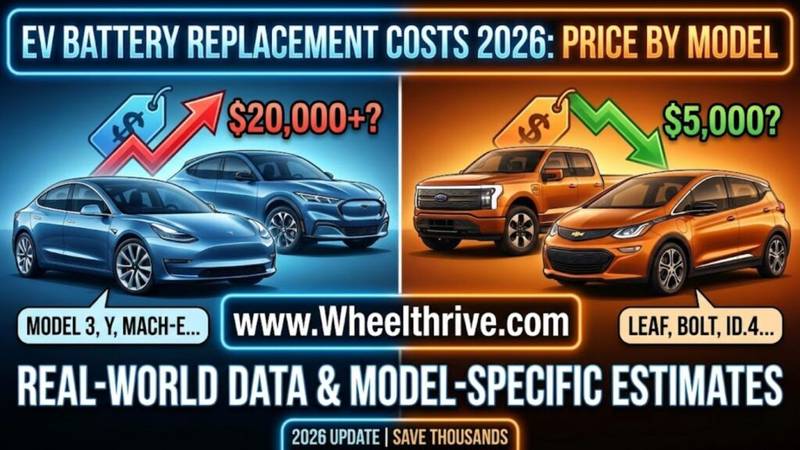
In 2026, the average cost to replace an EV battery has dropped to approximately $128 per kWh at the retail level. A replacement for a Tesla Model 3 typically costs $11,000 to $13,500 (parts & labor), while a Nissan Leaf (40kWh) averages $6,500 to $9,500. However, third-party refurbished packs can slash these costs by 40% if you know where to look.
If you are reading this, you are likely staring at an out-of-warranty repair quote that costs more than a used Honda Civic. The good news is that the “Dealer List Price” is no longer your only option.
The 2026 Cost Trend: Reaching the $80/kWh Holy Grail
According to 2026 projections from Goldman Sachs and BloombergNEF, raw battery pack prices were expected to hit $80 per kWh this year. While manufacturers are getting close to this number (paying roughly $110/kWh for the raw pack), the retail reality for you is different.
The “Retail Gap” Explained:
- Raw Cell Cost: ~$80/kWh (What Tesla pays Panasonic).
- Pack Level Cost: ~$110/kWh (With cooling, BMS, and casing).
- Retail Price: ~$130 – $150/kWh (What you pay after markup and shipping).
Why is the bill still so high? While the batteries themselves have become 50% cheaper since 2023, labor rates for high-voltage technicians have spiked. In 2026, certified EV mechanics charge upwards of $200 per hour. This means even if the battery is cheap, the 10 hours of labor required to drop the subframe and recalibrate the software keeps the total bill high.
EV Battery Replacement Cost by Model (2026 Price Table)
We analyzed quotes from dealership service centers and reputable third-party shops like Greentec Auto and Recell to build this 2026 price guide.
| Model | Battery Size | Dealer Cost (New) | 3rd Party (Refurb) | Labor Hours |
| Tesla Model 3 (LR) | 75 kWh | $13,500 – $15,800 | $9,000 – $11,000 | 3 – 5 hrs |
| Tesla Model Y | 75 kWh | $14,000 – $16,000 | $9,500 – $11,500 | 3 – 5 hrs |
| Nissan Leaf | 40 kWh | $8,000 – $10,000 | $5,500 – $7,000 | 5 – 7 hrs |
| Chevy Bolt EV | 66 kWh | $16,000 – $19,000* | $10,000 – $12,000 | 8 – 10 hrs |
| Ford Mustang Mach-E | 88 kWh (ER) | $18,000 – $22,000 | $13,000 – $15,000 | 10+ hrs |
| BMW i3 | 42 kWh | $18,000+ | $8,500 – $10,000 | 6 hrs |
Note on Chevy Bolt: Dealer prices remain artificially high because GM has prioritized new Ultium packs over legacy Bolt parts. Third-party is often the only viable option.
Detailed Model Analysis
1. Tesla Model 3 & Y (The Volume Leader)
The cost to replace a Tesla battery depends heavily on the chemistry.
- LFP (Standard Range): These iron-based batteries are cheaper to produce and replace, often costing under $9,000 for a refurbished swap.
- NCA (Long Range): The nickel-based packs used in Long Range models are more expensive.
- The “Structural” Problem: Unlike some older EVs, Tesla Model 3/Y battery packs are glued with structural foam. You generally cannot replace just one “bad module.” If a few cells die, the entire pack must be swapped, which is why the parts cost is so high compared to the labor.
2. Nissan Leaf (The Upgrade King)
The Nissan Leaf is unique in the EV world because of its cross-compatibility. You can take a 2013 Leaf that originally had a tiny 24kWh battery and install a brand new 2026 40kWh or 62kWh battery.
- The Adapter Kit: To make a new 2026 battery talk to a 2013 car, installers use a “CAN-bridge” adapter (approx. $500). This allows you to double your range for roughly $7,000. See our full guide on Nissan Leaf battery upgrade options to see if this upgrade makes sense for your specific VIN.
3. Ford Mustang Mach-E & F-150 Lightning
Ford’s battery packs are incredibly robust but labor-intensive to remove.
- Complexity: The Mach-E battery is integrated into the chassis. Dropping it requires removing huge sections of the subframe and cooling lines.
- Modular Repair: The silver lining is that Ford designed these packs with serviceable modules. If a single cell group fails, a Ford technician can theoretically open the pack and replace just that module for $3,000, rather than the $20,000 total pack cost. However, many dealers in 2026 still prefer to swap the whole unit to avoid liability.
New vs. Refurbished: Is it Safe?
When you see a quote for $9,000 vs. $16,000, the cheaper one is almost certainly a Remanufactured (Refurbished) pack.
Dealer New:
- Pros: 100% State of Health (SOH), full 4-year/50k mile warranty.
- Cons: Eye-watering price.
Refurbished (Third Party):
These are used packs from crashed cars that have been opened, tested, and had their “bad” modules replaced with healthy ones.
- Pros: 40-50% cheaper; eco-friendly recycling.
- Cons: You are essentially buying a used battery. Most come with 85-90% health, meaning you might lose 10-15 miles of range compared to a brand-new car. Warranties are typically shorter (12-36 months).
2026 Regulation Update: New “Right to Repair” laws in states like California and Minnesota are forcing manufacturers to sell internal battery modules to independent shops, making refurbishment safer and more standardized than in previous years.
Is It Worth It?
Before you swipe your credit card, do the “60% Rule” math. Insurance companies generally total a car if the repair exceeds 60-70% of the vehicle’s cash value. You should use the same logic.
Example A: Scrap It
- Vehicle: 2015 Nissan Leaf
- Book Value: $5,000
- Battery Cost: $7,000
- Verdict: Do not fix. The car is effectively totaled. Sell it to a DIYer or scrap it for parts.
Example B: Fix It
- Vehicle: 2020 Tesla Model 3
- Book Value: $18,000
- Battery Cost: $11,000
- Verdict: Fix it. You still have $7,000 of equity in the vehicle, and a fresh battery often increases the resale value.
Sometimes it’s smarter to cut your losses and buy a fresh used EV. Check the tax credits for used EVs here to see if you can get $4,000 off a newer replacement instead of fixing the old one.
Frequently Asked Questions
Q: Does insurance cover battery replacement?
- Generally, no. Insurance covers sudden damage (accidents, floods, fires, or road debris hitting the pack). They do not cover capacity degradation or wear-and-tear failure, just like they wouldn’t pay for a blown engine in a gas car.
Q: Can I upgrade my battery for more range?
- On a Nissan Leaf? Yes, it is very common. On a Tesla? Generally no. Software locks and physical size differences make it extremely difficult to put a Long Range battery into a Standard Range chassis without “hacking” the car, which voids all support.
Q: How long is the warranty on a replacement battery?
- Dealer replacements usually carry a 3-4 year warranty. Reputable third-party shops like Greentec or Recell usually offer 12-36 month warranties depending on the tier of battery you buy.
Last Take
Battery prices are falling, but labor is rising. In 2026, the golden rule is that you should never pay “Dealer List Price” for an out-of-warranty battery without getting a quote from a specialist.
Get 3 quotes. The difference between the Dealership and an Independent EV Specialist can be $5,000. Don’t leave that money on the table.
For more on global battery price trends, check the annual surveys from BloombergNEF. To find a reputable independent shop, we recommend checking Greentec Auto.