
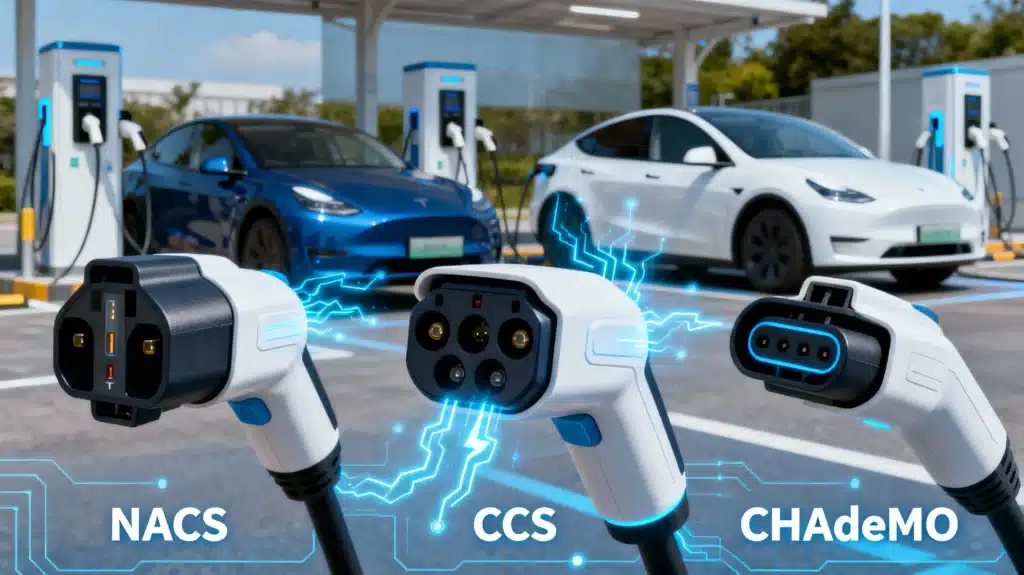
If you’re shopping for your first electric vehicle, you’ve probably run into a confusing “alphabet soup” of standards: NACS, CCS, J1772, CHAdeMO. It’s the number one barrier for new buyers, and it’s not your fault. For a decade, the EV industry has been fighting a “plug war,” and the confusion it created is the root of what I call “charger anxiety.”
This has replaced “range anxiety.” New buyers aren’t just worried about their battery dying; they’re worried about arriving at a charging station with 10% battery only to find the plug doesn’t fit or the machine is broken.
This guide is here to demystify it all, show you who won the war, and help you avoid making a multi-thousand-dollar mistake.
First, let’s clear up the single biggest point of confusion: AC charging vs. DC charging.
- AC Charging (Level 1 & 2): This is what you do at home, at work, or at a hotel. The power (Alternating Current) comes from the grid, and a charger inside your car (the “onboard charger”) converts it to DC (Direct Current) to fill the battery. It’s slow, adding 2-30 miles of range per hour. The standard plug for this in North America has long been the J1772.
- DC Fast Charging (Level 3): This is for road trips. The charger is a massive, high-voltage station (the “pump”) that bypasses your car’s slow onboard charger. It feeds DC power directly into your battery, adding 100-200 miles of range in just 20-40 minutes.
This article will focus only on the three competing DC fast-charging plugs in North America, because this is the battleground that matters for practical, long-distance travel: NACS, CCS, and CHAdeMO. This was the “Betamax vs. VHS” of our time, and the winner is now clear.
NACS: The New King of North American EV Charging
What is the NACS (North American Charging Standard) Plug?
You already know this plug. It’s the sleek, single plug that every Tesla has used since 2012. For a decade, it was Tesla’s proprietary standard, locking other cars out of its exclusive Supercharger network.
That all changed in November 2022, when Tesla opened its patent and made the design available for all other automakers to use, rebranding it as the North American Charging Standard (NACS).
Its technical design is its genius. Unlike its bulky competitors, NACS is a single, compact plug that cleverly handles both slow AC charging and high-speed DC charging using the same two main pins. It’s small, light, and elegant.
The User Experience: Why NACS is Winning the “Plug War”
There are two reasons NACS won the war, and the first is the user experience. As anyone who has fumbled with a heavy, cumbersome charging cable in the rain can tell you, design matters.
- The Ergonomic Win: The NACS plug is lightweight and can be plugged in easily with one hand. It’s a simple, user-friendly design.
- The Reliability Win: This is the real reason for its victory. The NACS plug is just the key; the Tesla Supercharger network is the kingdom. Tesla built and operates its own network as a seamless, vertically-integrated product. As a result, its reliability is legendary, with a documented average uptime of over 99.9%. You pull up, you plug in, it works.
The Great Switch: Why Every Automaker is Adopting NACS
For years, automakers like Ford, GM, and Hyundai faced a massive customer satisfaction crisis. They built great EVs, but their customers were forced to use the public charging networks, which were (and still are) plagued with reliability issues.
By adopting NACS, these automakers accomplished three things in one brilliant move:
- They instantly solved their biggest customer complaint by giving their drivers access to Tesla’s 15,000+ reliable Superchargers.
- They got to adopt a physically superior, more user-friendly, and cheaper-to-produce plug.
- They effectively offloaded the multi-billion-dollar burden of building and maintaining a reliable network onto Tesla.
The switch was a tidal wave. Starting in 2025, nearly every major automaker will begin building its North American EVs with a NACS port instead of a CCS port.
Automaker Transition to NACS (North America)
| Automaker | Native NACS Port Begins | Supercharger Access (via Adapter) |
| Ford | 2025 Models | Access Began in 2024 |
| General Motors (GM) | 2025 Models | Access Began in 2024 |
| Rivian | 2025 Models | Access Began in 2024 |
| Hyundai / Kia / Genesis | Q4 2024 / 2025 Models | Begins in 2025 |
| Nissan | 2025 / 2026 Models | Begins in 2024 (Ariya) / 2025 |
| Volvo / Polestar | 2025 Models | Access Began in 2024 |
| Mercedes-Benz | 2025 Models | Access Began in 2024 |
| BMW / Mini | 2025 Models | Begins in 2025 |
| Volkswagen / Audi / Porsche | 2025 Models | Begins in 2025 |
| Toyota / Lexus | 2025 Models | Begins in 2025 |
| Subaru | 2025 Models | Begins in 2025 |
| Stellantis (Jeep, Dodge, Ram) | 2026 Models | Begins in 2025 |
It’s Official: NACS is Now SAE J3400
This is the final nail in the coffin for the plug war. To make it a truly open standard, SAE International (the global standards body for engineers) has officially adopted the NACS design and codified it as SAE J3400.
This means NACS is no longer “Tesla’s plug.” It is now the official public standard for all of North America. Charging networks like Electrify America and ChargePoint are already adding J3400 plugs to their stations. This is the future.
CCS (Combined Charging System): The Fading Standard
What is the CCS (Combined Charging System) Plug?
For the last decade, CCS has been the “anti-Tesla” standard. It was created by an alliance of automakers (including Ford, GM, VW, and Hyundai) to compete with Tesla.
The “Combined” in its name means it physically combines the J1772 AC plug (for home charging) with two massive DC fast-charging pins underneath it. The result is a large, two-part “combo” plug. From 2015 to 2024, if you bought a non-Tesla EV in the US, it had a CCS port.
The User Experience: The “CCS Combover” and Reliability Woes
While functional, the real-world experience of using CCS has always been a major source of frustration for EV owners.
- The Plug: It is, to put it bluntly, a clunker. The plug and its permanently-attached cable are incredibly bulky, heavy, and cumbersome. It’s often a two-handed operation and can be genuinely difficult for some users to handle.
- The Handshake: The real failure of CCS is the software “handshake.” When you plug in, your car and the charger must communicate to verify your account and start the session. This process is notoriously buggy. This is the source of all the horror stories you’ve heard: dead touchscreens, “session failed” errors, and glitchy payment systems.
The CCS Network: A “Reliability Nightmare”
The true failure of the CCS standard wasn’t the plug itself; it was the fragmented, unreliable, and poorly maintained network ecosystem it relies on.
Tesla’s network is a single, vertically integrated product. The CCS network is a messy collection of different companies (like Electrify America, EVgo, and ChargePoint) competing for retail space and government grants. There is no unified standard for maintenance, and it shows.
The data is damning.
- A 2024 Consumer Reports study found that sessions at CCS-based networks were riddled with problems: 48% of visits to Shell Recharge had issues, followed by EVgo at 41% and Electrify America at 35%.
- A 2025 J.D. Power study noted that even as reliability “improves,” one in seven public charging attempts still fail.
- By contrast, Tesla’s NACS network consistently ranks #1 in customer satisfaction and maintains its 99.9%+ uptime.
This massive reliability gap is the single biggest reason the entire auto industry abandoned CCS and fled to NACS.
Should You Still Buy a Car with a CCS Plug?
Yes, absolutely. This is a critical point. While CCS is the fading standard, it is not obsolete. In fact, buying a 2024 or 2025 model with a CCS port puts you in a fantastic position.
Here’s why: Because of “The Great Switch,” automakers are sending NACS-to-CCS adapters to all their current CCS-equipped car owners. This means that for the next 5-10 years, a CCS car (like a 2024 Ford Mustang Mach-E or Hyundai Ioniq 5) will be the only car with the “best of both worlds”: it can use the entire (unreliable) CCS network and the entire (reliable) NACS/Tesla network. You will have the most charging options of anyone on the road.
That is, as long as your car doesn’t have the other plug.
CHAdeMO: The Obsolete Plug (And a Warning for New Buyers)
What is CHAdeMO?
CHAdeMO stands for “CHArge de MOve,” a pun on a Japanese phrase meaning “let’s have tea while charging.” It was a DC fast-charging standard developed in 2010 by a coalition of Japanese automakers, primarily Nissan and Mitsubishi.
In the early 2010s, it was a direct competitor to Tesla and was the plug used on the world’s best-selling EV at the time: the Nissan Leaf. It was technologically advanced for its day and was the first standard to widely support bidirectional charging (Vehicle-to-Grid, or V2G), allowing the car to send power back to a home. But it lost the format war.
Why is CHAdeMO Obsolete in North America?
CHAdeMO is the “Betamax” of EV plugs. It is a dead standard walking in the United States, and the evidence is overwhelming.
- No New Cars Use It: The only new battery-electric vehicle sold in North America that still uses a CHAdeMO port is the Nissan Leaf. (The Mitsubishi Outlander PHEV, a hybrid, also uses it). No other automaker supports it.
- Its Creator Abandoned It: This is the smoking gun. Nissan itself has abandoned the standard. Its new flagship EV, the Nissan Ariya, uses a CCS port. More importantly, Nissan has publicly announced that the all-new, redesigned 2026 Nissan Leaf will use the NACS port. When the only company supporting a standard gives up on it, that standard is officially dead.
- No New Chargers Are Being Installed: Charging networks are actively phasing out CHAdeMO. New installations have slowed to a crawl. Worse, many networks like Electrify America are removing their existing CHAdeMO plugs to replace them with more in-demand NACS or CCS plugs.
The 2025 Nissan Leaf: A Great Budget EV with a Fatal Flaw
This brings us to the most critical piece of consumer advice in this entire guide. The 2025 Nissan Leaf is, on paper, one of the most affordable electric vehicles in the usa. But it comes with a massive, practical, and potentially deal-breaking flaw.
What Plug Does the 2025 Nissan Leaf Use?
The 2025 Nissan Leaf (both the S and SV Plus models) uses the standard J1772 port for Level 2 AC home charging. But for DC fast charging, it only uses the CHAdeMO port.
The Real-World “CHAdeMO Problem” for 2025 Leaf Owners
Here is what that practically means for an owner. We call it the “Commuter Trap.”
- As a Commuter Car: If you have a garage or dedicated parking spot, will charge at home 99% of the time, and will only use the Leaf for local commuting (e.g., under 100 miles per day), it’s a fantastic, reliable, and affordable car.
- As a Road Trip Car: It is an unmitigated disaster. We cannot be more clear about this. Attempting a long-distance road trip in a 2025 Leaf is a recipe for extreme anxiety. You will be hunting for a “dying breed” of charger. You’ll be forced to use apps like PlugShare to plan your entire trip around the handful of remaining CHAdeMO plugs, all while praying the single one in that town isn’t broken or already in use.
This massive drawback is why the 2025 model is a tough sell against its upcoming replacement and competitors. You can see how its NACS-equipped 2026 successor is expected to perform in our 2026 Nissan Leaf vs. 2025 Chevrolet Equinox EV comparison.
The Compounding Factor: “Chargegate” and the Air-Cooled Battery
The obsolete CHAdeMO plug isn’t even the Leaf’s only road-trip problem. It gets worse.
Unlike nearly every other modern EV, which uses liquid cooling to manage battery temperature, the Nissan Leaf uses a cheaper air-cooled battery pack. On a road trip, this creates a perfect storm of failure known as “Rapidgate” or “Chargegate.”
Here is the real-world scenario for a Leaf owner:
- You (painfully) find a 50kW CHAdeMO station and charge your car. The battery gets hot.
- You drive 100 miles and (even more painfully) find a second CHAdeMO station.
- You plug in, but this time the car’s computer, protecting the already-hot, air-cooled battery, throttles your charging speed down to a crawl—often as low as 20-30kW.
- Your “fast” charging stop now takes 1.5-2 hours.
Because of this, a simple 300-mile drive can take 10-12 hours. The 2025 Nissan Leaf is, by design, fundamentally broken as a long-distance vehicle.
Your Guide to EV Adapters: Living the “Dongle Life”
During this 2024-2026 transition, adapters are a fact of life. But not all adapters are created equal.
The “Simple & Good” Adapters (Under $250)
These are simple “pass-through” adapters. They just change the shape of the plug because the electrical communication protocols are the same (CCS-based).
- CCS car (e.g., 2024 Ford) to NACS station: This is the adapter Ford, GM, and others are sending to their owners. It costs about $200 and unlocks the entire Tesla Supercharger network. This is a great adapter.
- NACS car (e.g., Tesla) to CCS station: Tesla has sold this for years. It lets Teslas use Electrify America stations.
- Tesla’s “Magic Dock”: This isn’t an adapter you buy. It’s an adapter built into the Tesla Supercharger. It lets any CCS car plug in without needing their own adapter.
The “Complex & Bad” Adapter (Over $1,000)
So, can our 2025 Leaf owner just buy an adapter to use the new NACS or plentiful CCS stations?
No.
CHAdeMO and CCS/NACS use completely different “languages” or communication protocols. You can’t just pass the electricity through; you need a bulky, complex computer-in-a-box to actively translate the signal.
These CHAdeMO-to-CCS “translator” adapters do exist from third-party companies, but:
- They are extremely expensive, costing $1,000 to $1,500.
- They are clunky, heavy, and often unreliable.
This “fix” is not a practical solution. It costs a significant portion of the car’s value and completely erases the “affordable” benefit of buying a Leaf in the first place.
Final Verdict: What EV Plug Should Your First Car Have?
Here is our final, crystal-clear advice for any new EV buyer.
- The Future (Buying in 2025-2026+): Your first choice should be a car with a native NACS (SAE J3400) port. This is the future-proof standard, and it’s what all manufacturers are switching to.
- The Present (Buying a 2023-2025 Model): A CCS port is perfectly fine and, in the short term, may even be better. You will get an adapter that gives you access to both the entire NACS (Tesla) network and the entire CCS network. You’ll have the most charging options of anyone.
- The Past (The One to Avoid): The CHAdeMO port is a deal-breaker. We strongly advise against buying any new or used EV with a CHAdeMO port (like the 2025 Nissan Leaf) unless you understand its severe limitations. It should only be considered as a short-range commuter car that will never be fast-charged away from home.
Now that you understand the one plug to avoid, you can confidently shop for your first EV. Your charging standard is just one piece of the puzzle. For a complete look at the best options on the market, check out our definitive guide to the affordable evs in USA.
FAQs About EV Charging Plugs
Q: What’s the difference between NACS and SAE J3400? A: They are essentially the same thing. NACS (North American Charging Standard) is the brand name Tesla gave its plug design. SAE J3400 is the official, open-standard name given to that design by SAE International, the engineering standards body. You will see them used interchangeably.
Q: I’m buying a 2024 car with a CCS plug. Will it be useless in five years? A: Absolutely not. This is a great time to buy a CCS car. First, your automaker will provide you with a NACS adapter, giving you access to the entire Tesla Supercharger network. Second, the thousands of existing CCS chargers aren’t disappearing overnight. For the next 5-10 years, owning a CCS car with an adapter will give you the most charging options.
Q: Can I use a Tesla Supercharger with my (non-Tesla) CCS car right now? A: Yes, in two ways. First, if your automaker has activated adapter access (like Ford and GM), you can use your NACS-to-CCS adapter at most V3 and V4 Superchargers. Second, you can charge at any Tesla Supercharger equipped with a “Magic Dock,” which has a built-in CCS adapter for any car to use. You can find these locations in the Tesla app.
Q: Can I buy an adapter for my Nissan Leaf to use CCS or NACS chargers? A: You can, but it is not a practical or affordable solution. Because CHAdeMO uses a totally different communication “language,” you can’t use a simple $200 plug adapter. You must buy a complex “translator” box that costs over $1,000, which negates the value of buying an affordable EV.
Q: Why is the 2025 Nissan Leaf so cheap if it has this charging problem? A: The 2025 Leaf is the final model of a very old generation. Its platform (including the CHAdeMO port and air-cooled battery) is over a decade old. This makes it very cheap to produce, but it also means it’s built on obsolete technology. Nissan is essentially clearing out old inventory before the all-new, NACS-equipped 2026 Leaf arrives.