
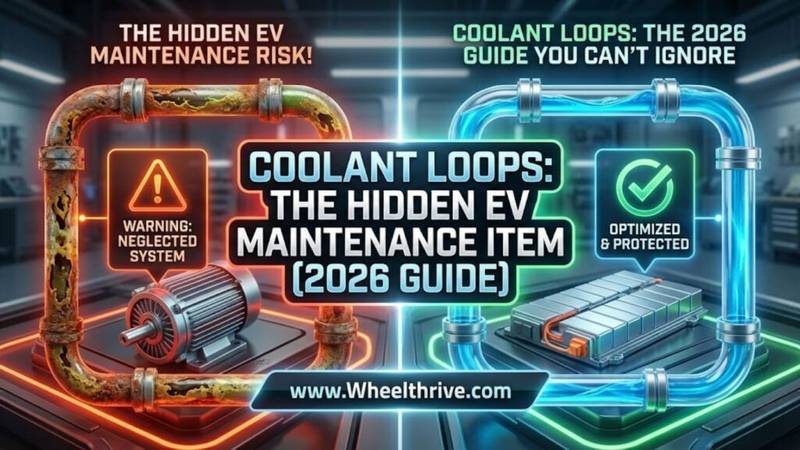
Unlike gas cars, EVs have multiple coolant loops. The most critical is the “Low Conductivity” (blue) loop for the battery, which prevents electrical shorts and isolation faults. While motor coolant often lasts 100k+ miles, low-conductivity battery coolant degrades faster and requires specific service intervals (e.g., every 35,000 to 40,000 miles for Hyundai/Kia models) to protect the High Voltage system.
The Myth of the “Maintenance Free” EV
We have all heard the sales pitch: “Buy an EV, and say goodbye to maintenance” No oil changes, no spark plugs, no timing belts. It sounds perfect. But as we move further into 2026 and millions of electric vehicles hit the 40,000-mile mark, a different reality is setting in.
The truth is, while you don’t have an engine to maintain, you have a Thermal Management System (TMS) that is arguably more complex than the radiator on a standard gas car. Your EV isn’t just a big battery on wheels; it is a supercomputer that needs to be kept at a perfect 25°C to 35°C (77°F – 95°F) to operate efficiently. To do that, it uses pumps, valves, and remarkably specific fluids that most owners—and even some general mechanics—are completely overlooking.
The Loops: It’s Not Just One System
If you pop the “frunk” (front trunk) of a modern EV like the Hyundai Ioniq 5, Kia EV6, or even the Porsche Taycan, you might be confused to see two separate coolant reservoirs. This isn’t redundancy; it is isolation.
Most modern electric architectures split their cooling into distinct circuits:
- The High-Temp Loop (The “Motor” Loop): This usually uses standard glycol (often Pink or Green). It cools the Drive Unit (electric motor) and the Inverter. These components can handle higher temperatures and use conductive fluid without much risk.
- The Low-Temp Loop (The “Battery” Loop): This is the critical one. It is often filled with Low Conductivity Coolant (frequently Blue). The battery pack needs to be kept cooler to prevent degradation, but more importantly, the fluid must be non-conductive for safety.
- The Cabin Loop: This is your A/C refrigerant loop (heat pump). It doesn’t use water-based coolant but exchanges heat with the other loops to warm the cabin in winter without draining the battery excessively.
What is “Low Conductivity” Coolant & Why Does It Matter?
You might be wondering, “Why can’t I just use the yellow stuff from the auto parts store?”
Please, put the bottle down.
Standard antifreeze conducts electricity. If a battery cell were to rupture or a cooling plate leaked inside your high-voltage battery pack, standard coolant would cause a bridge between the positive and negative terminals. The result? A catastrophic short circuit, potential thermal runaway, or at the very least, a “High Voltage Isolation Fault” that bricks your car instantly.
Low Conductivity Coolant (often called Dielectric Fluid) is formulated with specialized de-ionized water and inhibitors that do not conduct electricity. It adds a critical layer of safety.
The catch? These “non-conductive” properties are not permanent. Over time, heat cycles and contact with rubber hoses cause ions to leach into the fluid. As the fluid becomes more conductive, it loses its safety rating. This is why the EV Coolant Change Interval is not just a suggestion—it is a safety requirement.
The “Pink vs. Blue” Confusion (Hyundai/Kia Focus)
If you drive an E-GMP platform vehicle (Hyundai Ioniq 5, Ioniq 6, Kia EV6), this is likely why you are here.
Under your hood, you have two tanks:
- Inverter (Pink): Standard interval (120k+ miles).
- Battery (Blue): Strict, shorter interval.
For 2026, the confusion around the “Blue” coolant persists. The owner’s manual typically calls for a flush every 35,000 to 40,000 miles. However, because this fluid is expensive and the service is labor-intensive, some dealers are now testing the conductivity levels rather than performing a full flush.
While saving money is great, be careful. If your conductivity levels are borderline, you risk voiding your battery warranty if an isolation fault occurs later. Until official guidance changes globally, sticking to the 35k-40k mile replacement schedule is the safest bet for long-term battery thermal management system maintenance.
EV Coolant Maintenance Schedule
Maintenance intervals vary wildly between manufacturers. Use this table to check where your EV stands.
| Vehicle Make | Coolant Type | Recommended Interval | Notes |
| Tesla (Model 3/Y) | G48/Specific | “Lifetime” (No fixed interval) | System is sealed. Only replace if contaminated or during battery repair. |
| Hyundai / Kia (E-GMP) | Low Conductivity (Blue) | 35,000 – 40,000 Miles (or 3 years) | Critical service. Expensive ($400-$800) due to specialized fluid. |
| Hyundai / Kia (E-GMP) | Standard (Pink) | 120,000 Miles (or 10 years) | Standard interval similar to ICE cars. |
| Ford Mustang Mach-E | Orange (Yellow-colored) | 100,000 Miles (or 6 years) | Uses two separate loops but often utilizes the same fluid type. |
| Chevy Bolt EV | Dex-Cool (Orange) | 150,000 Miles (or 5 years) | Inspect loops for fluid levels regularly; verify with dealer. |
DIY vs. Dealer: Can I Flush It Myself?
As a DIY enthusiast, I love avoiding dealer markups. But for Low Conductivity Coolant, the verdict is: Likely No.
Here is why this isn’t a driveway job:
- The Tools: You cannot just “pour and burp” these systems like a 1990s Toyota. Modern EVs use Electronic Water Pumps (EWP) and complex valve blocks. You need a bidirectional scan tool (computer) to command the valves open and run the pumps to bleed the air out.
- The Risk: You are working near High Voltage components. Additionally, introducing even a small amount of tap water or dirt into the Low Conductivity loop ruins the fluid immediately.
- The Cost: The fluid itself is pricey (often $60-$80 per gallon). If you mess up the bleed procedure and overheat a module, the savings vanish instantly.
Recommendation: For the critical Battery Loop, visit a certified EV specialist or dealer. For the Motor loop (if separate and using standard fluid), seasoned DIYers with the right diagnostic software might attempt it, but proceed with caution.
Signs Your EV Coolant System Needs Attention
Your car is smart; it will usually tell you before things melt down. Look for these signs:
- Dashboard Warning: “Refill Inverter Coolant” or “Check Electric Vehicle System.”
- Loud Fan Noise: If your cooling fans are running at 100% speed while you are parked or Supercharging in mild weather, your battery thermal management system might be struggling due to low fluid or a blockage.
- Reduced Charging Speed: If the car cannot cool the battery, it will aggressively throttle your DC Fast Charging speeds to protect the cells.
- Visible Leaks: Check your garage floor. Blue puddles usually indicate a battery loop leak; Pink or Orange usually indicates the motor/inverter loop.
Frequently Asked Questions
- How much does an electric car coolant flush cost?For standard loops, expect to pay between $200 and $300. However, for Low Conductivity Loops (like in the Ioniq 5), prices range from $400 to $900. This higher price reflects the cost of the specialized fluid and the labor time required to vacuum-fill the system.
- Can I top up my EV coolant with water?Only in an extreme emergency for the motor loop. NEVER add tap water or standard coolant to a Low Conductivity battery loop. It will ruin the non-conductive properties instantly, potentially triggering a system shutdown.
- Do Teslas have coolant to change?Yes, Teslas use a glycol-based coolant to manage battery and motor temperatures. However, Tesla considers this a “lifetime” fluid. The system is sealed, and unless you have a leak or a specific repair, there is no scheduled Tesla battery coolant replacement schedule.
- Why is my EV coolant pink or blue?Color is used to distinguish the loops. Generally, Blue indicates the specialized Low Conductivity fluid for the battery (do not mix this). Pink, Orange, or Green usually indicates standard automotive glycol used for the motor and inverter. Always check your manual, as colors can vary by year.