
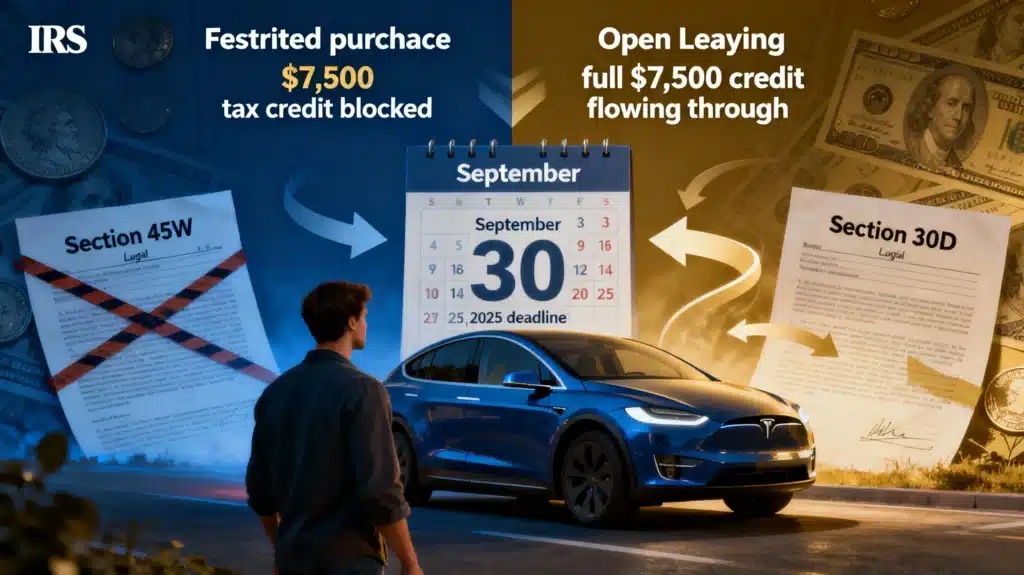
If you have been tracking the electric vehicle market, you likely marked September 30, 2025, on your calendar with a red pen. That date represented a critical pivot point for the IRS EV credit changes, specifically regarding the consumer-facing Section 30D credits. For many potential buyers, the hard sunset of specific consumer purchase subsidies has created a sudden vacuum in affordability.
However, while the “front door” to federal subsidies has effectively closed for many models due to strict income caps and battery mineral sourcing requirements, a “side door” remains wide open. It is known among financial experts as the EV lease loophole 2025, formally codified under Section 45W tax credit regulations.
This guide provides an in-depth analysis of how Section 45W works, why it survives the post-September 30 landscape, and how you can use it to secure the full $7,500 benefit even if you no longer qualify for a direct purchase credit.
Why the Buy vs Lease EV 2025 Debate Has Changed
Before September 30, the decision to buy or lease was often a matter of mileage limits and ownership preference. Today, it is purely a tax strategy.
The Inflation Reduction Act created a bifurcated system. Section 30D (the credit for buying) was designed with increasingly tighter guardrails. As of late 2025, the “Foreign Entity of Concern” (FEOC) restrictions on battery minerals have disqualified a vast majority of EVs from the purchase credit. Furthermore, high earners—single filers making over $150,000 or couples over $300,000—are statutorily locked out of these benefits.
This is where the Section 45W tax credit becomes the primary support mechanism for the market. Unlike the consumer credit, Section 45W is a “commercial clean vehicle credit.” When you lease a car, you do not technically own it; the leasing company (the lessor) does. Because the lessor is a business, they claim the commercial credit, which is immune to the North American assembly and battery sourcing requirements that plague consumer purchases.
The Mechanism of the Loophole
- The Transaction: You lease a vehicle that would otherwise be ineligible for a tax break (e.g., a foreign-made EV or one with Chinese-sourced battery components).
- The Credit: The leasing company (e.g., Hyundai Motor Finance, VW Credit) claims the $7,500 Section 45W credit.
- The Pass-Through: The leasing company applies that $7,500 credit to your lease agreement as a “Capital Cost Reduction.”
- The Result: You receive the immediate financial benefit of the tax credit in the form of lower monthly payments, effectively bypassing the consumer restrictions.
IRS EV Credit Changes September 30: The Aftermath
The IRS EV credit changes September 30 marked a definitive shift in federal incentives. With the sunsetting of broader consumer eligibility, the market has seen a surge in leasing volume.
Financial analysis of the post-September landscape suggests that leasing is no longer just an alternative; it is the only viable way for many Americans to access federal subsidies. This is particularly true for luxury models and vehicles manufactured in Europe or Asia, which lost all purchase-based eligibility under the tightened IRA guidelines.
Critical Note: Not all dealerships automatically pass this credit to the consumer. It is discretionary. You must verify that the “adjusted capitalized cost” of your lease reflects this $7,500 reduction before signing.
For a deeper dive into the numbers and exact scripts to use at the dealership, review our guide on how to negotiate an EV lease in 2025 to ensure you aren’t leaving this money on the table.
Financial Analysis: Buy vs Lease EV
To illustrate the power of the EV lease loophole 2025, let us look at a comparative financial scenario for a qualified EV with an MSRP of $55,000.
| Feature | Direct Purchase (Section 30D) | Lease Strategy (Section 45W) |
| Federal Credit Amount | $0 (If vehicle/buyer is ineligible) | $7,500 (via Cap Cost Reduction) |
| North American Assembly? | Required | Not Required |
| Income Limits? | Strict Caps ($150k/$300k) | None |
| Battery Sourcing Rules? | Strict FEOC Compliance | Exempt |
| Effective Net Price | $55,000 | $47,500 |
In this scenario, the “Lease Loophole” provides a $7,500 advantage that is completely inaccessible through a direct loan purchase.
The “Lease-to-Buy” Strategy
For those who prefer ownership, the optimal strategy in late 2025 is the “Lease-to-Buy” hack. This involves initiating a lease to secure the Section 45W incentive (the $7,500 rebate) and then executing a lease buyout clause almost immediately.
By doing this, you effectively “buy” the car for $7,500 less than MSRP, circumventing the income and sourcing restrictions that would have applied had you bought it with cash or a loan on day one.
Frequently Asked Questions (FAQ)
Is the EV lease loophole legal?
Yes. The IRS explicitly validated this under Notice 2023-9 and subsequent guidance for Section 45W. The distinction between a “commercial” lease and a “consumer” purchase is a feature of the Inflation Reduction Act, not an accidental oversight.
Does the September 30 sunset affect Section 45W?
The strict sunset provisions that took effect on September 30 largely impacted the consumer-facing Section 30D qualifications (specifically regarding mineral sourcing percentages). Section 45W remains a robust pathway for commercial entities (lessors) to claim credits on virtually any plug-in EV with a battery capacity of at least 7 kWh.
Can I use the loophole if I make over $300,000?
Yes. Income limits apply only to Section 30D (purchases). There are no income caps for the lessee when utilizing the Section 45W tax credit because the credit is technically claimed by the financial institution, not you.
Do all EVs qualify for the $7,500 lease credit?
Most do, but it depends on the leasing company’s policy. While the law allows them to claim it on almost any EV, some manufacturers (captives) may choose to keep the credit to offset their own costs rather than passing it to you. Always confirm the “rebate” or “capital cost reduction” line item.
Next Step
If you are considering a specific model and want to know if the manufacturer is currently passing the Section 45W credit to lessees, would you like me to pull the current lease incentive data for a specific brand (like Tesla, Hyundai, or Ford) to see if they are offering the full $7,500 pass-through?