
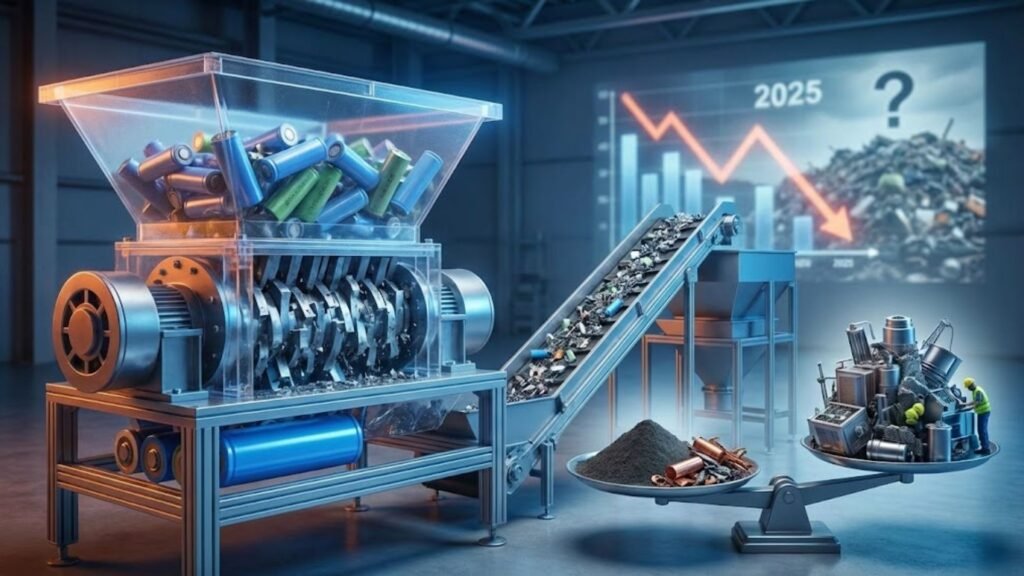
Lithium Iron Phosphate (LFP) batteries have effectively won the first round of the EV battery war. They are safer, cheaper to produce, and last longer than their nickel-rich counterparts. But as we move deep into 2025, the industry faces a silent crisis: the LFP battery recycling cost equation is currently broken.
While manufacturers love LFP for its low upfront cost, recyclers are facing a hard reality. Unlike Nickel Manganese Cobalt (NMC) packs, which are essentially “urban mines” full of expensive cobalt and nickel, LFP batteries are structurally distinct. They lack the high-value metals that traditionally subsidize the recycling process.
This analysis explores the economic bottleneck of recycling lithium iron phosphate and why 2025 is a make-or-break year for developing profitable recovery methods.
The Economic Bottleneck: Why LFP is Different
The core of the problem is simple math. In the recycling business, your revenue comes from the value of the materials you recover (black mass). Your costs come from logistics, discharging, dismantling, and chemical processing.
For NMC batteries, the profit margin battery recycling offers is healthy because the recovered cobalt and nickel are worth thousands of dollars per ton. The material value exceeds the processing cost.
For LFP, the story flips. The primary recoverable materials are:
- Lithium: Valuable, but volatile in price.
- Iron: Cheap and abundant.
- Phosphate: widely available as fertilizer feedstock.
In many current setups, the cost to transport and process an LFP pack is higher than the value of the materials extracted. This creates a “negative value” asset. Without government intervention or technological breakthroughs, spent LFP packs risk becoming a liability rather than a resource.
The Cost Structure of LFP Recycling in 2025
To understand the LFP battery recycling cost, we have to break down the expenses that eat into margins.
1. Logistics and Collection
Transporting hazardous waste (which spent batteries are classified as) is expensive. Because LFP batteries have a lower energy density, you effectively ship more “dead weight” per dollar of potential recovered material compared to NMC.
2. Pre-Treatment (Dismantling)
Automated dismantling is improving, but LFP packs—often designed with “cell-to-pack” technology to save space—are notoriously difficult to take apart. The glues and structural foams used to make EVs rigid make the recycler’s job a nightmare, increasing labor and energy costs.
3. Chemical Processing (The Hydrometallurgy Shift)
Old-school pyrometallurgy (smelting) burns off the plastic and electrolyte to leave a metal alloy. This works for cobalt, but it is useless for LFP because lithium is lost in the slag.
The industry is pivoting to hydrometallurgy—a chemical leaching process. While efficient at recovering lithium, it consumes significant amounts of chemical reagents (acids and bases). In 2025, the cost of these reagents remains a major barrier to profitability.
Emerging Solutions: Turning a Profit on LFP
If the profit margin battery recycling offers for LFP is low, why is the sector growing? Because the volume of LFP waste is about to explode, and the industry is adapting.
Direct Recycling
This is the “Holy Grail” for LFP. Instead of breaking the cathode down into raw atoms (lithium, iron, phosphorous), direct recycling aims to heal the cathode structure. It repairs the crystal lattice of the spent material so it can be reused in a new battery. This skips the expensive chemical processing steps and could theoretically lower recycling costs by 30-40%.
The “Toll Processing” Model
Because the material value is low, recyclers are moving away from buying spent batteries. Instead, they charge a “tipping fee” or service fee to the OEM (car manufacturer) to process the waste. The OEM retains ownership of the recovered lithium, securing their supply chain, while the recycler guarantees a fixed margin.
Government Incentives
Subsidies are bridging the gap. Governments recognize that we cannot landfill millions of tons of EV batteries. In 2025, we are seeing tighter regulations requiring minimum recycled content in new batteries, effectively forcing a market for recycled LFP materials regardless of the immediate spot price.
FAQ: LFP Recycling Economics
Why is recycling lithium iron phosphate less profitable than NMC? LFP batteries do not contain cobalt or nickel, which are the most expensive components in EV batteries. recovering iron and phosphate yields very low revenue, leaving lithium as the only major value driver.
What is the current LFP battery recycling cost trend? Costs are high but stabilizing. The shift from smelting to hydrometallurgy and direct recycling is gradually reducing the cost per kWh processed, but logistics remain a significant fixed expense.
Can LFP recycling ever be profitable without subsidies? Yes, but it relies on scale and technology. Direct recycling (cathode-to-cathode healing) offers the best path to profitability by eliminating the need for expensive chemical breakdown and re-synthesis.
How does the profit margin battery recycling vary by region? Regions with stricter environmental regulations (like the EU) often have higher recycling costs due to compliance, but also higher subsidies. Asian markets often have lower labor and chemical costs, allowing for tighter margins.
Conclusion
The LFP battery recycling cost challenge is not a permanent dead end; it is a temporary engineering hurdle. As we move through 2025, the winners in this space will not be the generalist recyclers, but the specialists who can optimize hydrometallurgy specifically for iron-phosphate chemistries.
For the EV industry, solving this is non-negotiable. We cannot build a sustainable future on disposable batteries. The economics will eventually balance out, driven by necessity, innovation, and the strategic value of securing domestic lithium supplies.
Interested in how this fits into the broader green ecosystem? Read more about our approach to Sustainability.