
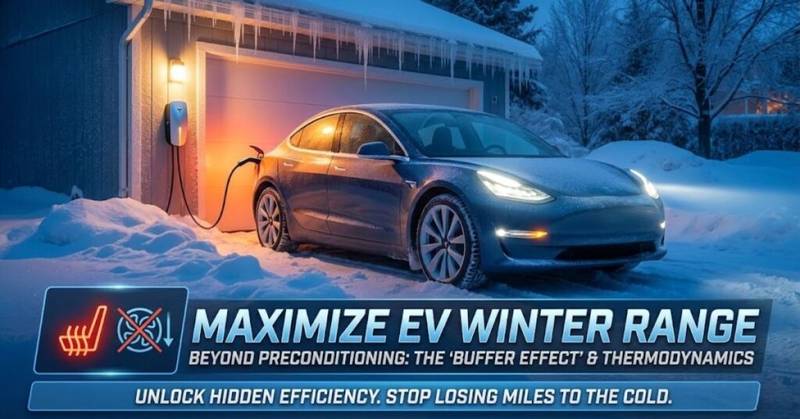
It’s a familiar sinking feeling for any EV owner living in a northern climate. You wake up, check your app, and see that freezing temperatures have shaved 20% off your available range overnight. While “ev winter range anxiety” is often dismissed by veteran drivers, the laws of physics are harder to ignore.
Most guides will tell you to simply “precondition” your car and while that is good advice, it is barely scratching the surface. To truly master winter driving and reclaim those lost miles, we need to dig deeper into the thermodynamics of your vehicle. It’s not just about getting the cabin warm; it’s about understanding how your Battery Management System (BMS) fights the cold and how you can strategically assist it.
Here is the advanced guide to maximizing your electric vehicle’s range when the mercury drops, moving beyond the basics into the physics of efficiency.
Why EV Winter Range Actually Drops
To fix the problem, you first need to understand the mechanism. Your EV isn’t “leaking” electricity in the cold; the chemistry is just getting sluggish.
Inside your lithium-ion battery, ions travel between the cathode and anode through a liquid electrolyte. As temperatures plummet, this electrolyte becomes more viscous (thicker). This increases internal resistance. Think of it like trying to swim through honey instead of water. Your car has to expend more energy just to push the electricity out of the battery, leaving less energy available to actually turn the wheels.
Furthermore, because the battery is cold, the BMS limits how fast it can accept energy. This is why regenerative braking is often weak or non-existent in the first 15 minutes of a winter drive. You aren’t just losing efficiency on propulsion; you’re losing the ability to recapture energy when stopping.
The “Buffer Effect”: Grid Power for Thermal Maintenance
You likely know you should keep your car plugged in, but let’s look at the specific strategy known as the “Buffer Effect.”
When your EV is plugged into a Level 2 home charger, the BMS can draw power directly from the wall to maintain the battery’s temperature, bypassing the battery pack entirely. This creates a thermal buffer.
The Strategy: Instead of just charging to 80% and letting the car sit for 8 hours, time your charge to finish exactly when you plan to leave. Charging generates heat as a byproduct. By timing the charge to end right before departure, you start your drive with a battery that is internally warm from the chemical activity of charging. This “active” heat means the BMS doesn’t have to waste energy heating the pack during the first few miles of your commute.
Pro Tip: If your charger has a “Departure Time” setting, use it. The car will calculate exactly when to start charging to ensure the battery is warm and full right when you open the door.
Heat Pumps vs. Resistive Heating: The Efficiency Battle
If you are in the market for an EV or wondering why your current one struggles, check the heating system. There are two main types: Resistive (PTC) and Heat Pumps.
- Resistive Heating: This works like a giant toaster. It passes electricity through a coil to create heat. It is 100% efficient, meaning 1kW of electricity creates 1kW of heat. That sounds good, until you compare it to the alternative.
- Heat Pumps: These work like a refrigerator in reverse, moving heat from the outside air into the cabin. Even in freezing temps, there is thermal energy in the air. A heat pump can have a Coefficient of Performance (COP) of 3 to 4. This means 1kW of electricity moves 3kW to 4kW of heat.
The Impact: In deep winter, a resistive heater can chew through 10% to 15% of your battery just keeping the cabin warm. A heat pump can do the same job for a fraction of the energy. If you have a choice, always prioritize a model with a heat pump for cold climates.
Cabin Thermodynamics: Heated Seats vs. Air
If you want to see the biggest immediate gain in range, stop trying to heat the entire volume of air inside your car.
Heating the air in your cabin (convection) is incredibly energy-intensive. You are heating thousands of liters of air, the glass windows, the dashboard, and the roof. Conversely, heated seats and steering wheels use conduction—transferring heat directly to your body.
- The Math: A typical cabin heater might draw 3,000 to 6,000 watts to bring a cold car up to temp.
- The Alternative: A heated seat typically draws only 45 to 75 watts.
By lowering your cabin thermostat to 66°F (19°C) and relying on the seat heater, you can save kilowatts of power per hour. You are creating a “micro-climate” of warmth around the driver rather than wasting energy heating the empty space in the back seat.
The Tire Pressure Variable
Gas laws dictate that for every 10°F drop in ambient temperature, tire pressure drops by about 1 PSI. Driving on under-inflated tires increases the contact patch with the road, which significantly increases rolling resistance.
In an EV, where efficiency is paramount, soft tires can cost you 3-5% of your range. Check your pressures specifically on cold mornings and inflate them to the manufacturer’s recommended “cold” pressure.
Frequently Asked Questions
How to extend EV range in winter?
- Precondition while plugged in: Use grid power to warm the car before unplugging.
- Use Seat Heaters: Rely on conduction heating (seats) rather than convection (air) to save massive amounts of energy.
- Check Tire Pressure: Inflate tires to compensate for pressure drops caused by the cold.
- Drive Smoothly: Avoid hard acceleration, which stresses a cold battery.
Does EV range decrease in winter? Yes. You can expect a drop of 10% to 30% depending on the severity of the cold. This is due to increased air density (drag), higher use of cabin heating, and the reduced chemical efficiency of the cold battery.
How can I increase my EV range? Adopt eco-driving habits. Coast when possible, use “Eco” mode to dampen throttle response, and minimize the use of the cabin heater by dressing warmly and using seat warmers.
What is the 80 20 rule for charging batteries? Generally, you should keep your battery between 20% and 80% for daily use to prolong its life. However, in extreme winter conditions, some manufacturers recommend charging to 90% or even 100% before a long trip to account for the expected range loss.
How cold is too cold for EV? EVs can operate in sub-zero temperatures (even -20°F/-30°C). However, if the battery gets “deep frozen” (left unplugged for days in extreme cold), the BMS may prevent the car from driving until it heats itself up, which consumes significant energy. Always keep it plugged in during extreme cold snaps.
Should I warm up my EV before driving? Yes, but do it while it is connected to the charger. This preserves the energy in the battery for driving rather than heating.
What affects EV range the most? In winter, cabin heating is the single biggest auxiliary power draw, followed by speed (aerodynamic drag) and the internal resistance of the cold battery.
Do Teslas lose battery faster in cold weather? All EVs, including Teslas, lose range in the cold. Tesla’s advantage is its sophisticated thermal management system (Octovalve) which efficiently scavenges heat from the motor and battery to warm the cabin, mitigating some of the loss compared to older EVs.
Is electric resistance heating better than a heat pump? No. Resistive heating is faster to warm up but much less efficient. A heat pump is far superior for range preservation.
Is a heat pump worth it on an EV? Absolutely. For anyone living in regions with regular winter weather, a heat pump is an essential feature that pays for itself in preserved range and efficiency.
Which is better PTC heater or heat pump EV? A heat pump is better for efficiency. A PTC (Positive Temperature Coefficient) heater is essentially a resistive heater; it is reliable and cheap but drains the battery quickly.
Is a heat pump better than electric heating? Yes. A heat pump moves existing heat rather than creating it from scratch, making it 3-4 times more efficient than standard electric resistive heating.
Understanding the “why” behind winter range loss allows you to mitigate it effectively. By leveraging the buffer effect, prioritizing efficient heating, and maintaining your tires, you can confidently drive past the gas stations no matter how low the temperature drops.
For more strategies on getting the most out of every kilowatt, explore our comprehensive guide on Eco-Driving and Sustainability.