
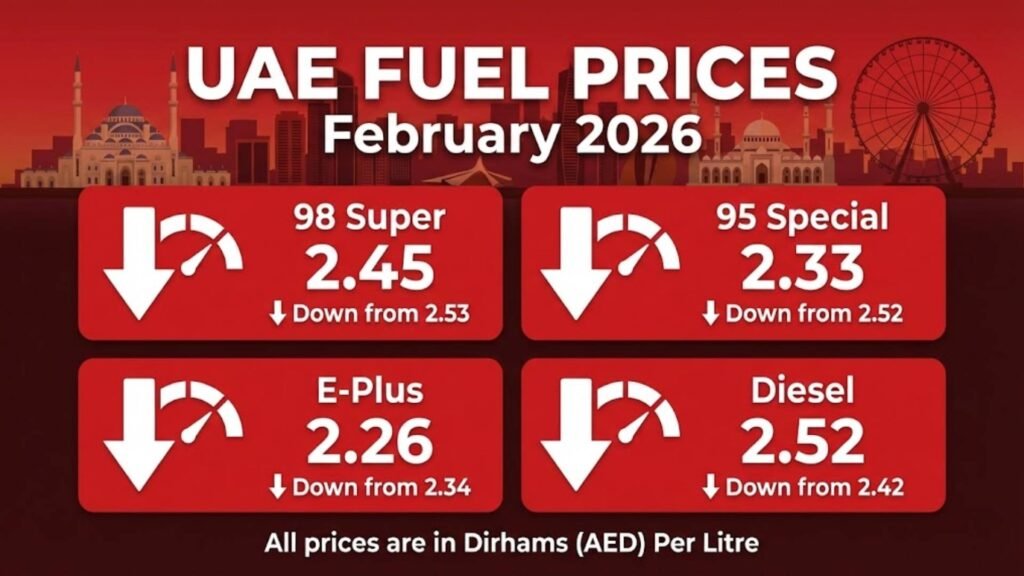
Looking for the latest petrol price in UAE for February 2026? The UAE fuel prices for this month show a welcome downward trend, with all gasoline grades and diesel experiencing price reductions compared to January 2026. Whether you’re a daily commuter in Dubai, a fleet manager in Abu Dhabi, or simply planning your monthly budget, understanding the current fuel prices in the UAE is essential for effective financial planning.
In this comprehensive guide, we break down the gasoline prices in Dubai and across the UAE for February 2026, compare them with previous months, analyze the factors driving these changes, and answer frequently asked questions about fuel pricing in the Emirates.
February 2026 UAE Fuel Prices at a Glance
| Super 98 | 2.45 AED/L |
| Special 95 | 2.33 AED/L |
| E-Plus 91 | 2.26 AED/L |
| Diesel | 2.52 AED/L |
Current Petrol Prices in UAE – February 2026
The UAE fuel prices for February 2026 have been officially announced by the UAE government, bringing good news for motorists across the Emirates. Effective from February 1, 2026, all fuel types have seen price reductions compared to the previous month.
Complete Fuel Price Breakdown
| Fuel Type | February 2026 | January 2026 | Change |
| Super 98 | 2.45 AED/L | 2.53 AED/L | -0.08 AED |
| Special 95 | 2.33 AED/L | 2.42 AED/L | -0.09 AED |
| E-Plus 91 | 2.26 AED/L | 2.34 AED/L | -0.08 AED |
| Diesel | 2.52 AED/L | 2.55 AED/L | -0.03 AED |
Table 1: UAE Fuel Prices for February 2026 (per litre)
UAE Fuel Price Comparison: Last Three Months
To better understand the pricing trends, here’s a detailed comparison of gasoline and diesel prices in the UAE over the past three months:
| Fuel Type | Feb 2026 | Jan 2026 | Dec 2025 | Trend |
| Super 98 | 2.45 AED | 2.53 AED | 2.70 AED | Downward |
| Special 95 | 2.33 AED | 2.42 AED | 2.58 AED | Downward |
| E-Plus 91 | 2.26 AED | 2.34 AED | 2.51 AED | Downward |
| Diesel | 2.52 AED | 2.55 AED | 2.85 AED | Downward |
Table 2: Three-Month Fuel Price Comparison (AED per litre)
Key Insights: February 2026 Fuel Price Changes
- Super 98: Decreased by 0.08 AED/L (3.16% reduction) – from 2.53 AED to 2.45 AED
- Special 95: Decreased by 0.09 AED/L (3.72% reduction) – from 2.42 AED to 2.33 AED
- E-Plus 91: Decreased by 0.08 AED/L (3.42% reduction) – from 2.34 AED to 2.26 AED
- Diesel: Decreased by 0.03 AED/L (1.18% reduction) – from 2.55 AED to 2.52 AED
These reductions reflect the ongoing volatility in global oil markets and the UAE’s commitment to maintaining competitive fuel prices while balancing economic sustainability.
Current Diesel Price in UAE
The diesel price in UAE for February 2026 is set at 2.52 AED per litre, down from 2.55 AED in January 2026. This modest reduction of 0.03 AED per litre provides some relief for commercial transport operators, logistics companies, and businesses dependent on diesel-powered machinery.
Diesel prices are particularly significant for the UAE’s logistics and transportation sectors, which form the backbone of the country’s trade and commerce infrastructure. Even small fluctuations in diesel costs can have cascading effects on goods pricing across the supply chain.
What Factors Influence Fuel Prices in the UAE?
Understanding the factors that drive petrol prices in the UAE can help consumers and businesses anticipate future changes. Here are the key determinants:
1. Global Crude Oil Prices
The most significant factor affecting UAE fuel prices is the international crude oil market. Brent crude and West Texas Intermediate (WTI) prices directly influence domestic fuel costs. Geopolitical tensions, production decisions by major oil-producing nations, and global economic conditions all play a role in determining crude oil prices.
2. OPEC+ Production Decisions
The Organization of the Petroleum Exporting Countries (OPEC) and its allies (OPEC+) control approximately 40% of global oil production. Their decisions to increase or decrease production quotas have immediate impacts on global supply and, consequently, fuel prices in the UAE and worldwide.
3. Supply and Demand Dynamics
Regional and global demand for petroleum products fluctuates based on economic activity, seasonal variations, and transportation needs. Higher demand typically leads to increased prices, while oversupply conditions can drive prices down.
4. Currency Exchange Rates
Since oil is traded globally in US dollars, fluctuations in the USD-AED exchange rate (though pegged) can influence fuel pricing calculations and import costs for refined products.
5. Government Policies and Subsidies
The UAE government reviews fuel prices monthly through the Fuel Price Follow-up Committee. While the UAE has moved toward market-linked pricing in recent years, government oversight ensures price stability and consumer protection.
6. Refining and Distribution Costs
The costs associated with refining crude oil into usable fuel products and distributing them across the UAE’s service station network also contribute to the final retail price.
How Do UAE Fuel Prices Compare Globally?
The UAE’s fuel prices remain among the most competitive globally, thanks to the country’s position as a major oil producer and its proximity to refining facilities. While prices are no longer heavily subsidized, they typically remain lower than in many European and Asian markets.
| Country/Region | Approx. Price (AED/L) |
| UAE | 2.33 – 2.52 AED |
| Saudi Arabia | 2.10 – 2.30 AED |
| United Kingdom | 7.50 – 8.00 AED |
| United States | 3.50 – 4.50 AED |
| India | 4.50 – 5.50 AED |
| Singapore | 6.00 – 7.00 AED |
Table 3: Global Fuel Price Comparison (approximate, per litre in AED equivalent)
Impact of Fuel Prices on UAE Residents and Businesses
Changes in gasoline prices in the UAE have far-reaching implications:
For Individual Motorists
- Monthly fuel expenses: directly impact household budgets
- Commuting costs: affect overall cost of living calculations
- Vehicle choice decisions: fuel efficiency considerations influence purchasing decisions
For Businesses
- Logistics and transportation companies: face direct cost impacts on operations
- Delivery services: must adjust pricing models based on fuel costs
- Manufacturing and construction sectors: experience operational cost changes
- Retail prices of goods: may fluctuate based on transportation costs
Future Outlook: What to Expect in March 2026

The UAE fuel prices are reviewed and updated on the first day of each month. New rates for March 2026 will be announced at the end of February 2026, taking into account:
- Global crude oil market trends
- OPEC+ production decisions
- Regional supply and demand factors
- International economic conditions
Motorists and businesses are advised to stay informed through official UAE government channels and reputable news sources for the latest updates on fuel pricing.
Money-Saving Tips for UAE Motorists
While you cannot control petrol prices in Dubai or the wider UAE, you can take steps to maximize fuel efficiency:
- Maintain Proper Tire Pressure: Under-inflated tires can increase fuel consumption by up to 3%
- Regular Vehicle Servicing: Clean air filters and properly tuned engines run more efficiently
- Smooth Driving Habits: Avoid rapid acceleration and heavy braking
- Remove Excess Weight: Extra load increases fuel consumption
- Use Air Conditioning Wisely: AC usage can increase fuel consumption by 5-10%
- Plan Your Routes: Combine errands and avoid peak traffic hours when possible
Frequently Asked Questions (FAQs)
What is the petrol price in UAE today?
As of February 2026, the current petrol prices in the UAE are: Super 98 at 2.45 AED/L, Special 95 at 2.33 AED/L, and E-Plus 91 at 2.26 AED/L. Diesel is priced at 2.52 AED/L. These prices are effective from February 1, 2026.
How much is a full tank of petrol in Dubai?
The cost of a full tank depends on your vehicle’s fuel tank capacity and the petrol grade used. For a typical 50-litre tank using Special 95 (2.33 AED/L), a full tank would cost approximately 116.50 AED.
Why do fuel prices change every month in the UAE?
The UAE government reviews fuel prices monthly to align with global oil market fluctuations. This market-linked pricing approach ensures transparency and reflects international crude oil price movements.
Which petrol should I use for my car in the UAE?
Always refer to your vehicle manufacturer’s recommendations. Most standard vehicles run efficiently on Special 95 (2.33 AED/L). High-performance vehicles typically require Super 98 (2.45 AED/L). Using a lower grade than recommended may affect engine performance.
Are fuel prices the same across all Emirates?
Yes, fuel prices are standardized across all seven Emirates (Dubai, Abu Dhabi, Sharjah, Ajman, Fujairah, Ras Al Khaimah, and Umm Al Quwain) as they are set by the UAE government’s Fuel Price Follow-up Committee.
How can I find the cheapest petrol station in Dubai?
Since fuel prices are regulated and standardized across the UAE, all petrol stations (ENOC, EPPCO, ADNOC, Emarat) charge the same price for each fuel grade. The price you pay will be identical regardless of which station you visit.
Conclusion
The petrol price in UAE for February 2026 brings welcome relief for motorists with across-the-board reductions in all fuel categories. Super 98 at 2.45 AED/L, Special 95 at 2.33 AED/L, E-Plus 91 at 2.26 AED/L, and diesel at 2.52 AED/L represent significant savings compared to December 2025 prices.
These price adjustments reflect the dynamic nature of global oil markets and the UAE’s responsive pricing mechanism. Whether you’re budgeting for personal transportation or managing commercial fleet operations, staying informed about fuel price trends helps in effective financial planning.
Bookmark this page and check back at the beginning of March 2026 for updated fuel prices. For the most current information, always refer to official UAE government announcements.