
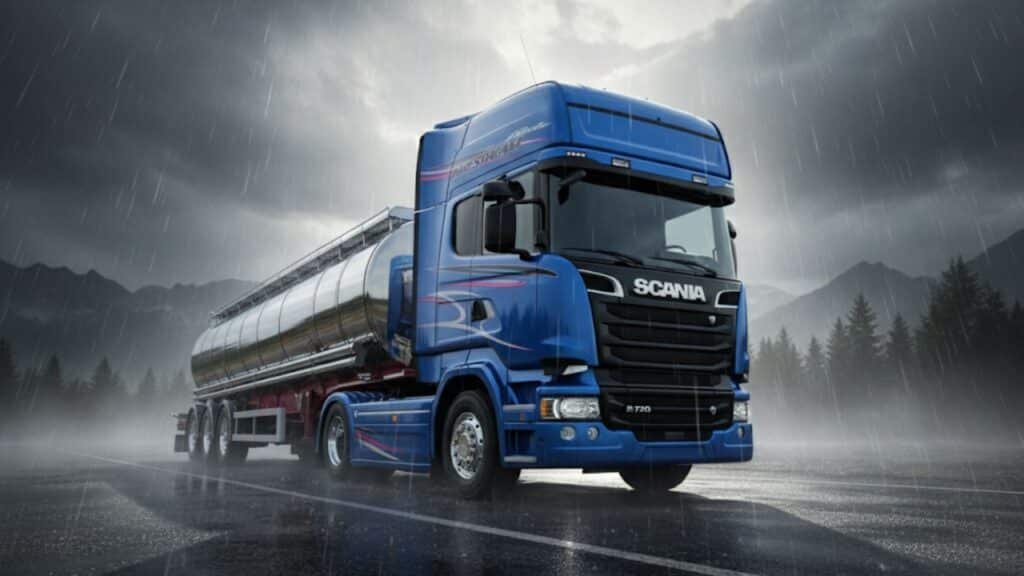
The Scania R730 stands as a titan in the world of heavy-duty transport, a vehicle synonymous with immense power and capability. For fleet managers and owner-operators, however, the allure of its legendary V8 engine is always weighed against a critical operational metric: fuel consumption. Understanding the true Scania R730 MPG is not just about a single number; it’s about decoding its performance under the extreme conditions it was built to conquer. This comprehensive report provides an expert-level analysis of the R730’s fuel economy, delves into the specifications of its powerhouse engine, and benchmarks it against competitors. Furthermore, it expands to cover the entire Scania R-series, examining engine reliability, longevity, and the enduring debate: Scania versus Volvo.
The Scania R730: the Real-World MPG and Fuel Consumption
The conversation around the Scania R730‘s fuel consumption must begin with a crucial understanding of its purpose. This is not a truck designed for hypermiling with light loads on flat terrain. It is an engineering masterpiece built for the most demanding haulage tasks, where moving massive weight efficiently is the primary goal. Its fuel consumption figures are a direct reflection of the incredible work it performs.
What is the True Fuel Consumption of the Scania R730?
Pinpointing a single MPG figure for the Scania R730 is misleading, as its consumption is highly sensitive to terrain, load, and even weather. However, independent tests and real-world operator data provide a clear and realistic range.
During a comprehensive road test conducted by Commercial Motor, the R730 demonstrated a fuel economy range between 7.02 MPG and 8.19 MPG. The variance in these figures was directly attributed to operational conditions; the lower figure was recorded on a day with strong westerly winds battering the truck, while the higher figure was achieved on the opening day of the test. The most challenging segment, featuring severe gradients, saw consumption drop to 5.96 MPG, highlighting the significant impact of terrain on performance.
This data aligns with reports from operators in the field. In Australia, where the R730 is often used in quad-roadtrain configurations grossing up to 130 tonnes, one operator reported using 630-650 litres of diesel per trip. Notably, this was a similar quantity of fuel used by a 600hp Mack truck pulling a lighter 130-tonne triple combination, showcasing the R730’s relative efficiency when performing extreme work. For operators in very mountainous terrain with loads consistently over 40 tons, the powerful V8 is essential, though it comes at a cost. One driver noted a 2 MPG penalty compared to a less powerful model, a trade-off for the torque required to handle such conditions.
It is also important to consider the total fluid consumption. The R730 utilizes AdBlue (Diesel Exhaust Fluid) for its Selective Catalytic Reduction (SCR) emissions system. Consumption is typically around 5-6% of fuel use, which adds a tangible cost to every mile driven. In the Commercial Motor test, this equated to an additional cost of approximately £2.07 per 100 km on top of the fuel cost.
Ultimately, the R730’s fuel consumption should not be viewed through the lens of a standard long-haul truck but as a measure of its extraordinary work capacity. The key performance indicator for a vehicle in this class is not simply miles per gallon, but rather fuel consumed per ton-mile. When hauling immense loads that would stall lesser trucks, the R730’s ability to convert fuel into productive work demonstrates a unique form of efficiency.
The Power Behind the Performance: How Many Horsepower Does a R730 Have?
The heart of the Scania R730 is its iconic DC16 V8 engine, a 16.4-litre, 90-degree V8 that has become legendary in the trucking industry. This engine produces a headline-grabbing
730 horsepower (approximately 544 kW) at around 1800-1900 RPM.
However, for the operators who rely on this truck, the more critical figure is its colossal torque output. The R730’s engine delivers an astonishing 3,500 Nm (2,581 lb-ft) of torque. What makes this figure truly remarkable is that this peak torque is available across a wide, low-rev band, from just 1,000 to 1,400 RPM. This characteristic is the essence of Scania’s “low-rev philosophy.” While horsepower is what allows the truck to maintain high speeds on the highway, it is this immense, readily available torque that gets the heavy load moving and pulls it relentlessly up steep grades.
This low-rev design has profound real-world benefits. By delivering maximum pulling power at low engine speeds, the R730 can hold a higher gear for longer, significantly reducing the number of downshifts required on rolling terrain. A review of the truck pulling an 80-tonne C-train noted that the V8 did a “sensational job of highway hills,” lugging down where needed but maintaining a high average speed with minimal gear changes. Scania itself recommends a cruising speed of just 1,000 RPM for the R730, a lower sweet spot than even the powerful R620. This ability to work “smarter, not harder” reduces stress on the engine and driveline, directly contributing to the enhanced durability and longevity for which Scania engines are renowned.
Comparative Fuel Economy: R730 vs. the Competition
In the ultra-high-power segment, the Scania R730’s primary rival has historically been the Volvo FH16. In a direct comparison test, the Volvo FH16 700 returned an overall average of 7.81 MPG. This gave it a slight edge over the R730, which averaged between 7.02 and 8.19 MPG under the same test conditions.
The key difference emerged in specific sections of the test. On easier A-roads and motorways, the Volvo achieved an impressive 9.0 MPG, more than 1.1 MPG better than the Scania’s 7.84 MPG on the same stretch. However, on more demanding sections, their figures were much closer.
This data points to a fundamental difference in engineering philosophy between the two Swedish giants. Volvo’s inline-six engine and I-Shift transmission are exceptionally optimized for fuel-efficient, steady-state cruising on highways, a well-known brand strength. The Scania V8, while still efficient, is engineered to excel under extreme load, where its raw torque and pulling power provide an operational advantage. The choice between them, therefore, is not about which is universally superior, but which is better suited for a specific application.
Scania R-Series Fuel Efficiency
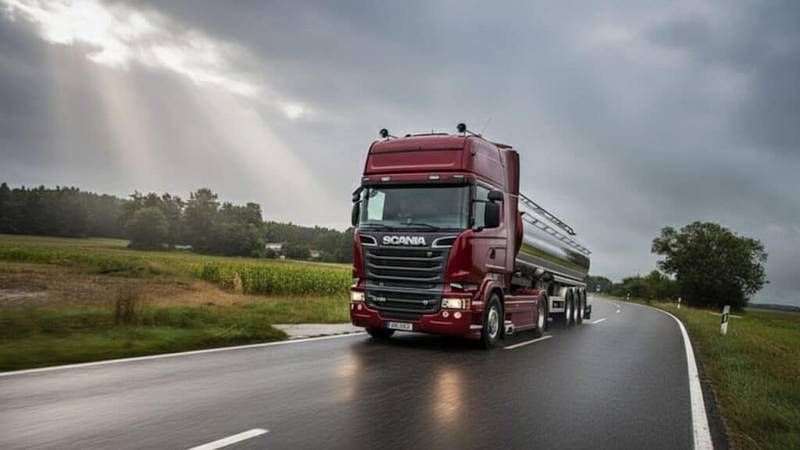
While the R730 is Scania’s flagship powerhouse, the broader R-Series is celebrated for its overall fuel efficiency. This reputation is not based on marketing claims but on a legacy of validated, real-world performance that consistently places Scania at the top of the industry for operational economy.
An Award-Winning Legacy: The R-Series Reputation for Fuel Efficiency
Scania’s commitment to fuel efficiency is best demonstrated by its consistent success in independent testing. The company won the prestigious “Green Truck” award for four consecutive years up to 2020, a German comparison test rigorously monitored on public roads. This award validates Scania’s holistic approach to efficiency, which combines:
- Advanced Engine Technology: From powerful V8s to hyper-efficient inline-sixes.
- Superior Aerodynamics: The R-Series cab has been rigorously tested and refined to reduce air resistance, directly improving fuel economy.
- Driver Support Systems: The dashboard includes a support screen that tracks fuel economy and driving style, providing real-time feedback to help drivers operate more efficiently.
This combination results in impressive figures across the R-Series lineup, with some configurations boasting an average consumption as low as 23.25 litres per 100 km (12.1 MPG).
The following table provides a comparative overview of the key models within the Scania R-Series, highlighting their performance and fuel consumption characteristics.
| R730 | 16.4L V8 | 730 | 3500 | 7.0 – 8.2 MPG (28-33 L/100km) |
| R580 | 16.4L V8 | 580 | 3000 | 3.5 – 4.7 MPG (50-67 L/100km) / 30-40 L/100km (Long Haul) |
| R540 | 12.7L I6 | 540 | 2700 | ~11.2 MPG (25.1 L/100km) (Test Conditions) |
| R500 | 12.7L I6 | 500 | 2550 | 2.8 – 3.5 MPG (67-83 L/100km) (Tipper Application) |
| R460 Super | 13L I6 | 460 | 2500 | ~11.9 MPG (19.7 L/100km) (Test Conditions) |
Scania R500 & R580 Fuel Consumption: The V8 Workhorses
The R500 and R580 models represent the versatile workhorses of Scania’s engine lineup, offering substantial power for a wide range of applications.
- Scania R500: Data from markets like India, where the R500 is often used in heavy tipper applications, suggests a tentative mileage of 1.2-1.5 km/L. This translates to approximately 2.8-3.5 MPG or a consumption rate of 67-83 L/100km, reflecting its use in demanding, low-speed, off-road, or construction environments. However, generational improvements have made a significant impact. A Swiss haulage company reported that its new generation Scania R 500 consumed 16.5% less fuel than its older R 490 model performing the exact same work, resulting in substantial annual savings.
- Scania R580: The R580, often used in long-haul heavy transport, shows slightly better fuel economy. Tentative figures place its mileage in the range of 1.5-2 km/L, or about 3.5-4.7 MPG (50-67 L/100km). Real-world discussions among European drivers suggest that for typical long-haul work with a 35-tonne gross weight, an average consumption of 30-40 L/100km (7.1-9.4 MPG) is an achievable target.
The Scania R540: The Efficient Powerhouse
The Scania R540 demonstrates that exceptional power and efficiency are not limited to the V8 range. Powered by a highly advanced 12.7-litre inline-six diesel engine, the R540 produces a formidable 540 hp and 2,700 Nm of torque. This model is a testament to Scania’s engineering prowess, proving that a well-designed inline-six can deliver performance that rivals smaller V8s while offering superior fuel economy. Its capabilities were showcased in the 2020 “Green Truck” test, where an R 540 not only won the award but did so with an average fuel consumption of just
25.14 L/100km (11.2 MPG), all while achieving the highest average speed of all competitors.
Which Scania is the Most Fuel Efficient? Meet the Champion
For operators where fuel economy is the absolute top priority, the undisputed champion of the Scania lineup is the Scania R460 Super Highline. In the 2024 “Green Truck” comparison test, this model was crowned the most fuel-efficient tractor unit available.
It achieved this title by recording an astonishing average fuel consumption of 11.9 MPG (19.7 L/100km). This performance was not just good; it was dominant. The R460 Super was 0.41 litres per 100 km more efficient than its closest competitor. For a long-haul truck traveling 150,000 km per year, this difference translates into a saving of over 600 litres of fuel annually.
This remarkable achievement is credited to Scania’s groundbreaking “Super” powertrain. Introduced in 2021, this new 13-litre engine platform delivered a step-change in efficiency, providing an 8% fuel saving over the already-efficient previous generation. Scania’s repeated victories in the “Green Truck” awards—winning 9 of the 14 times the competition has been held—is a clear indicator of a deliberate corporate strategy. It demonstrates that the company’s engineering focus is not solely on the raw power of its V8s but on delivering class-leading total operating economy across its entire product range.
Scania Engines: A Masterclass in Durability and Reliability
Beyond power and efficiency, the cornerstone of Scania’s reputation is the legendary durability of its engines. For any transport business, reliability is paramount, as unplanned downtime is one of the most significant threats to profitability. Scania has built its brand on producing engines that are not just powerful, but are built to last.
How Long Do Scania Engines Last? The Million-Kilometer Benchmark
With proper care and adherence to manufacturer service schedules, a Scania engine is fully capable of exceeding 1,000,000 kilometers (approximately 620,000 miles). Industry experts agree that for a well-maintained heavy-duty truck engine, a mileage of 500,000 km is not considered high.
The single most critical factor in achieving this longevity is timely and correct maintenance. Following the manufacturer’s recommended service intervals for replacing oil, filters, and coolant is essential. Regular oil changes, in particular, are the lifeblood of a truck engine. Scania provides detailed preventative maintenance schedules tailored to different operational types, with recommendations for replacing major components like turbochargers at intervals ranging from 400,000 km for severe-duty applications to 900,000 km for standard long-haul transport. This proactive approach to maintenance is key to ensuring the engine reaches its full potential lifespan.
How Reliable Are Scania Engines? I-Series and G-Series In Focus
Scania engines are renowned for their reliability, a reputation built over decades of service in the world’s most demanding conditions. The company’s newest generation of inline engines even claims an increase in the base engine lifespan by up to 50% over the previous, already industry-leading generation.
However, the reality of modern diesel engines is complex. While Scania’s core mechanical components—the engine block, crankshaft, and pistons—remain exceptionally robust, the sophisticated ancillary systems required to meet modern emissions and performance standards can introduce new points of failure. Real-world feedback from mechanics and operators provides a balanced view:
- I-Series (Inline) Engine Issues: Forum discussions among experienced technicians reveal that some of the more common issues are related to these complex systems, especially on earlier Euro 5 and Euro 6 models.
- Fuel Systems (XPI/HPI): Early common-rail XPI systems were sensitive to fuel quality, with some early R480 models experiencing injector problems due to contaminated diesel. The older HPI system has also been reported to break down, causing significant downtime.
- Emissions Systems (EGR/VGT): Early XPI engines could suffer from condensation buildup in the secondary EGR cooler, which in rare cases could lead to head gasket failure. The Variable Geometry Turbo (VGT) can be prone to getting stuck, particularly on trucks that run fully loaded in one direction and empty on the return leg, as the lack of consistent load can affect the VGT’s self-cleaning cycle.
- Sensors: Like any modern engine, Scania’s are reliant on a host of sensors. A faulty crankshaft sensor, for example, has been diagnosed as the cause of a misfire, excessive smoke, and a heavy diesel knock.
- G-Series Reliability: The G-Series is generally regarded as a reliable and functional workhorse. However, it is not immune to issues. One review of a Scania G380 reported a failure of its HPI fuel system after just one month of rental service, resulting in a low reliability score of 2.0 out of 5.0 for that specific vehicle.
This feedback highlights a critical distinction for potential buyers. An investment in a Scania truck is an investment in a mechanically superb and durable core engine. However, achieving operational reliability in the modern era also requires a commitment to the proper maintenance and diagnosis of its advanced electronic and emissions control systems.
The Heart of the Operation: Where Are Scania Engines Made?
Scania is a truly global company with a manufacturing footprint that spans the world. While its headquarters and primary research and development remain in Södertälje, Sweden, the company has major production facilities across Europe, including France, the Netherlands, Poland, and Finland. It also has significant manufacturing and assembly plants in South America (Brazil and Argentina) and Asia to serve those key markets.
Scania Fuel Tank Capacity
To support a wide variety of applications, Scania offers a modular range of fuel tank options. Capacities can range from as small as 150 litres for specialized urban vehicles to as large as 900 litres for long-haul tractors. For extreme applications, such as the R730 road train operating in the Australian outback, standard chassis-mounted tanks are insufficient, necessitating the fitment of additional gantry-mounted tanks to ensure adequate range.
Why is Scania Better Than Volvo? (Or Is It?)
The rivalry between Scania and Volvo is one of the most passionate in the entire automotive world. Both are Swedish icons, both are global leaders in heavy transport, and both command intense loyalty from their customers. The question of which is “better” has no simple answer, as it delves into differing philosophies of engineering, design, and driver experience. The choice often comes down to an operator’s specific priorities and needs.
| Feature | Scania | Volvo |
| Performance Philosophy | Raw Power & Durability (V8 Focus) | Smooth Precision & On-Road Efficiency |
| Driver Comfort | High, but more driver-focused/traditional | Industry leader in ergonomics and comfort |
| Technology & Innovation | Excellent (Opticruise, Super Powertrain) | Benchmark (I-Shift, advanced safety systems) |
| Perceived Reliability | Legendary mechanical durability | Excellent uptime, advanced diagnostics |
| Ideal Application | Heavy Haulage, Demanding Terrains, Vocational | Long-Haul Highway, Fleet Operations |
A Head-to-Head Comparison: Power, Comfort, and Efficiency
A detailed breakdown of how the two brands stack up reveals these philosophical differences in practice:
- Performance and Power: Scania is almost universally praised for its raw power, rugged durability, and the emotional appeal of its V8 engine’s unique growl. Drivers and operators who prioritize sheer pulling force and performance under the most extreme loads often gravitate towards Scania. Volvo, in contrast, is lauded for its seamless precision and smooth power delivery. Its engines, particularly the D13 and D16 inline-sixes, are engineered for reliable, efficient performance, executing every task with a quiet competence.
- Comfort and Technology: This is an area where Volvo is often perceived to have an edge. Volvo trucks are renowned for their exceptional driver comfort, ergonomic cab design, and cutting-edge technology. The Volvo I-Shift automated transmission is frequently cited as the industry benchmark for its smoothness and intelligence. Scania cabs are also highly comfortable and driver-centric, but some argue they lag slightly behind Volvo in achieving the perfect balance of ultimate comfort and functionality.
- Fuel Efficiency: The battle for fuel efficiency is incredibly close. As noted, Volvo often shows an advantage in on-highway, steady-speed applications. However, Scania’s “Super” powertrain and its repeated “Green Truck” victories prove that it is, at minimum, a world-class competitor and, in many tested configurations, the outright leader in overall transport efficiency. The choice depends heavily on the specific route and application.
- Reliability and Maintenance: Both brands enjoy an enviable reputation for building reliable, long-lasting trucks. Their approaches, however, differ slightly. Scania’s reputation is built on a foundation of exceptional mechanical durability and a modular design that simplifies certain repairs. Volvo champions a more proactive approach to maintenance, leveraging advanced diagnostics and a comprehensive service network to maximize vehicle uptime.
Frequently Asked Questions (FAQ) for Truck Operators
This section provides clear, concise answers to some of the most common questions related to heavy truck fuel consumption and operation.
What is the average MPG for a Heavy Goods Vehicle (HGV)?
On average, a fully loaded Class 8 semi-truck in the United States can be expected to achieve around 6 to 8 miles per gallon (MPG). A Canadian study found a similar average of 39.5 L/100km, which is approximately 7 MPG. This figure can vary significantly based on factors like load, terrain, speed, and vehicle aerodynamics.
How many litres per 100 km does a typical truck use?
A typical European long-haul truck consumes between 30 and 40 litres of diesel per 100 kilometers. This figure is for standard operations. More demanding applications, such as B-train combinations, can see consumption rise significantly, with averages around 57.6 L/100km.
How does payload weight affect fuel consumption per ton?
Payload weight has a direct and significant impact on fuel consumption. The heavier the vehicle, the more energy is required to move it. Industry research indicates that a 10% increase in the gross vehicle weight can result in a 5% increase in fuel consumption. This is why optimizing payload and avoiding unnecessary weight is a key strategy for improving a fleet’s overall efficiency.
Are diesel trucks getting better MPG?
Yes, modern diesel trucks are significantly more fuel-efficient than their predecessors. Continuous improvements in engine technology, aerodynamics, transmission efficiency, and tire rolling resistance have led to substantial gains. An independent test comparing a 2016 Scania S 500 to a 1992 Scania Streamline 143 with the same horsepower found that the modern truck was 25% more fuel-efficient.
How can I calculate my truck’s fuel consumption?
To calculate the amount of fuel needed for a trip, use the following simple formula: Fuel Needed (in gallons) = Total Trip Distance (in miles) ÷ Vehicle’s Fuel Efficiency (in MPG). To determine the total fuel cost for the trip, you then multiply the amount of fuel needed by the price per gallon.
Checkout: Electric car with 300 mile range on a Budget: It’s Possible