
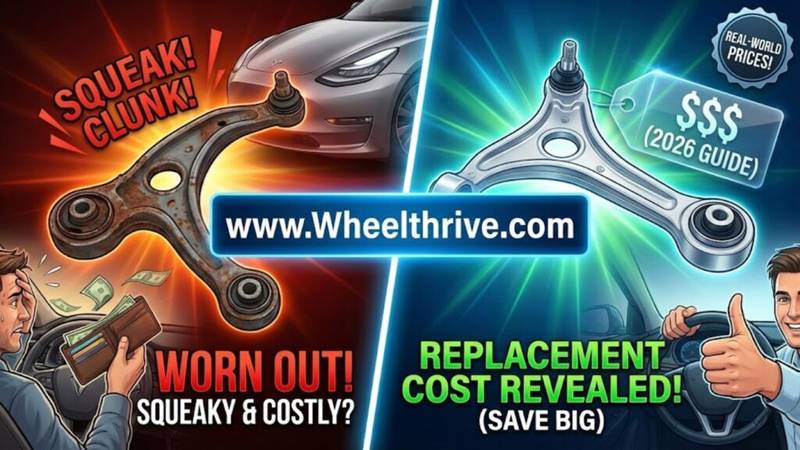
In 2026, replacing both front upper control arms on a Tesla Model 3 costs between $1,100 and $1,300 at a Tesla Service Center. However, independent EV shops typically charge $700 to $900 using upgraded aftermarket parts. If you are handy, a DIY repair costs roughly $250 in parts.
If your sleek electric sedan has started sounding like an old mattress every time you turn the wheel or hit a speed bump, you are dealing with the notorious “Tesla Squeak.” It’s annoying, embarrassing, and if ignored, potentially dangerous. Below, we break down exactly what you should pay to fix it and why the dealership might not be your best option.
The “Tesla Squeak”: Symptoms & Diagnosis
Before you spend money, confirm the diagnosis. The sound is distinctive a high-pitched creaking or groaning noise coming from the front wheel wells. It is most audible at low speeds, such as navigating a parking garage or turning into a driveway.
The Cause:
The ball joint boot on the original 2017-2023 Tesla control arms was poorly sealed from the factory. Over time, water splashes up, enters the boot, and settles on the metal ball joint. Rust forms, causing the joint to grind dry against the housing.
The Test:
- Park the car on level ground.
- Open the frunk.
- Push down firmly on the front bumper (you might need a friend to help get enough movement).
- If it squeaks in rhythm with the bounce, your Upper Control Arms (UCAs) are toast.
Cost Breakdown: Service Center vs. Independent
Labor rates have shifted significantly in 2026. Here is the math to help you decide where to take your car.
| Service Provider | Parts Cost (Pair) | Labor Cost | Total Est. | Warranty |
| Tesla Service Center | $380 (OEM Rev J) | $820 (3.5 hrs @ $235/hr) | $1,200 | 12 Months |
| Independent EV Shop | $250 (Meyle HD) | $525 (3.5 hrs @ $150/hr) | $775 | Varies |
| DIY (Do It Yourself) | $250 (Aftermarket) | $0 (Your Sweat) | $250 | Parts Only |
Note: Tesla Service Center labor rates have hiked to approximately $235/hr in many major metro areas for 2026, driving the “Official” repair cost up significantly compared to previous years.
OEM vs. Aftermarket: Is “Meyle HD” Worth It?
When you go to an independent shop or do it yourself, you have a choice: buy the Tesla part or go aftermarket.
OEM (Tesla)
- Pros: Guaranteed fit; latest “Revision” (currently Rev J or newer) supposedly addresses the sealing issue.
- Cons: Even the newer revisions are prone to failure eventually. The design prioritizes lightweight aluminum but remains fragile in wet climates.
Aftermarket (Meyle HD / Unplugged Performance)
- Recommendation: Meyle HD is widely considered the gold standard in 2026.
- Why: They use a larger ball joint head and significantly better rubber sealing materials. They often come with a 4-year warranty, which is 4x longer than Tesla’s parts warranty.
- Cost: Often cheaper or the same price as OEM, but they typically last 2x longer.
The “Grease Injection” Fix (The $10 Band-Aid)
Browse any forum, and you will see people suggesting the “needle method.”
What is it?
You use a needle grease gun nozzle to puncture the rubber dust boot of the control arm and inject lithium grease directly into the joint.
Does it work?
Yes, it usually stops the squeak instantly for 3-6 months.
The Danger:
This is temporary. The squeak exists because the joint is already pitted and rusted. Grease lubricates the rust, but it doesn’t fix the pitted metal. Eventually, the arm could physically separate, causing the wheel to fold under the car while driving.
Verdict: Do this only while waiting for your replacement parts to arrive (1-2 weeks max). Do not treat it as a permanent repair.
Will Tesla Cover This Out of Warranty?
This is a known manufacturing defect, referenced in internal documents like TSB-20-31-006.
The Strategy:
If you are at 51,000 miles (just barely out of the 50k bumper-to-bumper warranty), do not just accept the $1,200 quote. Politely ask the Service Advisor for a “Goodwill Repair” given the low mileage and known history of this part failing.
Success Rate:
In 2026, success is low (around 20%), as the fleet has aged and Tesla has tightened its purse strings. However, it is always worth asking before you authorize the charge. Check your specific warranty coverage for suspension components before booking to ensure you aren’t actually still covered under a specific state law or extended plan.
Refer to our guide: Is the Tesla Extended Warranty Worth It?
Step-by-Step DIY Overview (Is it Hard?)
Difficulty: 6/10 (Intermediate)
Tools Needed:
- Floor Jack & Tesla Lift Puck
- 15mm & 18mm sockets
- Torque Wrench (Must be able to hit 56 Nm accurately)
The Tricky Part:
The bolts for the upper control arm are often physically blocked by the 12V battery bracket (driver side) or the air intake box (passenger side). You cannot just reach in and unbolt them; you have to remove the “frunk tub” (the plastic storage bin) to access the bolt heads properly. This adds about 30 minutes to the job but makes the actual suspension work much easier.
Budgeting for these is part of understanding out-of-warranty EV repair costs.
Frequently Asked Questions
Q: Do I need an alignment after replacing control arms?
- A: ABSOLUTELY. Changing suspension geometry affects both toe and camber. Without a professional alignment (approx. $200), you will ruin your tires in less than 1,000 miles. Do not skip this step.
Q: Can I just replace the bushings?
- A: No. On the Tesla Model 3, the ball joint is integrated permanently into the aluminum arm. You must swap the whole unit.
Q: Is the “lower” control arm the same price?
- A: No. The lower arms (often called Lateral Links or Compression Rods) are actually more expensive ($400+ per part) and much harder to replace due to the tension on the springs.
Final Take
If you plan to keep your Model 3 for another 50,000 miles, skip the Tesla OEM part. Buy the Meyle HD arms and pay a local independent EV shop to install them. You will save roughly $400 upfront and likely never have to deal with the squeak again.
Don’t ignore the squeak. A separated ball joint at 70mph is catastrophic. Order your replacement arms today.
For more verification on failure rates, you can check the NHTSA complaints page for “Tesla Model 3 Suspension.” You can also find the specific aftermarket parts at the Meyle Official Catalog.