
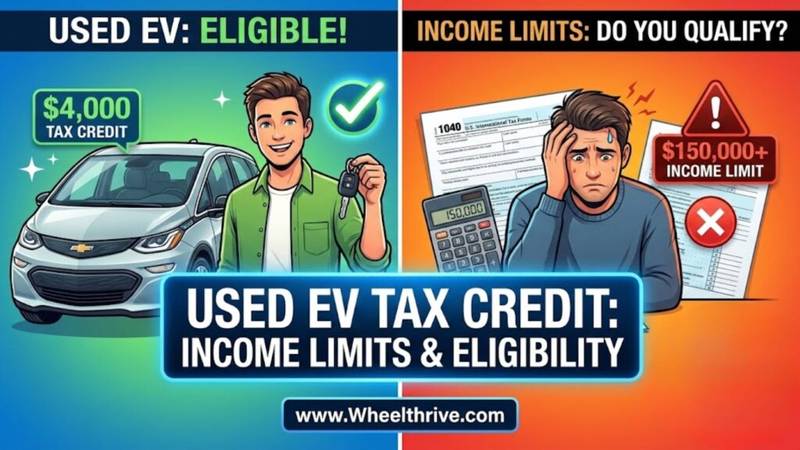
For the 2025 tax year (filed in 2026), the Modified Adjusted Gross Income (MAGI) limits for the Used EV Tax Credit are $75,000 for single filers, $112,500 for heads of household, and $150,000 for joint filers. If you exceeded these caps, you may need to repay the point-of-sale rebate to the IRS.
The “One Big Beautiful Bill” 2026
If you are reading this in early 2026, the landscape for electric vehicle incentives has shifted dramatically. Under the One Big Beautiful Bill Act (OBBBA), the general availability of the used EV tax credit (Section 25E) for new purchases officially expired on September 30, 2025.
This guide is specifically designed for two groups of people:
- Tax Filers: You bought a used electric vehicle between January 1, 2025, and September 30, 2025, and you are now sitting down to file Form 8936 to reconcile your taxes.
- Delivery Loophole Buyers: You signed a binding contract to purchase a qualified used EV before the September 30 deadline but took delivery in early 2026.
If you are looking to buy a used EV today without a prior contract, unfortunately, the federal incentives have largely dried up, but knowing the rules can save you from a massive tax bill if you already claimed the money at the dealership.
The Magic Numbers: Do You Qualify?
The most critical part of filing your 2025 taxes is understanding the “Lesser Of” rule. This is the loophole that saves thousands of taxpayers from having to pay back the IRS.
The “Lesser Of” Rule Explained:
To qualify for the credit, your Modified Adjusted Gross Income (MAGI) must be below the cap in either:
- The year you took delivery (2025)
- OR the year prior (2024)
This is a massive benefit. For example, if you made $74,000 in 2024 but got a promotion and earned $85,000 in 2025, you still qualify by using your 2024 income. You essentially get two shots at meeting the requirement.
Income Limit Reference Table:
| Filing Status | MAGI Limit (Cap) |
| Single / Married Filing Separately | $75,000 |
| Head of Household | $112,500 |
| Married Filing Jointly | $150,000 |
What is MAGI?
For 99% of taxpayers, your Modified Adjusted Gross Income is identical to your Adjusted Gross Income (AGI). You can find this number on Line 11 of your Form 1040. It only differs if you have foreign income exclusions or income from Puerto Rico/American Samoa. While saving on taxes, don’t lose money on premiums. Check our guide to insurance for used EVs to ensure you are fully protected.
The “Clawback” Nightmare: Did You Earn Too Much?
This is the scenario keeping people up at night during the 2026 filing season.
The Scenario:
You went to the dealership in June 2025. The dealer verified your license, and you transferred the $4,000 credit to them for an instant discount on the car. At the time, you signed an affidavit stating you thought your income would be under the limit. But life happened—you got a bonus, sold some stock, or worked overtime—and your final 2025 income ended up being $76,000 (just $1,000 over the limit).
The Consequence: Recapture
If your income in both 2024 and 2025 exceeds the limits listed above, you are not eligible. On your 2025 tax return (specifically Line 24 of Form 1040 via Form 8936), the IRS will add that $4,000 back to your total tax bill. You have to pay it back.
The Advice:
Before you panic, pull up your 2024 tax return immediately. If your MAGI on that return was under $75,000 (for singles), you are safe. You qualify based on the prior year rule, and you keep the money.
Vehicle Eligibility: The $25,000 Hard Cap
Even if your income is perfect, the car itself must meet strict criteria. The most common point of failure is the sale price cap.
The Rule: The sale price must be $25,000 or less.
The “Junk Fee” Trap:
Many buyers were tricked by dealers who listed a car for $24,500 but added fees.
- Taxes & Registration: These do not count toward the $25k limit.
- Dealer Doc Fees & Add-ons: These do count.
Example:
If you bought a Tesla Model 3 for $24,500 and the dealer charged a $600 “Document Fee,” the total sale price is $25,100. The credit is denied. Period.
Model Year Rule:
The car must be at least two model years old at the time of purchase. For a purchase made in 2025, the vehicle must be a Model Year 2023 or older. Cheap EVs often come with hidden costs. Read about used EV repair risks before you commit to an older model just to get a tax break. Ensure the low price isn’t due to a bad battery. Check the EV battery replacement cost by model first.
How to File Form 8936 in 2026
Filing for the used EV tax credit in 2026 is slightly different because most people already received the money upfront. You are filing primarily to “reconcile” the transaction.
- Get the Time-of-Sale Report: You cannot claim this credit without the official report the dealer submitted to IRS Energy Credits Online. This document contains the submission ID you need.
- Verify VIN: Enter the Vehicle Identification Number (VIN) exactly as it appears on your registration.
- Calculate Credit: Enter the lesser of $4,000 or 30% of the sale price. (If you bought a cheaper EV for $10,000, your credit is only $3,000).
- Recapture Check: If you received the transfer at the dealer, Line 9 of Schedule A (Form 8936) will ask for the amount. If you are eligible, this zeroes out. If you are ineligible due to income, this amount flows to your tax liability line.
Frequently Asked Questions
Q: Can I still get the credit if I buy a used EV today (Jan 7, 2026)?
- Generally, no. The One Big Beautiful Bill Act effectively expired the credit for new purchase agreements on September 30, 2025. Unless you have a binding written contract signed before that date, you missed the window for this specific federal incentive. You can check the archive of eligible vehicles at Fueleconomy.gov to see what would have qualified.
Q: Does the income limit apply to gross or net income?
- It applies to Modified Adjusted Gross Income (MAGI). This is essentially your “Pre-Tax” income before you take standard or itemized deductions. It is usually higher than your “Net Pay” but lower than your total gross salary if you contribute to a 401(k).
Q: Can I use the credit if I bought from a private seller?
- No. To prevent fraud, the IRS requires that you buy from a licensed dealer who is registered with the IRS Energy Credits Online portal. Private party sales on Craigslist or Facebook Marketplace never qualified for the credit. the savings can help buffer potential out-of-warranty repair costs.
Conclusion
If you bought a used EV in 2025, the most important task you have this tax season is verifying your income using the “Two-Year Lookback.” Remember, you only need to pass the income test in 2024 OR 2025, not both.
Check Line 11 on your 2024 tax return right now. If it’s under $75,000 (for single filers), you are likely safe from the IRS clawback and can file with confidence.