
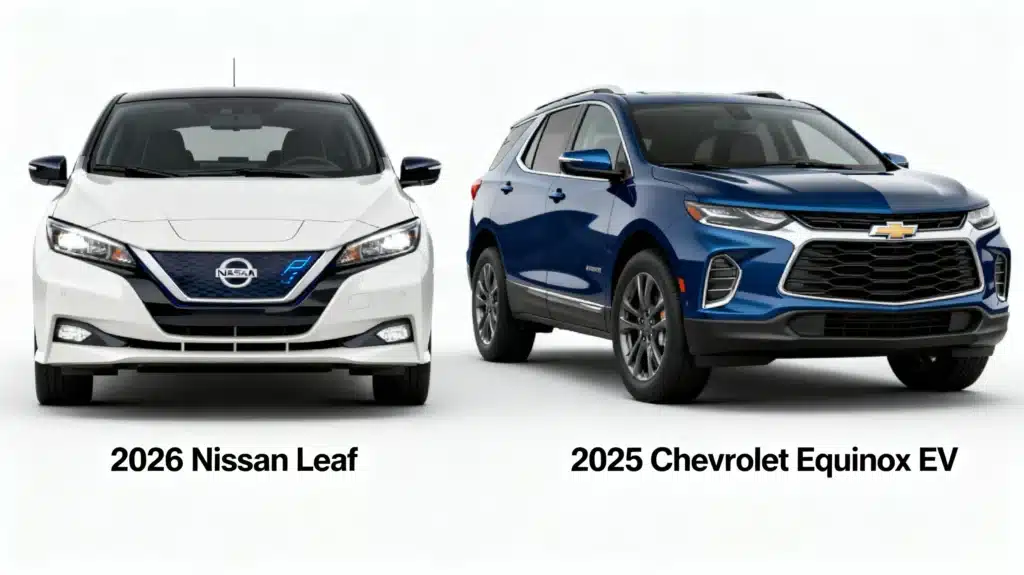
Shopping for an affordable electric crossover in 2026? You’re looking at two of the most compelling options in the budget-friendly EV space: the all-new 2026 Nissan Leaf and the 2025 Chevrolet Equinox EV. Both vehicles promise to deliver practical electric transportation without the premium price tag, but they take distinctly different approaches. The Leaf enters the market at $29,990, making it America’s most affordable EV, while the Equinox EV counters with superior range and available all-wheel drive starting at $34,995. This comprehensive comparison breaks down everything you need to know to make the right choice for your family.
The battle between these affordable electric vehicles represents a pivotal moment for mainstream EV adoption. With federal tax credits ending September 30, 2025, and both vehicles offering different value propositions, understanding their strengths and weaknesses has never been more critical for budget-conscious buyers.
Price and Value: Breaking Down the Bottom Line
When it comes to the 2026 Leaf vs Equinox EV pricing battle, the numbers tell an interesting story that goes beyond the sticker price.
Starting MSRP Comparison
The 2026 Nissan Leaf S+ enters the market at an aggressive $29,990, undercutting virtually every competitor in the electric crossover segment. This positions the Leaf as the most accessible entry point for families transitioning to electric vehicles. Moving up the trim ladder, the SV+ starts at $34,230, while the fully-loaded Platinum+ tops out at $38,990.
The 2025 Chevrolet Equinox EV LT begins at $34,995 for the front-wheel-drive configuration. While $5,000 more expensive than the base Leaf, the Equinox EV offers significantly more interior space and cargo capacity. All-wheel-drive models add another $3,300 to the price, bringing the LT AWD to $38,295. The sportier RS trim starts at $43,400 for FWD models.
Federal Tax Credit Eligibility
Both vehicles qualified for the full $7,500 federal EV tax credit through September 30, 2025. This incentive dramatically altered the value equation, potentially bringing the effective price of the Leaf S+ down to approximately $22,490 and the Equinox EV LT to around $27,495. However, with the tax credit ending, the price gap between these vehicles becomes more significant for buyers taking delivery after September 2025.
The Equinox EV qualifies for the credit because it’s assembled in Mexico at GM’s Ramos Arizpe plant, while the 2026 Leaf is manufactured in Japan. Both meet North American assembly requirements under the revised guidelines.
Standard Equipment Value
At the base price, the Nissan Leaf S+ comes remarkably well-equipped with dual 12.3-inch displays, wireless Apple CarPlay and Android Auto, wireless charging, LED headlights, and the ProPILOT Assist driver assistance system. The S+ trim also delivers the longest range of any Leaf variant at 303 miles.
The Equinox EV LT counters with a massive 17.7-inch touchscreen (the largest among EVs in its class), an 11-inch digital instrument cluster, Google Built-In integration, 19-inch wheels, and Chevrolet Safety Assist package with adaptive cruise control. However, the base LT requires additional packages to unlock features like heated seats and Super Cruise hands-free driving.
Real-World Ownership Costs
Beyond the purchase price, these vehicles deliver different long-term value propositions. Analysis shows the Equinox EV costs approximately $8,200 less to operate over five years compared to equivalent gas-powered compact SUVs when factoring in fuel savings, reduced maintenance, and available incentives.
Both vehicles share identical warranty coverage: 3 years/36,000 miles basic warranty and 8 years/100,000 miles on the EV battery and components. This industry-standard coverage provides peace of mind for first-time EV buyers concerned about battery longevity.
Range and Efficiency: The Numbers That Matter Most
For many buyers, range anxiety remains the primary barrier to EV adoption. Here’s how these affordable crossover EVs stack up in real-world driving conditions.
EPA-Estimated Range
The 2025 Chevrolet Equinox EV takes the lead in the range department with an EPA-estimated 319 miles on front-wheel-drive models. This impressive figure exceeds many competitors in the affordable EV segment and approaches the range of vehicles costing $20,000 more. All-wheel-drive Equinox EV models achieve a still-respectable 307 miles per charge.
The 2026 Nissan Leaf S+ delivers an EPA-estimated 303 miles of range from its 75 kWh battery pack. This represents a dramatic improvement over the previous-generation Leaf, which maxed out at 212 miles. However, higher trim levels with larger wheels see reduced range, with the Platinum+ dropping to approximately 259 miles.
Real-World Range Testing
EPA estimates rarely translate directly to real-world performance, especially in challenging conditions. Edmunds’ real-world EV range testing revealed the Equinox EV exceeded its EPA estimate, achieving an impressive 356 miles on a single charge under optimal conditions. This 37-mile surplus demonstrates GM’s conservative EPA testing approach and gives buyers confidence in the published numbers.
Winter performance tells a different story. In freezing temperatures (-6°F to 20°F) at highway speeds (75-78 mph), the Equinox EV AWD experienced range reductions of 30-40%, delivering approximately 150-181 miles per charge with climate control active. These real-world winter tests align with industry-wide cold-weather performance degradation across all EV platforms.
The 2026 Leaf’s real-world range hasn’t been extensively tested yet, but Nissan’s improved aerodynamics (0.25 Cd) and thermal management should help it perform competitively. The Leaf’s slightly smaller battery and lighter curb weight (4,187 lbs vs. the Equinox’s estimated 4,800+ lbs) may provide efficiency advantages in city driving.
Energy Efficiency Ratings
The Nissan Leaf achieves superior efficiency ratings with 131 MPGe city, 111 MPGe highway, and 121 MPGe combined. This higher efficiency stems from its more compact dimensions and advanced aerodynamic design, making it ideal for urban commuters who prioritize maximum miles per kilowatt-hour.
The Equinox EV posts 117 MPGe city, 100 MPGe highway, and 109 MPGe combined for front-wheel-drive models. While less efficient on paper, the Equinox’s larger battery capacity compensates with greater total range. The AWD configuration drops to approximately 108 MPGe combined due to the additional motor and increased weight.
Battery Specifications
Both vehicles feature liquid-cooled lithium-ion battery packs with thermal management systems to optimize performance across temperature extremes. The Equinox EV’s 85 kWh battery (usable capacity) represents one of the largest packs in the affordable EV segment. The Leaf’s 75 kWh battery strikes a balance between range, weight, and cost.
GM’s Ultium battery platform in the Equinox EV utilizes pouch-style cells optimized for energy density and fast-charging capability. Nissan’s battery technology incorporates lessons learned from over a decade of Leaf production, focusing on longevity and thermal stability.
Maximizing Range in Real-World Conditions
Both manufacturers recommend preconditioning the battery and cabin while plugged in to preserve range for driving. The Equinox EV’s available heat pump (standard on higher trims) improves winter range by approximately 10% compared to traditional resistive heating. Using heated seats and steering wheel preferentially over cabin heating extends range significantly in both vehicles.
Driving at moderate highway speeds (60-65 mph vs. 75+ mph) can improve range by 15-20% in both vehicles. The Equinox EV’s “Snow/Ice” and “Range” drive modes optimize power delivery for maximum efficiency. The Leaf offers Standard, Eco, Sport, and Personal drive modes with adjustable regenerative braking via e-Step technology.
Performance and Drivetrain: Power Delivery and Handling
Electric vehicles deliver instantaneous torque and smooth acceleration that transforms the daily driving experience. Here’s how these best affordable crossover EVs perform behind the wheel.
Power and Acceleration
The 2026 Nissan Leaf offers two powertrain options. The base configuration produces 174 horsepower and 254 lb-ft of torque, while higher trims unlock 214 horsepower and 261 lb-ft. This power flows exclusively through a front-wheel-drive setup, as Nissan has opted not to offer all-wheel drive on the third-generation Leaf. Acceleration from 0-60 mph takes approximately 7.6 seconds with the higher-output motor—brisk enough for confident highway merging but not sports-car quick.
The 2025 Chevrolet Equinox EV delivers more power across the board. Front-wheel-drive models produce 220 horsepower and 242 lb-ft of torque, while the available dual-motor all-wheel-drive system cranks out 288 horsepower and 333 lb-ft. The FWD configuration reaches 60 mph in roughly 7.0 seconds, while AWD models shave that to around 6.5 seconds. This additional power proves valuable when fully loaded with passengers and cargo or when navigating hilly terrain.
Drive Modes and Handling Characteristics
The Leaf provides four selectable drive modes: Standard, Eco, Sport, and Personal. These modes adjust throttle response, regenerative braking intensity, and climate control settings to balance performance with efficiency. The e-Step regenerative braking technology allows near-one-pedal driving, using the motor to slow the vehicle while recapturing energy. A low center of gravity and multi-link rear suspension enhance handling responsiveness for a crossover of this size.
The Equinox EV emphasizes comfort over sportiness, with suspension tuning optimized for ride quality on rough pavement. The vehicle’s substantial 4,800+ pound curb weight provides stability at highway speeds but increases body roll in aggressive cornering. One-pedal driving via the “Regen on Demand” paddle allows drivers to maximize energy recovery without using the brake pedal.
All-Wheel Drive Availability
This represents one of the clearest differentiators between these vehicles. The Equinox EV offers optional all-wheel drive across all trim levels for an additional $3,300. This dual-motor system improves traction in rain, snow, and challenging road conditions—critical for buyers in northern climates or mountainous regions.
The 2026 Leaf remains front-wheel drive only across all trims. While front-wheel drive proves adequate for most driving conditions, especially with modern traction control systems, it limits the Leaf’s appeal to buyers who need maximum all-weather capability or prefer the enhanced dynamics of dual-motor AWD.
Winter testing of the Equinox EV AWD demonstrated capable performance in snow and ice, maintaining composure on snow-covered Kansas highways during a 1,200-mile winter road trip. The Snow/Ice drive mode optimizes power delivery and regenerative braking for slippery conditions.
Towing and Payload
Neither vehicle prioritizes towing, but the Equinox EV can tow up to 1,600 pounds with the optional trailering package. While modest by truck standards, this capacity handles small utility trailers or bike racks. The Leaf offers a towing capacity of approximately 2,149 pounds in European specifications, though U.S. towing specifications haven’t been confirmed.
Technology and Interior: Where You’ll Spend Every Drive
Modern EVs compete as much on technology and interior ambiance as they do on range and performance. Both the Chevy Equinox EV vs Nissan Leaf battle includes impressive digital cockpits and connectivity features.
Infotainment and Connectivity
The Chevrolet Equinox EV makes a bold statement with its 17.7-inch diagonal center touchscreen—the largest display among EVs in its class. This massive screen runs Google Built-In software, providing native Google Maps navigation, Google Assistant voice control, and direct access to Google Play Store apps. The system feels responsive and intuitive, though some users miss traditional physical controls for climate settings.
An 11-inch digital instrument cluster provides customizable driver information, displaying speed, range, energy consumption, and navigation directions. Wireless Apple CarPlay and Android Auto compatibility are notably absent on the base model, as Google Built-In serves as the primary interface. A Wi-Fi hotspot keeps passengers connected on long trips.
The 2026 Nissan Leaf takes a different approach with dual displays: either twin 12.3-inch screens or dual 14.3-inch displays depending on trim level. This horizontal “monolith” display design creates a premium, cohesive dashboard appearance inspired by the current Murano. The Leaf includes wireless Apple CarPlay and Android Auto as standard equipment across all trims, providing broader smartphone integration options than the Equinox.
Google Built-In also features in the Leaf, offering Nissan’s Intelligent Route Planner that finds charging stations, preconditions the battery, and optimizes energy consumption for efficient road trips. The MyNissan app consolidates access to multiple charging networks, allowing one-app payment and station location across thousands of public chargers.
Driver Assistance Technology
This category reveals one of the most significant differences between these affordable electric SUVs.
Chevrolet Super Cruise represents one of the most advanced hands-free driver assistance systems available. Available on upper Equinox EV trims (requires the Active Safety Package 3 for $3,355), Super Cruise enables hands-free driving on over 400,000 miles of compatible divided highways across North America. The system uses high-precision GPS, LiDAR map data, and a driver attention monitoring camera to maintain lane position, adjust speed via adaptive cruise control, and even execute automatic lane changes to pass slower traffic.
Super Cruise requires the driver to remain attentive with eyes on the road, monitored by a driver-facing camera. The steering wheel lighting provides clear feedback about system status: green indicates hands-free operation, while red prompts the driver to take control. Real-world users report that Super Cruise transforms long highway drives, reducing fatigue on multi-hour trips.
Nissan ProPILOT Assist comes standard on all 2026 Leaf trims but requires hands-on operation at all times. The system combines intelligent cruise control with steering assist to maintain a set distance from vehicles ahead and keep the Leaf centered in its lane. ProPILOT can bring the vehicle to a complete stop in traffic and resume when traffic moves, enhancing convenience in stop-and-go conditions.
ProPILOT Assist with Navi-link syncs with the navigation system to anticipate curves and off-ramps, automatically adjusting speed for safer cornering. The system operates on both highways and city streets with clear lane markings. However, unlike Super Cruise, ProPILOT requires constant hand contact with the steering wheel—it’s a hands-on system, not hands-free.
Both vehicles include comprehensive standard safety packages. Chevrolet Safety Assist features automatic emergency braking, front pedestrian braking, lane keep assist with lane departure warning, forward collision alert, following distance indicator, and IntelliBeam automatic high beams. The Equinox EV earned a five-star overall safety rating from NHTSA.
The Leaf includes automatic emergency braking, blind spot intervention, rear cross-traffic alert, and intelligent lane intervention. Advanced camera systems offer HD 360-degree around-view monitoring with innovative features like Invisible Hood View (showing the area normally blocked by the hood), front wide view (176-degree perspective), and moving object detection.
Interior Space and Comfort
Size matters for families, and the Equinox EV delivers significantly more interior volume. With a 116.3-inch wheelbase and 190.4-inch overall length, the Equinox provides 41.7 inches of front legroom and 38.0 inches in the second row. The seats accommodate taller adults comfortably on long trips, with supportive bolstering and available heating and ventilation.
The Nissan Leaf’s more compact dimensions (105.9-inch wheelbase, 171.3-inch length) translate to a tighter rear seat. However, Nissan’s “wide-open interior” philosophy utilizes the flat floor (no transmission tunnel) to maximize perceived spaciousness. Available features include heated front seats, a heated steering wheel with memory settings, and Nissan’s Zero Gravity seats designed to reduce fatigue on extended drives.
Both vehicles offer premium available features. The Leaf Platinum+ includes a dimmable panoramic glass roof that transitions from transparent to opaque at the touch of a button, customizable 64-color ambient lighting, Bose Personal Plus audio system, and premium seating materials with a leather-like feel. The Equinox EV RS adds ventilated front seats, multi-color ambient lighting, premium Evotex seating surfaces, and a head-up display with Convenience Package II.
Cargo Capacity: A Clear Winner
The Equinox EV’s larger footprint delivers substantial cargo advantages. Behind the second row, the Equinox provides 26.4 cubic feet of storage. Fold the 60/40-split rear seats flat, and capacity expands to 57.2 cubic feet—enough for multiple suitcases, sports equipment, or big-box store purchases.
The more compact Leaf offers just 20.0 cubic feet behind the rear seats, with an estimated 37 cubic feet total when seats fold down. While adequate for daily errands and grocery runs, the Leaf’s limited cargo space may prove constraining for larger families or those who frequently transport bulky items. The Leaf does include a Divide-N-Hide cargo system for organizing smaller items.
Charging: Speed, Convenience, and Infrastructure Access
Fast charging capability often determines whether an EV works for your lifestyle, especially for road trips and long-distance travel.
Charging Speed and Technology
Both vehicles support DC fast charging up to 150 kW, allowing relatively quick charging stops on road trips. At this rate, both can charge from 10-80% in approximately 30-40 minutes under optimal conditions. However, charging speeds decrease in cold weather until the battery reaches optimal temperature.
The Equinox EV includes an 11.5 kW onboard charger for Level 2 home charging, fully replenishing the battery in approximately 9.5 hours on a 240V outlet. The Leaf requires about 12 hours for a full charge at home with its 75 kWh battery.
Real-world charging experiences varied significantly by network during winter testing of the Equinox EV. GM Energy-branded chargers at Flying J locations delivered reliable 350 kW-capable charging with amenities like covered parking, lighting, and familiar gas-station conveniences. Tesla Superchargers with Magic Dock adapters also performed flawlessly. However, third-party networks like Electrify America and EVgo proved less reliable, with non-functional stalls and reduced charging speeds.
Charging Port Configuration
This represents one of the most significant practical differences between these vehicles and reveals an unusual design choice by Nissan.
The 2026 Nissan Leaf features dual charging ports: a J1772 port on the driver’s side for Level 2 AC charging (home and destination charging) and a separate NACS port on the passenger side exclusively for DC fast charging. This dual-port configuration mirrors the Japanese-market Ariya’s setup (J1772 AC plus CHAdeMO DC).
The unusual limitation: the Leaf’s NACS port only works for DC fast charging, not AC charging. This means you cannot use a Tesla Wall Connector or Tesla Destination Charger for home or hotel charging—those require the J1772 port or an adapter. For DC fast charging, the NACS port provides native access to Tesla Superchargers without any adapter required.
The 2025 Chevrolet Equinox EV currently uses a CCS (Combined Charging System) port for both AC and DC charging. GM has announced plans to transition to NACS ports on future production, but 2025 models require a CCS-to-NACS adapter (like GM’s official adapter) to access Tesla Superchargers. This adapter requirement adds a step but works reliably once connected.
Public Charging Network Access
The Leaf’s native NACS DC port grants immediate access to Tesla’s vast Supercharger network—over 20,000 charging stations across North America—without carrying adapters. This represents a significant convenience advantage for road trips, as Tesla’s network offers superior reliability, coverage, and charging speeds compared to most third-party networks.
The Equinox EV relies primarily on non-Tesla networks (Electrify America, EVgo, ChargePoint) until obtaining a NACS adapter. While these networks continue expanding, they suffer from lower station density in rural areas and more frequent equipment malfunctions.
Both vehicles support bidirectional charging capabilities. The Leaf includes Vehicle-to-Load (V2L) functionality with a 1.5 kW output, allowing you to power small appliances and devices during camping trips or power outages. The Equinox EV offers an available bidirectional 3 kW charging module that enables V2L and potentially vehicle-to-grid (V2G) functionality.
Which Affordable EV Crossover Should You Buy?
After analyzing every aspect of the 2026 Nissan Leaf vs. 2025 Chevrolet Equinox EV comparison, the right choice depends on your specific priorities, budget, and driving patterns.
Choose the 2026 Nissan Leaf If You…
Prioritize affordability above all else. At $29,990, the Leaf S+ represents the most accessible entry point into modern electric crossovers. That $5,000 price advantage over the Equinox EV buys a lot of gas, covers insurance differences, or serves as down payment savings.
Drive primarily in urban and suburban environments. The Leaf’s compact dimensions (171.3 inches long, 71.3 inches wide) make it nimble in city traffic and easier to park in tight spaces. The superior efficiency (121 MPGe combined) maximizes range from the smaller battery during city driving.
Want immediate Tesla Supercharger access without adapters. The NACS DC fast charging port provides native compatibility with America’s most reliable charging network right out of the box. For frequent road trippers, this convenience factor matters tremendously.
Value style and technology. The third-generation Leaf sheds its dorky hatchback heritage with sleek crossover styling, dimmable panoramic roof, 64-color ambient lighting, and premium interior materials that rival vehicles costing $10,000 more.
Don’t need all-wheel drive or maximum cargo space. If you live in a mild climate and don’t regularly haul large items, the Leaf’s front-wheel-drive-only configuration and 20 cubic feet of cargo space may suffice.
Choose the 2025 Chevrolet Equinox EV If You…
Need maximum range and interior space. The 319-mile EPA range (356 miles in real-world testing) eliminates range anxiety for most buyers. The 57.2 cubic feet of cargo space with seats folded handles family road trips and Costco runs with ease.
Want all-wheel-drive capability. The available dual-motor AWD system provides superior traction in rain, snow, and ice—essential for buyers in northern states or mountainous regions. The $3,300 upcharge for AWD represents reasonable value for enhanced safety and confidence.
Value technology and hands-free driving. Super Cruise represents the most advanced driver assistance system available in an affordable EV, transforming long highway drives into relaxing, fatigue-free experiences. The massive 17.7-inch touchscreen and Google Built-In integration create a tech-forward experience that feels years ahead of competitors.
Frequently drive in cold climates. While both vehicles experience winter range reduction, the Equinox’s larger battery and available heat pump provide more usable cold-weather range. Starting with 319 miles and losing 35% still leaves 207 miles—adequate for most winter driving scenarios.
Have a larger family or regularly transport passengers. The Equinox’s significantly longer wheelbase and greater interior volume translate to more comfortable rear-seat accommodations for teenagers and adults. The extra elbow room matters on multi-hour road trips.
The Bottom Line
Both vehicles represent compelling values in the rapidly evolving affordable EV market. The 2026 Nissan Leaf wins on price, efficiency, urban maneuverability, and charging convenience with native Tesla Supercharger access. It’s the smart choice for budget-conscious buyers, city dwellers, and those prioritizing style and efficiency over maximum utility.
The 2025 Chevrolet Equinox EV justifies its higher price with superior range, dramatically more cargo space, available all-wheel drive, and the most advanced hands-free driving system in its class. It’s the better pick for families, cold-climate drivers, and those who need a true do-everything crossover that happens to be electric.
Neither vehicle makes significant compromises in critical areas like build quality, warranty coverage, or core EV functionality. Both represent the maturation of affordable electric vehicles from quirky early adopters’ curiosities into genuinely practical family transportation.
For most buyers, the decision comes down to this: Do you value the Leaf’s $5,000 lower price and compact convenience, or the Equinox’s superior space, range, and capability? There’s no wrong answer—both vehicles deliver exceptional value in America’s most important EV segment.