 Skip to content
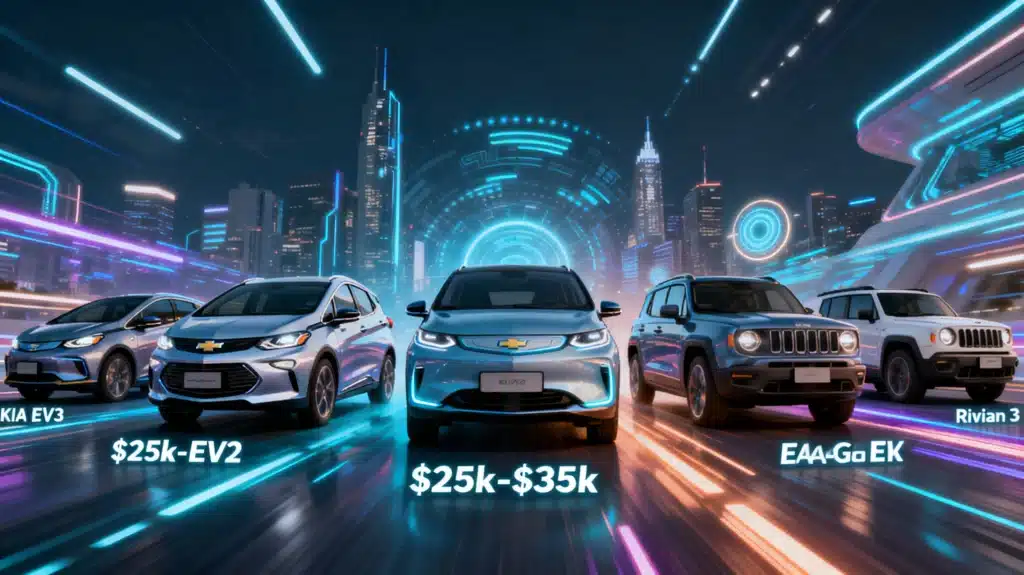
The electric vehicle revolution is accelerating, and if you’ve been waiting for genuinely affordable EVs that don’t compromise on quality or technology, your patience is about to pay off. The 2026-2027 model years represent a watershed moment for budget-conscious car buyers, as major automakers finally deliver on their promises of electric vehicles priced under $35,000—and in some remarkable cases, well below $25,000. From the revived Chevrolet Bolt to the groundbreaking Jeep Renegade EV, the next 18 months will reshape what Americans can expect from affordable electric transportation.
2026-2027 Turning Point for Affordable Electric Vehicles
The automotive landscape is experiencing a fundamental shift. While early electric vehicles catered primarily to affluent early adopters willing to pay premium prices, manufacturers now recognize that mainstream adoption requires accessibility. Battery costs have plummeted from $1,100 per kilowatt-hour in 2010 to approximately $140-180 per kWh in 2025, with projections indicating they’ll drop below $100 per kWh by 2028. This cost reduction directly translates to lower vehicle prices, finally bringing electric cars within reach of average American households.
Global EV sales reached 2.1 million units in September 2025 alone, up 26% year-over-year, demonstrating surging consumer interest. However, the average electric vehicle price hovers around $47,000, pricing out millions of potential buyers. The upcoming wave of affordable EVs launching in 2026-2027 directly addresses this gap, targeting price points between $25,000 and $35,000 where demand is strongest but supply has been minimal.
Chinese automakers have proven that high-quality electric vehicles can be manufactured at dramatically lower costs, producing models priced between $10,000 and $25,000 in their home market. While tariffs prevent most of these vehicles from entering the US, their existence has forced American and European manufacturers to dramatically rethink their cost structures and manufacturing processes. The result is the impressive lineup of affordable EVs detailed below.
The Next-Generation Chevrolet Bolt 2026: Affordable EV Excellence Returns
General Motors stunned the automotive world by discontinuing the original Chevrolet Bolt after the 2023 model year, eliminating one of the few genuinely affordable electric vehicles available to American consumers. The decision proved temporary. GM announces the triumphant return of the Bolt nameplate for 2027, completely redesigned and better positioned to compete in the rapidly evolving affordable EV segment.
The 2027 Chevrolet Bolt represents far more than a simple refresh. Built on entirely new architecture with GM’s latest Ultium battery technology, this next-generation model addresses every weakness of its predecessor while maintaining the affordability that made the original Bolt beloved by budget-conscious EV enthusiasts.
Pricing and Trim Levels
The 2027 Bolt launches with strategic pricing designed to undercut nearly every competitor. The base LT trim starts at $28,995 including destination charges, positioning it as one of the most affordable EVs in America. An LT with Comfort Package increases the price to $29,990, while the sportier RS trim begins at $32,995. The range-topping RS with Tech Package reaches $35,685, still remarkably affordable considering its equipment level.
This pricing structure places the new Bolt thousands of dollars below competitors like the Nissan Leaf starting at $31,485, and dramatically undercuts more expensive options like the Hyundai Kona Electric and Chevrolet’s own Equinox EV which begins around $35,000.
Performance and Technology Upgrades
The original Bolt’s most significant limitation was its painfully slow DC fast charging, maxing out at just 50 kilowatts when competitors offered 150-350 kW charging speeds. GM listened. The 2027 model supports 150-kW DC fast charging, achieving 10-80% charge in just 26 minutes—approximately three times faster than the previous generation. The inclusion of Plug & Charge technology further streamlines the charging experience, automatically authenticating and billing without requiring apps or RFID cards.
Power output reaches 210 horsepower from GM’s efficient electric drive unit, delivering peppy acceleration and 0-60 mph times around 6.5 seconds—perfectly adequate for daily driving while prioritizing efficiency over unnecessary performance. The range hovers around 255 miles, a modest improvement over the previous generation but more than sufficient for the typical American driver’s daily needs.
Interior and Features
GM completely redesigned the Bolt’s interior, incorporating dual 11-inch displays for instrumentation and infotainment, Google Built-in integration providing seamless navigation and voice control, and significantly improved materials throughout the cabin. The longer wheelbase creates more passenger space despite the vehicle’s compact exterior dimensions, addressing complaints about rear-seat cramping in the original model.
Higher trims offer Super Cruise, GM’s hands-free driver assistance technology for compatible highways, panoramic glass roof, heated seats and steering wheel, and wireless smartphone charging. These features, previously reserved for luxury vehicles, demonstrate how quickly advanced technology is trickling down to affordable segments.
Manufacturing and Battery Technology
Production takes place at GM’s Fairfax facility near Kansas City, with deliveries beginning in early 2026 for higher trims and late 2026 for the base LT. The Bolt utilizes lithium iron phosphate battery cells, which cost less to produce, last longer, and prove safer than traditional nickel manganese cobalt cells, though they offer slightly lower energy density.
This strategic choice reflects GM’s commitment to affordability without compromising safety or longevity. LFP batteries also perform better in extreme temperatures and degrade more slowly, potentially extending the vehicle’s useful life beyond typical EV ownership periods.
Kia EV3 2026/2027: Compact SUV Sophistication Meets Affordability
While the Chevrolet Bolt targets traditional compact car buyers, the Kia EV3 addresses the compact SUV segment where American buyer preference increasingly concentrates. This stylish crossover delivers Kia’s award-winning design language, practical interior space, and advanced technology at a targeted starting price below $35,000.
Design and Positioning
The EV3 essentially represents a smaller, more affordable sibling to the popular Kia EV9, sharing design elements and platform architecture while cutting costs through strategic simplification. Kia positions this vehicle as the accessible entry point to their electric lineup, hoping to capture buyers who want EV technology but can’t justify $45,000+ price tags.
The exterior showcases Kia’s distinctive design philosophy with vertical LED daytime running lights, clean aerodynamic surfacing achieving a 0.26 coefficient of drag, five-spoke aero-optimized wheels, and a streamlined rear incorporating a subtle boat-tail design for improved efficiency. These aren’t just styling flourishes—every element serves the dual purposes of visual appeal and maximizing range.
Powertrains and Performance
Kia offers multiple configurations to suit different budgets and requirements. The base model uses a single electric motor powering the rear wheels, providing adequate performance for daily driving while maximizing efficiency and minimizing costs. Higher trims offer dual-motor all-wheel drive for buyers in snow-prone regions or those preferring extra traction and performance.
The performance-oriented GT variant accelerates from 0-60 mph in under six seconds, demonstrating that affordable doesn’t mean slow. Kia’s new i-Pedal 3.0 regenerative braking technology allows genuine one-pedal driving, with adjustable regeneration levels controlled via steering wheel-mounted paddles.
Battery Options and Range
Two battery configurations address different buyer needs and budgets. The standard-range battery provides approximately 230 miles of range, perfect for urban and suburban drivers who rarely venture beyond their metro area. The long-range battery extends capability to around 270 miles, enabling occasional road trips without range anxiety.
Both configurations support rapid DC fast charging, though specific charging speeds haven’t been officially announced. Based on Kia’s other EV offerings, expect 10-80% charging in 25-30 minutes on compatible high-power chargers.
Interior Technology and Features
The EV3’s cabin mirrors Kia’s upscale approach seen in the larger EV9, featuring dual displays for instruments and infotainment, wireless Apple CarPlay and Android Auto integration, dual wireless smartphone charging pads, panoramic sunroof on higher trims, and Kia’s comprehensive suite of advanced driver assistance features.
The 60/40 split-folding rear seats provide cargo flexibility, while clever interior packaging maximizes usable space despite compact exterior dimensions. Kia promises up to 25.4 cubic feet of cargo capacity, competitive with traditional gasoline compact SUVs.
Pricing and Availability
While official US pricing hasn’t been confirmed, Kia targets a starting price around $35,000 for base configurations, scaling to approximately $50,000 for fully-loaded GT models. This positions the EV3 slightly above the Chevrolet Bolt but below mid-size electric SUVs like the Kia EV6 which starts around $44,000.
The vehicle launched in Korea during mid-2024, with European deliveries beginning in late 2025. North American availability is anticipated for mid-to-late 2026 as a 2026 or 2027 model year vehicle. The strategic timing allows Kia to refine the product based on real-world feedback from earlier markets before US introduction.
Jeep Renegade EV 2027: Breaking the $25,000 Barrier
Perhaps no upcoming vehicle generates more excitement than the Jeep Renegade EV, which Jeep executives promise will start “just below $25,000.” If Jeep delivers on this commitment, the Renegade EV will represent the most affordable new electric vehicle from a mainstream manufacturer available to American buyers, potentially transforming the affordable EV landscape overnight.
The $25,000 Price Promise
Jeep CEO Antonio Filosa confirmed at the June 2024 Stellantis Investor Day that the electric Renegade would launch in 2027 with a base price under $25,000. This announcement generated both excitement and skepticism, as achieving such aggressive pricing requires extraordinary cost management and manufacturing innovation.
Stellantis CEO Carlos Tavares acknowledged that reaching this price point demands production of lithium iron phosphate batteries domestically, a capability Stellantis currently lacks in the United States. This creates potential complications regarding federal tax credit eligibility, though the base price alone makes the Renegade EV competitive even without incentives.
Platform and Design Philosophy
The Renegade EV will likely utilize Stellantis’s Smart Car platform, shared with vehicles like the recently announced Vauxhall Frontera and Fiat Grande Panda. This modular architecture enables significant economies of scale, spreading development costs across multiple brands and models while allowing customization for specific market requirements.
Early indications suggest the Renegade EV will feature distinctive Jeep design elements including the iconic seven-slot grille reinterpreted for electric propulsion, higher ground clearance for light off-road capability, rugged body cladding emphasizing outdoor adventure positioning, and compact dimensions ideal for urban environments.
Powertrain Specifications
Limited technical details have been released, but industry sources indicate the Renegade EV will offer up to two 70-kilowatt electric motors, creating a combined system output around 140 kilowatts or 188 horsepower. While modest by performance EV standards, this power level proves perfectly adequate for a vehicle prioritizing affordability and efficiency over acceleration bragging rights.
All-wheel drive should be available on higher trims, leveraging Jeep’s legendary 4×4 expertise adapted for electric propulsion. Expect multiple drive modes optimized for different surfaces, including road, snow, and potentially a basic off-road mode maintaining the Renegade’s adventure-capable character.
Range and Charging
Based on platform-mates like the Vauxhall Frontera which offers 186-248 miles of range from a 54-kWh battery, expect the Renegade EV to deliver similar figures. While 190-240 miles won’t satisfy long-distance road warriors, it covers the vast majority of American driving patterns where the average daily commute spans just 40 miles round-trip.
Charging specifications remain unconfirmed, though the platform likely supports DC fast charging at speeds sufficient to add meaningful range during meal or shopping stops. Given the budget positioning, don’t expect the 350-kW ultra-rapid charging found in premium EVs, but 100-150 kW charging would provide good utility.
Market Impact and Strategy
If Jeep successfully delivers a sub-$25,000 electric SUV, it could fundamentally disrupt the affordable vehicle market. Currently, only five new vehicles of any type are available under $25,000 in the United States, and none are electric. The Renegade EV would instantly become the value leader, potentially accelerating EV adoption among price-sensitive buyers who previously considered electric vehicles unattainable.
However, execution challenges are substantial. Manufacturing EVs profitably at this price point while meeting US safety and emissions regulations requires unprecedented efficiency. Some industry analysts question whether Jeep can achieve the promised pricing without significant compromises in quality, features, or capabilities.
Rivian R3 2027: Premium Brand Accessibility
Rivian built its reputation producing high-end adventure vehicles like the R1T truck and R1S SUV, commanding prices from $70,000 to well over $100,000. The upcoming Rivian R3 represents a dramatic strategic pivot, targeting mainstream buyers with a more accessible price point around $35,000 while maintaining Rivian’s distinctive design language and adventure-oriented positioning.
Design Philosophy and Differentiation
The R3 adopts a compact crossover form factor, smaller than the mid-size R2 SUV also launching in 2026. Rivian describes the design as a high-riding hatchback with distinctive retro-modern styling, incorporating Rivian’s signature horizontal headlight and taillight bars, minimalist surfacing emphasizing clean aerodynamics, unique pop-up glass rear hatch enabling easy cargo access without opening the full liftgate, and aggressive wheel arches suggesting off-road capability.
The R3X performance variant amplifies these elements with more assertive styling, unique performance-oriented wheels and tires, additional off-road equipment, and exclusive color options. Rivian positions the R3X as the brand’s “tech demonstrator,” showcasing performance and capability in an accessible package.
Powertrain Options and Performance
Rivian plans three distinct powertrain configurations for maximum flexibility. Single-motor rear-wheel drive serves as the base option, prioritizing efficiency and affordability while delivering adequate performance for daily driving. Dual-motor all-wheel drive adds traction and performance for buyers in challenging climates or those desiring quicker acceleration. Tri-motor configuration, likely exclusive to the R3X, positions two motors at the rear axle and one at the front, enabling sub-three-second 0-60 mph acceleration and advanced torque vectoring for enhanced handling.
This tiered approach mirrors strategies used by established automakers, allowing buyers to select powertrains matching their actual needs rather than forcing everyone into expensive high-performance configurations.
Battery and Range
Rivian confirms the largest available battery pack will provide over 300 miles of range, though specific capacity hasn’t been disclosed. The company developed new 4695 cylindrical battery cells offering improved energy density and power output compared to previous generations, enabling better performance with less overall battery mass.
Multiple battery options will be available, though Rivian learned from the complexity challenges plaguing the R1 platform. Expect fewer permutations than the R1’s confusing array of choices, simplifying manufacturing while still providing meaningful choice.
Interior Design and Technology
The R3’s cabin blends Rivian’s signature rugged aesthetic with upscale materials and finishes. A large rectangular touchscreen display dominates the dashboard, providing controls for vehicle functions, entertainment, and climate systems. Notably, Rivian doesn’t currently plan to offer Apple CarPlay or Android Auto integration, instead relying on their proprietary interface and built-in apps.
Front and rear seats fold flat, enabling car-camping adventures consistent with Rivian’s outdoor lifestyle positioning. Standard Wi-Fi hotspot, wireless smartphone charging, and Amazon Alexa voice assistant provide connectivity and convenience features increasingly expected in modern vehicles.
Advanced Driver Assistance and Autonomy
The R3 incorporates Rivian’s latest autonomy hardware including 11 cameras, five radar sensors, and updated compute platform. While specific capabilities haven’t been detailed, expect parity with the current R1 platform’s driver assistance features including adaptive cruise control, lane centering, automatic emergency braking, blind-spot monitoring, and parking assistance.
Rivian continues developing more advanced autonomous capabilities, though full self-driving remains years away industry-wide. The R3’s sensor suite provides hardware foundation for future software updates as technology and regulations evolve.
Pricing Strategy and Market Position
Industry estimates place R3 starting pricing around $37,000, with fully-equipped models reaching approximately $45,000-$47,000 before options. The R3X performance variant likely commands $50,000-$60,000, similar to high-performance trims of the larger R1 platform.
This positions the R3 above the Chevrolet Bolt and Jeep Renegade EV but below mid-size electric SUVs from established manufacturers. Rivian targets buyers who appreciate the brand’s adventure-oriented philosophy and distinctive design but found the R1 platform’s $70,000+ pricing inaccessible.
Production Timeline and Availability
Rivian prioritizes R2 production, scheduled to begin mid-2026 at their Normal, Illinois facility. The R3 and R3X follow, with production anticipated for late 2026 or early 2027. Interestingly, Rivian announced the R3X performance variant will launch first, likely targeting enthusiasts willing to pay premiums for early access while manufacturing processes scale for the mainstream R3.
European deliveries are expected toward the end of 2027 or early 2028, following the North American launch. Reservations require just $100 deposits, with thousands already claimed despite the distant delivery timeline.
How These Affordable EVs Fit the Market
These four vehicles represent just the vanguard of a broader industry transformation. Tesla continues developing more affordable variants of existing models, potentially including a sub-$30,000 compact car, though specific timeline and specifications remain unconfirmed. Ford’s family of affordable electric vehicles launching in 2027 includes a compact pickup truck targeting $30,000, built on an entirely new platform designed from inception for cost-effective manufacturing.
Nissan prepares the next-generation Leaf with updated design, improved range, and competitive pricing expected around $30,000 for base trims. Volkswagen’s ID.2 compact car aims for European markets initially, with potential US introduction if demand justifies federalization costs.
The convergence of multiple manufacturers around the $25,000-$35,000 price range isn’t coincidental. Market research consistently identifies this segment as having the strongest demand but weakest supply, creating opportunities for manufacturers who can profitably serve these buyers. Federal and state incentive programs, while recently reduced, still provide valuable support for qualifying vehicles and buyers.
For consumers evaluating when to make the electric transition, the 2026-2027 timeframe offers compelling opportunities. Waiting just 12-18 months provides access to dramatically improved technology, more competitive pricing, and broader selection compared to today’s limited affordable options. However, current EV owners enjoy immediate benefits including lower operating costs, reduced maintenance, and access to HOV lanes in many states.
Those ready to explore current affordable electric vehicles in the marketplace can review comprehensive comparisons and buyer’s guides at dedicated resources covering affordable electric vehicles in the USA, which analyze total cost of ownership, incentive programs, and charging infrastructure considerations beyond simple sticker price comparisons.
What Makes These Upcoming Models Different?
Previous generations of affordable EVs often felt like compromises—stripped-down vehicles missing features buyers expected. The 2026-2027 wave changes this equation. Advanced manufacturing techniques reduce costs without eliminating desirable features. Cheaper battery technologies like lithium iron phosphate deliver adequate range and longevity at lower prices. Streamlined product lineups minimize complexity and manufacturing costs while still offering meaningful choice.
Chinese manufacturers demonstrated that attractive, well-equipped electric vehicles can be produced profitably at price points Western manufacturers previously considered impossible. While tariffs and regulatory requirements prevent direct Chinese imports, their existence forces established manufacturers to fundamentally rethink cost structures and accepted wisdom about pricing floors.
The result is vehicles like the Bolt offering 255 miles of range, 150-kW fast charging, dual 11-inch displays, and available Super Cruise for under $30,000. Or the Jeep Renegade EV promising genuine Jeep capability and design under $25,000. These aren’t compromise vehicles; they’re thoughtfully engineered products targeting specific buyer needs without unnecessary cost padding.
FAQs About Upcoming Affordable EVs
Which upcoming EV will be the cheapest?
The Jeep Renegade EV aims for a starting price “just below $25,000,” making it the most affordable if Jeep delivers on this promise. The Chevrolet Bolt follows closely at $28,995 starting price.
Will these affordable EVs qualify for federal tax credits?
Qualification depends on complex requirements including battery sourcing, vehicle assembly location, and buyer income limits. The Chevrolet Bolt assembled in Kansas should qualify, while the Jeep Renegade EV faces uncertainty due to its reliance on potentially foreign-sourced LFP batteries.
How do these new affordable EVs compare to used gas cars?
At $25,000-$35,000, these new EVs compete directly with both new budget gas cars and 2-3 year old used vehicles. Total cost of ownership often favors EVs due to dramatically lower fuel and maintenance costs, though higher insurance and potential charging equipment installation costs must be considered.
What’s the real-world range of these affordable EVs?
Expect 200-270 miles depending on model and configuration, adequate for 95% of daily driving. Cold weather, highway speeds, and aggressive driving reduce range by 20-40%, so planning for worst-case scenarios ensures reliable transportation.
Can I road trip in an affordable EV?
Yes, though it requires more planning than gas vehicles. DC fast charging networks continue expanding, making most major routes viable. Budget extra time for charging stops, typically 20-30 minutes every 150-200 miles.
Are these EVs suitable for cold climates?
Modern EVs include battery thermal management systems and efficient heat pumps minimizing winter range loss. Expect 20-30% range reduction in freezing temperatures—manageable with planning and access to home charging for overnight preconditioning.
What’s the total cost of ownership compared to gas cars?
Most analyses show EVs achieving lower total cost over 5-10 years despite higher purchase prices. Electricity costs roughly one-third of gasoline per mile, while maintenance runs 30-50% less due to fewer moving parts and no oil changes.
Should I wait for 2026-2027 models or buy now?
Current EV owners benefit immediately from lower operating costs and available incentives. However, waiting 12-18 months provides access to better technology, lower prices, and wider selection. The decision depends on your current vehicle’s condition and immediate transportation needs.