 Skip to content
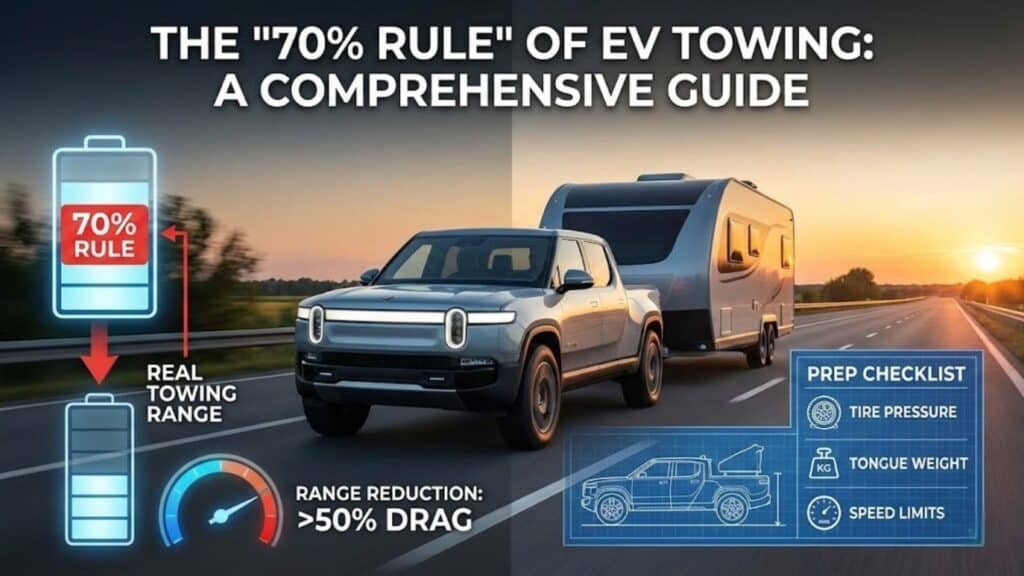
You bought the electric truck. You have the instant torque to pull a mountain. But the first time you hitched up your boat or camper, you likely experienced that sinking feeling: looking at your dashboard and watching your predicted range freefall.
Range anxiety is manageable during daily driving, but it becomes a critical logistical challenge when towing. The reality is that towing a trailer drastically reduces EV range—often by 50% or more. This isn’t just about weight; it’s about physics.
This guide introduces the “70% Rule,” a vital heuristic for planning your trips, avoiding being stranded, and understanding the towing with electric truck range loss that catches so many new owners off guard.
What is the “70% Rule” of EV Towing?
If you take nothing else from this article, memorize this rule.
When you are towing long distances, you are not working with 100% of your battery. You are effectively working with a usable window of about 70%.
Here is the math of the 70% Rule:
- The Bottom Buffer (10%): You never want to arrive at a charger with 0%. You need a safety buffer for broken chargers, headwinds, or missed exits. That removes the bottom 10%.
- The Top Cap (20%): On a road trip, DC fast charging slows down significantly after 80% state of charge (SoC). Waiting for that last 20% can take as long as the first 80%. To keep moving efficiently, you unplug at 80%.
- The Result: You are driving between 80% and 10% charge. This leaves you with 70% of your battery capacity for each leg of the journey.
Applying the Rule
If your truck has a rated range of 300 miles, and towing cuts that efficiency by 50% (a standard expectation), your “100%” towing range is actually 150 miles.
Applying the 70% Rule:
- 150 miles (Real Towing Range) x 0.70 (Usable Battery Window) = 105 miles.
The Takeaway: When planning a towing trip in a 300-mile EV, plan your charging stops roughly every 100 to 110 miles. It sounds conservative, but it is the only way to guarantee a stress-free trip.
The Physics of Range Loss: It’s Not the Weight
Many drivers assume that a heavy trailer kills range. Surprisingly, weight is a secondary factor. The true enemy of towing with electric truck range loss is aerodynamic drag.
Why Speed is the Enemy
Aerodynamic drag increases with the square of your speed. This means if you double your speed, the wind resistance quadruples.
- At 45 mph: The air flows relatively smoothly over your truck and trailer.
- At 70 mph: You are punching a massive hole through the atmosphere. The trailer acts like a parachute behind you, creating a turbulent low-pressure zone that sucks energy out of your battery pack.
This is why slowing down from 70 mph to 60 mph can sometimes extend your range by 15-20%. In an Internal Combustion Engine (ICE) vehicle, you notice this as slightly worse gas mileage. In an EV, where efficiency is tracked by the kilowatt-hour, the penalty is immediate and visible.
Regenerative Braking Limitations
Weight does matter when climbing hills, but EVs have an advantage: regenerative braking. On the way down, you recapture some of that potential energy. However, trailers with their own surge brakes or electric brakes can sometimes interfere with regen efficiency, meaning you don’t capture as much energy as you would unladen.
Vehicle Specifics: Real-World Expectations
Different trucks handle these physics differently. It comes down to battery pack size and thermal management.
Rivian R1T Towing Guide
The Rivian R1T is a towing powerhouse, but it is not immune to physics. In most real-world tests, a Rivian R1T towing guide suggests a strict 50% range reduction when towing a full-height travel trailer.
- The Good: The R1T’s trip planner is excellent at estimating arrival percentage based on current consumption.
- The Bad: The boxy shape of the R1T combined with a boxy trailer is an aerodynamic brick.
- The Strategy: Use the “Tow Mode” immediately to adjust the suspension stiffness and regen settings, which helps stability.
The Silverado EV and Heavy Duty Work
If you are looking at heavy-duty options, the specs on the Silverado EV Work Truck link here show just how much battery capacity matters. The massive battery pack in the Silverado WT is designed specifically to brute-force through the aerodynamic penalties of towing, offering a higher baseline range than many competitors.
The Essential Pre-Tow Checklist
Before you hit the highway, use this checklist to minimize range loss and ensure safety.
- Tire Pressure: Inflate rear truck tires to the maximum load rating listed on the door jamb. Soft tires increase rolling resistance.
- Trailer Tires: Ensure trailer tires are at max cold pressure to reduce drag.
- Aero Check: If possible, remove roof racks or rooftop tents from the tow vehicle if they aren’t being used. Smooth out the airflow.
- Tongue Weight: Ensure 10-15% of the trailer weight is on the tongue. Too little causes sway (safety issue); too much lifts the front of the truck, ruining aerodynamics.
- Route Planning: Check the elevation. Climbing a mountain grade with a trailer will drain the battery 3x faster than flat driving.
Tools of the Trade: Using an EV Towing Range Calculator
Never rely on the “Guess-o-meter” on your dashboard when you first hitch up. It calculates range based on your past driving history (which was likely efficient city driving), not your current heavy load.
You need a dedicated EV towing range calculator or planning tool.
- A Better Routeplanner (ABRP): This is the gold standard. You can input your specific vehicle model and enter a “Reference Consumption” (e.g., 1.8 mi/kWh). It will map out exactly where to stop.
- PlugShare: Use this to verify that the chargers ABRP suggests are actually working and trailer-friendly (pull-through spots are rare, so you may need to unhitch).
- The Manual Math: Reset your trip meter. Drive 10 miles on the highway. Look at your efficiency (mi/kWh). Multiply that number by your battery size (kWh).
- Example: 1.1 mi/kWh x 135 kWh battery = 148 miles total range. Apply the 70% rule to that number.
FAQs
Q: Does towing mode improve range? A: Generally, no. Towing modes often adjust torque distribution and suspension for stability, not efficiency. Some modes may actually increase consumption slightly to keep battery cooling pumps running high.
Q: How accurate is the built-in EV towing range calculator in the truck? A: It takes time to learn. For the first 20-30 miles of towing, the truck is “learning” the new weight and drag. During this period, the estimate will be inaccurate. Trust manual calculations until the system calibrates.
Q: Can I charge to 100% to get more range? A: Yes, for the first leg of the trip. Depart home with 100%. However, at public DC fast chargers, stopping at 80% is standard etiquette and time-management, as the charging speed throttles down massively.
Q: Does the shape of the trailer matter? A: Immensely. A teardrop trailer or a pop-up camper might only reduce range by 30%, whereas a tall, boxy travel trailer will reduce it by 50% or more. The frontal area is the biggest variable in towing with electric truck range loss.
Q: Will a Rivian R1T towing guide apply to other trucks like the F-150 Lightning? A: The physics are the same, but the efficiency numbers differ. The F-150 Lightning is less aerodynamic than the Rivian but often has more usable bed space. The 50% loss rule is a safe baseline for all electric trucks.