
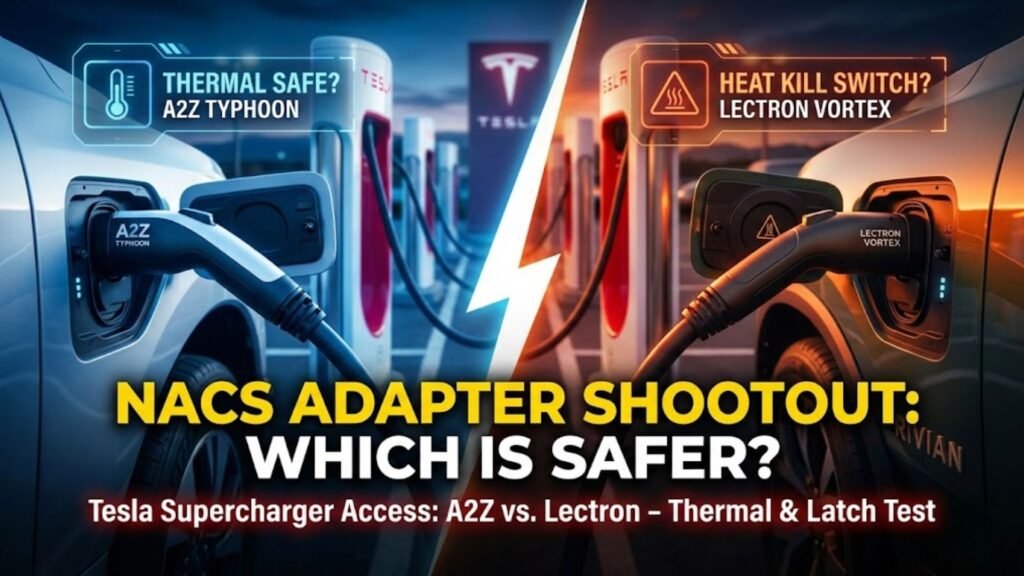
The gates have opened. With the Tesla Supercharger network finally accessible to Ford, Rivian, and GM drivers, the anxiety of finding a reliable DC fast charger is vanishing. However, this freedom creates a new hardware challenge: you need a bridge between your car’s CCS port and Tesla’s NACS plug.
This isn’t just about plastic shapes; it is about managing high-voltage current safely. Two third-party heavyweights have emerged to fill the gap left by backordered OEM adapters: the A2Z Typhoon vs Lectron NACS adapter.
If you are a Ford F-150 Lightning owner or a Rivian driver planning a road trip, you need to know which of these devices will actually initiate a charge and, more importantly, which one won’t overheat. This NACS to CCS adapter review breaks down the thermal safety and usability of the market leaders.
Thermal Safety: The “Kill Switch” Factor
When you push 500 amps through a connector, heat is the enemy. Both A2Z and Lectron have recognized that relying solely on the car or the charger to detect overheating is risky. This brings us to the most critical feature: the temperature kill switch.
In our analysis of the safest Tesla adapter for Ford and other non-Tesla EVs, the implementation of this safety feature is what separates high-quality gear from dangerous knockoffs.
The Lectron Vortex Approach
The Lectron Vortex emphasizes a dual-temperature sensor setup. If the adapter internal temperature exceeds roughly 175°F (approx. 80°C), the mechanical switch triggers to cut the charge immediately. This is a hard stop. It prevents the plastic from melting or the pins from fusing to your vehicle’s charge port—a nightmare scenario no driver wants to face.
The A2Z Typhoon Strategy
The A2Z Typhoon utilizes a similar thermal protection cutoff. Their engineering focuses on heat dissipation through the casing design. By using high-grade UL-rated materials, the Typhoon aims to delay heat soak, allowing you to sustain higher charging speeds (thermal throttling) for longer periods before a cutoff is even necessary.
For the average user, both systems provide a necessary fail-safe that cheap, unbranded adapters on online marketplaces simply lack.
The Latch Battle: Usability in the Field
Performance on paper is one thing; wrestling with a stiff plastic connector in freezing rain is another. The user experience of the latching mechanism is where the A2Z Typhoon vs Lectron NACS adapter debate often gets settled.
Lectron Vortex
Lectron has opted for a very stiff, firm latch. The advantage here is security. Once it clicks, you know it is engaged, and the likelihood of a “communication error” due to a loose connection is low. However, some users report that it requires significant force to detach from the Tesla plug, which can be frustrating if you have limited hand strength.
A2Z Typhoon
The Typhoon features a slide-lock mechanism that many users find more intuitive. It offers a smooth engagement that “snaps” satisfyingly. The design allows for easier one-handed operation when connecting the Tesla handle to the adapter before plugging the whole assembly into your car.
A2Z Typhoon vs Lectron NACS Adapter: The Verdict
Choosing between these two comes down to your specific priorities.
- Choose the A2Z Typhoon if: You prioritize ease of use and a smoother latching mechanism. It is often favored by drivers who charge daily and want a seamless mechanical experience.
- Choose the Lectron Vortex if: You want a rugged, heavy-duty feel and widely recognized brand support. Its strict thermal triggers make it a strong contender for the title of safest Tesla adapter for Ford drivers who often push their charging sessions to the limit.
FAQ: NACS Adapter Essentials
Do I need a third-party adapter if Ford/Rivian promised me one? Yes, if you don’t want to wait. OEM adapters are currently facing massive shipping delays. Buying a high-quality third-party unit ensures you have Supercharger access immediately.
Will using a Lectron or A2Z adapter void my warranty? Generally, no. However, you should always check your specific vehicle manufacturer’s warranty terms. Using reputable, tested adapters like these is significantly safer than using unbranded generic versions.
What is the maximum charging speed these adapters support? Both the Typhoon and Vortex are rated for up to 500A and 1000V. In real-world terms, they can handle the maximum speeds current 400V architecture EVs (like the Mach-E or R1T) can pull from a V3 or V4 Supercharger.
Is the A2Z Typhoon vs Lectron NACS adapter comparison relevant for V2 Superchargers? No. Non-Tesla EVs generally cannot use V2 (older) Superchargers even with an adapter because V2 hardware does not speak the CCS communication protocol. These adapters are for V3 and V4 Superchargers.
Final Thoughts
The era of adapter anxiety is ending, but the era of adapter quality is just beginning. Whether you choose the rugged Lectron or the user-friendly A2Z, ensuring you have a unit with active thermal monitoring is non-negotiable.
As the charging infrastructure expands, having a reliable piece of hardware in your frunk turns the vast Tesla network from a “nice to have” into a reliable daily asset.