
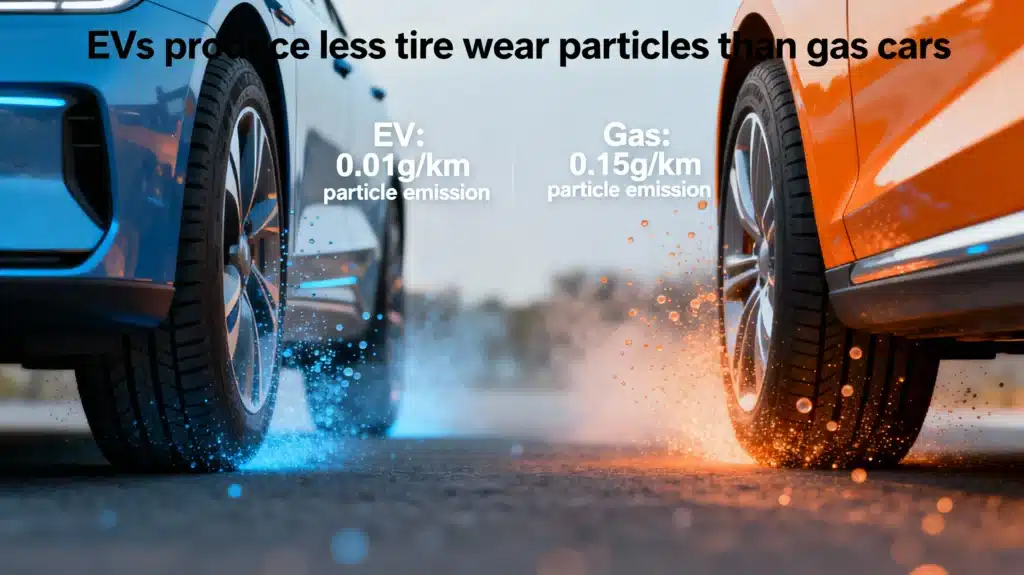
You’ve probably seen the viral headlines floating around your social feeds. They usually claim something alarming like, “Electric Cars Are Actually Dirtier Than Gas Cars Because of Their Tires!” It’s the kind of “gotcha” moment critics love to share.
The logic seems sound at first glance: Electric vehicles (EVs) are heavy due to their massive battery packs. Heavier cars chew through tires faster. Therefore, EVs must be spewing clouds of rubber particulate matter (PM) that dwarf the pollution from a standard gas engine.
But is that actually true?
As we dig into the latest scientific data, including a pivotal EV tire pollution study 2025, the answer is a resounding “No”—but with some important nuances that every EV owner needs to understand.
The Kernel of Truth: The Weight Problem
Let’s be honest—physics is physics. A Tesla Model Y or a Ford Mustang Mach-E is significantly heavier than a comparable internal combustion engine (ICE) vehicle. That battery pack adds roughly 1,000 to 1,500 pounds to the curb weight.
Historically, heavier vehicles do cause more road abrasion and tire wear. If you drove a gas car and loaded it with 1,000 pounds of bricks, your tires would indeed wear out faster, releasing more micro-particles into the air.
However, equating an EV to a “gas car full of bricks” ignores the single most important mechanical difference that changes the pollution equation entirely: how the car stops.
The VTTI Revelation: Regenerative Braking
A recent scientific analysis referencing the Virginia Tech Transportation Institute (VTTI) study has completely shifted the narrative. The researchers didn’t just look at weight; they looked at the total “non-exhaust emissions”—which combines both tire wear and brake dust.
Here is the critical finding: While EVs are heavier, their use of regenerative braking significantly reduces brake dust emissions.
When you lift your foot off the accelerator in an EV, the electric motor reverses direction to capture energy and slow the car down. This means you rarely touch your physical brake pedal. In a gas car, slowing down is purely friction-based—brake pads clamping onto metal rotors, grinding them down and releasing clouds of toxic metallic dust (particulate matter) at every stoplight.
The Virginia Tech tire wear study suggests that because EVs virtually eliminate brake dust, their total non-exhaust particulate output is often lower than that of lighter gas cars, particularly in stop-and-go city driving where air quality is most critical.
The Net Result: Are We Cleaner?
To get the full picture, we have to look at the net impact.
- Tailpipe Emissions: EVs have zero. Gas cars emit CO2, NOx, and other pollutants every second the engine is running.
- Brake Dust: EVs produce almost zero (thanks to regen braking). Gas cars produce a significant amount.
- Tire Particulate: EVs produce marginally more due to weight and torque, though this is being mitigated by new EV-specific tire compounds from manufacturers like Michelin and Bridgestone.
When you sum these columns up, the non-exhaust emissions electric vehicles produce are not enough to tip the scales back in favor of gas cars. The elimination of tailpipe exhaust and the drastic reduction in brake dust creates a cleaner net result for our air quality.
For a deeper dive into how eco-driving habits can further reduce your footprint, check out our guide on Sustainability.
Don’t Ignore the Real Risks: The NEMA 14-50 Issue
While the media distracts you with exaggerated tire dust myths, there are actual safety issues that new EV owners often overlook. If you are setting up a home charger, you need to know this.
There is a widespread issue with NEMA 14-50 outlets melting under the continuous load of EV charging, often due to the use of residential-grade parts.
Many owners buy a $10 outlet from a big-box store intended for a dryer (which runs for 45 minutes occasionally) and use it for an EV charger (which pulls maximum amperage for 6-8 hours straight). Residential-grade outlets cannot handle this heat cycle.
- The Fix: Always insist your electrician uses an industrial-grade outlet (like Hubbell or Bryant brands) or, even better, hardwire your charging station directly.
Don’t let the “tire myth” keep you from buying an EV, but do let the “melting outlet reality” keep you vigilant about your home setup.
Frequently Asked Questions
- Do EVs wear out tires faster than gas cars? Yes, typically 20% faster if you have a heavy foot. The instant torque and heavy battery weight increase wear, but choosing tires specifically designed for EVs can mitigate this difference.
- Is brake dust toxic? Yes. Brake dust contains heavy metals like copper and iron. Because EVs use regenerative braking, they emit significantly less of this toxic dust compared to gas vehicles.
- What did the Virginia Tech study find about EV pollution? The study found that while EVs may have slightly higher tire emissions due to weight, this is offset by the massive reduction in brake emissions, making them cleaner overall in urban environments.
- Are EV tires different from regular tires? Yes. EV-specific tires are built with stronger sidewalls to support the weight and specialized rubber compounds to reduce rolling resistance and withstand high torque.